Skip to content
fishing forecast

atlantic bumper

Chloroscombrus chrysurus · Carangidae · forage fish

EstuarySea

Small silvery jack that forms schools, with a dark saddle-shaped mark at the base of the tail. Very common in bays, beaches and estuaries; used as food and bait.

Also called: palombeta, pilombeta, favoleta, garapau, juva, Atlantic bumper

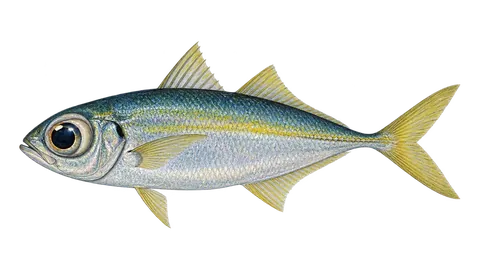
Scientific illustration of Atlantic bumper
common size
15–25 cm
maximum
65 cm
common weight
0.0–0.2 kg
record/max.
0.1 kg
depth
0–110 m
ideal water
22–29 °C
location

Sample location: choose yours to see the forecast for where you fish.

period

Reading the weather across 3 global models and 31 simulations…

the species

everything about the atlantic bumper

overview

who is the atlantic bumper

The palombeta is a small, tall, flattened jack that forms schools in the coastal zone and enters lagoons and estuaries. In the western Atlantic it ranges from Massachusetts to Uruguay, including the Gulf of Mexico and the Caribbean, and in the eastern Atlantic from Spain to Angola. Adults stay over soft shelf bottoms, sometimes near the surface; juveniles are common in brackish water and often travel with jellyfish. They eat small fish, squid, zooplankton and detritus. FishBase gives a common length of 25 cm and maturity at 12.4 cm; the 'maximum' of 65 cm is doubtful, since the largest published weight is 121 g. It is a commercial fishery species, sold fresh and salted, and appears in beach and shrimp trawls.

fun facts

  • Juveniles tend to stay near jellyfish, where they find shelter.
  • The dark saddle-shaped mark at the base of the tail is the easiest field sign to recognize it.
  • In the eastern Pacific the species is replaced by Chloroscombrus orqueta; FishBase notes the two may be one species.
how to recognize it

identification

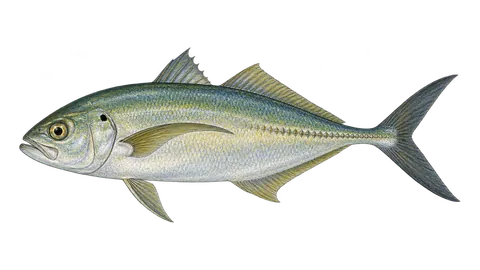
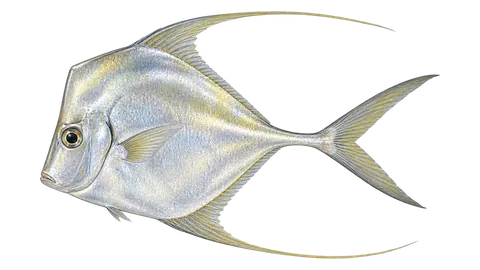
Tall, flattened body, metallic blue on top and silver below, with a short head and blunt snout. The easiest sign is the dark saddle-shaped mark at the base of the tail, plus another mark on the top of the gill cover. It has two dorsal fins, the second and anal fins long and similarly shaped, small round scales, and an upper tail lobe larger than the lower. Weak scutes appear only at the tip of the lateral line, near the tail. The xixarro and xerelete have a larger eye or well-marked scutes along the whole lateral line.

distribution

where found

open on the large map

All of the Brazilian coast, in bays, beaches, estuaries, coastal lagoons and the inner shelf. Continues through the western Atlantic from Massachusetts to Uruguay, including the Gulf of Mexico and the Caribbean. In the eastern Pacific it is replaced by Chloroscombrus orqueta, which FishBase says may be the same species.

Habitat: Shallow waters of bays, beaches and estuaries, and soft bottoms of the inner shelf, down to about 110 m; juveniles stay in brackish water, often with jellyfish.

coast

North CoastNortheast CoastSoutheast CoastSouth Coastcoastal
calendar and clock

when to fish

best season

time of yearbest: Oct–Apr
JanFebSeaAprMayJunJulAugSepOctNovDec

It appears all year, but in the Southeast and South the schools come closer to shore in the warm months. In the Northeast and North it varies little.

best time of day

0h6h12h18h sunrise ~6amsunset ~6pm

Daytime. Schools are active by day near the surface and bottom; at night they disperse.

weather, water and behavior

what affects the atlantic bumper
sensitivity The little bars show how much each factor affects this species. Five full: it feels it a lot.

cold and cold fronts

Cold water in the South pushes the schools farther from the beach.

atmospheric pressure

Not very sensitive.

moon

Small effect.

rain

It tolerates brackish water; it only disappears when the inlet turns fresh and muddy.

water level

Not applicable at sea.

noise

The school tolerates an anchored boat, but scatters when an engine is near.

wind

A choppy sea scatters the schools off the beach.

tide

The rising tide brings the school into bays and river mouths.

depth

From the surface to about 30 m for most shore catches.

technique, gear and bait

how to fish

rod
light rod 6' to 7' or cane pole
spinning / baitcasting reel
spinning reel 1000 to 2500
line
monofilament 0.20 to 0.30 mm
leader
sabiki (chuveirinho) size 8 to 12
hook
hook no. 10 to 14, or sabiki rigs

lures

  • sabiki with feathers or fish skin

natural baits

  • small shrimp pieces
  • fish strips

accessories

  • aerated bucket or livewell
  • cast net (where permitted)
  • sinker of 10 to 30 g

tip from an angler

For live bait, release it from the hook with a wet hand and put it in the live well with running water; it loses scales easily and dies fast if squeezed.

what the law says

rules for the atlantic bumper

Summary of the regulations we found, with the source for each. Rules change; before keeping or transporting fish, check with the state environmental agency.
Conservation: It is not on the Brazilian national list (Portaria GM/MMA nº 1.667/2026). There is a federal minimum size of 12 cm in the Southeast and South.

Minimum size 12 cm (ES to RS)

12 cm (total length)ESRJSPPRSCRSSoutheast CoastSouth Coast

It is forbidden to fish for, keep aboard or land palombeta under 12 cm total length along the coast of Espírito Santo, Rio de Janeiro, São Paulo, Paraná, Santa Catarina and Rio Grande do Sul. The rule does not apply to fish caught by trawl, and enforcement tolerates up to 20% of the catch weight below the size.

Source: Instrução Normativa MMA nº 53/2005, arts. 2º and 4º and Annex II (MMA)

catch and release
catch and release Releasing the fish alive, quickly and with a wet hand. During a closed season it isn't always allowed: what the regulation says applies.

Small and fragile: if you will not use it as bait or food, release it right away without squeezing or scraping the scales, preferably with a wet hand.

in the kitchen

Dark, tasty flesh from a small fish, good fried whole, pickled in escabeche or salted. FishBase says it is sold fresh and salted. It is also widely used as bait for larger predators.

calculator

how much it weighs without taking it out of the water

Length-weight relationship W = a·Lb (a = 0.0123, b = 2.94; FishBase (relação peso-comprimento bayesiana, estimativa da própria espécie)). It's an average: a fat or lean fish can vary by 10% to 20%.

estimated weight

—

sources and references

The seasonal weights (months), the time of day and the sensitivities (cold, pressure, moon, wind, rain, tide, strong light, murky water and noise) are the app's editorial estimates, drawn from the literature below and from field experience of anglers and guides. They are not official data nor measurements made for this species, and they may vary by region and year. Closed seasons and legal rules appear in the rules section, with the norm and a link. Common sizes and weights are ranges around the common length given by FishBase, with weight calculated from the length-weight relationship. FishBase gives 65 cm maximum length, but the maximum published weight is 121 g and the common length is 25 cm; the app keeps FishBase's values and treats 65 cm as a doubtful extreme.

  1. scientific FishBase: Chloroscombrus chrysurus (ficha da espécie)Size, length-weight, depth, habitat, distribution, biology, and IUCN status. Page checked on Oct 13, 2026.
  2. scientific FishBase: nomes populares de Chloroscombrus chrysurusNames by country and language. Palombeta is the name used on the Brazilian coast and in Normative Instruction MMA 53/2005 itself; favoleta, garapau and juva appear in the FishBase list.
  3. official Portaria GM/MMA nº 1.667, de 27 de abril de 2026: Lista Nacional Oficial de Espécies da Fauna Ameaçadas de Extinção (peixes e invertebrados aquáticos)The species is not on the list. Checked in the DOU of April 28, 2026.
  4. official Instrução Normativa MMA nº 53, de 22 de novembro de 2005: tamanho mínimo de captura de espécies marinhas e estuarinas do litoral Sudeste e SulAnnex II, from Espírito Santo to Rio Grande do Sul. Checked on October 13, 2026: Palombeta (Chloroscombrus chrysurus), 12; art. 2º (ban on fishing for, storing aboard and landing below the size), §1º (trawl exception) and art. 4º (20% tolerance in Annex II).
  5. scientific FishBase: Chloroscombrus chrysurus, tamanho e pesoMaximum length 65 cm (TL), common length 25 cm, maximum published weight 121 g and maturity at 12.4 cm. The 65 cm figure does not fit the published weight; read it with caution. Checked on October 13, 2026.
don't confuse

similar species