lookdown
Selene vomer
The silver dish of the coast: very tall, very thin body, long filaments and a sideways fight.
Also called: galo-de-penacho, galo, peixe-galo

- common size
- 20–35 cm
- maximum
- 48 cm
- common weight
- 0.3–1 kg
- record/max.
- 2.1 kg
- depth
- 1–50 m
- ideal water
- 22–28 °C
who is the lookdown
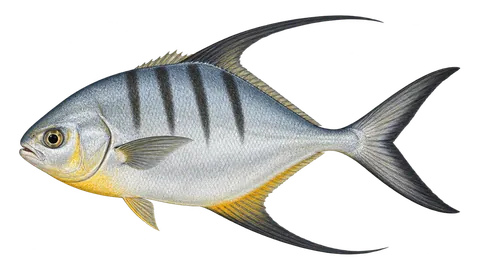
The lookdown is the silver dish of the coast: a very tall, very thin, mirror-like body that nearly disappears when seen head-on. It lives along the whole coast, near sand and mud bottoms, in bays, channels, beaches and around pilings, piers and wrecks, almost always in small groups. It eats small crustaceans, shrimp and small fish. Adults have long filaments on the dorsal and anal fins, the "penacho" (plume). It bites small baits, micro jigs and shrimp, and fights sideways, using its tall body against the current, which surprises for its size. The meat is good but scarce: it's mostly a fun fishery.
fun facts
- Almost invisible head-on: the thin silver body reflects its surroundings.
- In juveniles, the first dorsal spines also form long filaments that shorten as they grow.
identification
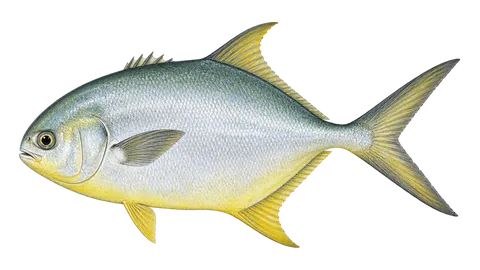
Very tall and extremely flattened body, metallic silver, head profile almost vertical and a very low mouth. Adults with very long lobes on the dorsal and anal fins, in filaments. Difference from pompanos: pompanos have a blunt, rounded snout, and the pampo-galhudo has dark vertical bars. The galo-de-fundo (another species) has short lobes and a dark spot on the caudal peduncle.
Loading the next 7 days…
Each card shows the day's index (0 to 100) and, below it, a strip with the index for each hour, from 0h to 23h. from poor to excellent.
where found
All along the coast, in bays, channels, sheltered beaches and structures, from Amapá to Rio Grande do Sul.
Habitat: Near sand and mud bottoms in bays and channels, around pilings, piers, wrecks and ledges.
coast
states
Amapá, Pará, Maranhão, Piauí, Ceará, Rio Grande do Norte, Paraíba, Pernambuco, Alagoas, Sergipe, Bahia, Espírito Santo, Rio de Janeiro, São Paulo, Paraná, Santa Catarina, Rio Grande do Sul
when to fish
best season
In the Southeast and South it appears most from late spring to autumn. In the Northeast, all year.
best time of day
Daytime, with peaks at dawn and dusk. Bites during the day, most active late afternoon and at dawn.
what affects the lookdown
sensitivity The little bars show how much each factor affects this species. Five full: it feels it a lot.
cold and cold fronts
Cold water reduces its presence in the South.
atmospheric pressure
Not very sensitive.
moon
Small effect.
rain
Not very relevant.
water level
Clear water helps; heavy surf muddies the bays and shuts them down.
noise
Moderate at piers and pilings.
wind
Strong wind gets in the way of light tackle fishing.
tide
With the tide running, it stays close to structures and channel edges, eating what the current brings. At slack tide it stays nearby but bites less.
depth
From 1 to 20 m near the bottom; down to 50 m on the shelf.
how to fish
- rod
- 6'0" to 7'0", 6 to 14 lb
- spinning / baitcasting reel
- spinning reel 2500 to 3000
- line
- 10 to 15 lb braided line
- leader
- fluorocarbon 15 to 20 lb
- hook
- hook #1 to 1/0
lures
- micro jig 7 to 20 g
- jig head 1/8 oz with small shrimp
natural baits
- shrimp
- small sardine fillet
- thin squid strips
accessories
- small pliers
tip from an angler
Small lures, near the bottom and the structure. Work the micro jig with short taps and let it fall: the lookdown bites on the drop.
rules for the lookdown
Summary of the regulations we found, with the source for each. Rules change; before keeping or transporting fish, check with the state environmental agency.
Conservation: Not on the national list of threatened species.
We found no species-specific rule beyond the region's general rules.
catch and release
catch and release Releasing the fish alive, quickly and with a wet hand. During a closed season it isn't always allowed: what the regulation says applies.
Thin body and delicate slime: wet your hands, hold it by the tail and from below, and release quickly.
in the kitchen
White, tasty meat, but it yields little fillet. Fry it whole.
how much it weighs without taking it out of the water
Length-weight relationship W = a·Lb (a = 0.01288, b = 2.95; FishBase (estimativa bayesiana, comprimento total)). It's an average: a fat or lean fish can vary by 10% to 20%.
estimated weight
—
sources and references
The season weights (months), the time of day and the sensitivities (cold, pressure, moon, wind, rain, tide, strong light, murky water and noise) are the app's editorial estimates, based on the literature below and on the field experience of anglers and guides. They are not official data nor a measurement made for this species, and they may vary by region and year. Closed seasons and legal rules appear in the rules section, with the norm and a link.
- scientific FishBase — Selene vomer (ficha da espécie)Names, distribution, biology, length-weight relationship and references. Page checked on October 13, 2026.
- official Portaria GM/MMA nº 1.667, de 27 de abril de 2026 — Lista Nacional Oficial de Espécies da Fauna Ameaçadas de Extinção (peixes e invertebrados aquáticos)Most recent national list. The species is not on it (search by scientific name in the text published in the DOU, checked on October 13, 2026).
- official ICMBio/SALVE — Ficha de Selene vomer (avaliação nacional do risco de extinção)National assessment by ICMBio, published in 2023. DOI verified on Crossref.
- scientific IUCN Red List — Selene vomer (avaliação global: Pouco Preocupante, LC, 21/08/2012)Global assessment. Link given on the FishBase entry (Red List, version 2025-2).
- scientific Carpenter, K. E. (org.) (2002). The living marine resources of the Western Central Atlantic. Vol. 3: Bony fishes part 2 (Opistognathidae to Molidae). FAO Species Identification Guide for Fishery Purposes. Roma: FAO.Chapter Carangidae (Smith-Vaniz, W. F.).
- scientific Menezes, N. A.; Buckup, P. A.; Figueiredo, J. L.; Moura, R. L. (orgs.) (2003). Catálogo das espécies de peixes marinhos do Brasil. São Paulo: Museu de Zoologia da USP. 160 p.List of the marine species recorded in Brazil. Printed work; the URL is the bibliographic record in FishBase, which cites the catalogue for the species.