Federal minimum size (20 cm) in the Southeast and South
20 cm (TL)ESRJSPPRSCRSSoutheast CoastSouth Coast
Fishing for, keeping on board or landing parati under 20 cm total length is prohibited on the coast of ES, RJ, SP, PR, SC and RS.
Mugil curema · Mugilidae · omnivore
The small mullet of the estuaries. Fun on light tackle and one of the best live baits for snook and weakfish.
Also called: parati, saúna, saúba


Choose the place and the species. The index, from 0 to 100, combines weather, sun, moon and tide with each fish's habits. Up to 28 days, with each day's confidence.
Reading the weather across 3 global models and 31 simulations…
Each card shows the day's index (0 to 100) and, below it, a strip with the index for each hour, from 0h to 23h. from poor to excellent.
Choose how many fishing days. We compare each stretch by its average index, discount days with a warning or closed season, and show the 3 best.
Line: the middle value of 31 simulations of the American GEFS model. Band: where 8 out of 10 fall. Narrow, firm trend; wide, high uncertainty.
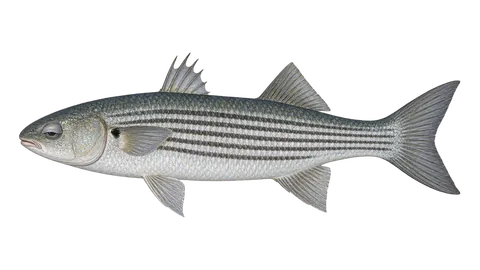
The parati is the small estuary mullet, found along the whole coast. It lives in schools by mangrove edges, channels, sheltered beaches and river mouths, sifting mud and algae. It rarely exceeds 40 cm, but it is abundant all year and fun on light tackle, with dough, bread and chum. It is also one of the best live baits for snook, weakfish and bluefish: a 10 to 15 cm parati under a float is a trophy bait. It spawns at sea in the warm months, and juveniles enter the estuaries in large numbers. Tasty meat, good fried or grilled over embers.
Small mullet with a round body and flattened head, greenish back and silvery flanks, almost without stripes. It has a golden spot on the gill cover, a dark spot at the base of the pectoral fin, and the second dorsal and anal fins covered in scales. Anal fin with 9 soft rays. Difference from the mullet: the mullet is larger, has 6 to 7 clear dark stripes and an anal fin with 8 rays.
The whole coast, from Amapá to Rio Grande do Sul, in estuaries, coastal lagoons and sheltered beaches.
Habitat: Mangrove edges, tidal channels, river mouths, sheltered beaches, marinas and piers.
coast
states
Amapá, Pará, Maranhão, Piauí, Ceará, Rio Grande do Norte, Paraíba, Pernambuco, Alagoas, Sergipe, Bahia, Espírito Santo, Rio de Janeiro, São Paulo, Paraná, Santa Catarina, Rio Grande do Sul
Present in estuaries all year. In the South and Southeast it bites best from late summer to autumn, when the year's young have grown; in winter it disappears from parts of the southern estuaries.
Daytime. Active by day, with more bites early in the morning and late in the afternoon.
Strong cold empties the shallow southern estuaries; on sunny days after the front it returns to the shore.
Not very sensitive; stable weather makes it easier to keep the chum in place.
Small effect; moon tides move more schools in the channels.
Tolerates dirty water; heavy rain only bothers through the current and debris on the line.
A high river pushes the schools toward the estuary mouth.
The schools near the shore flee shade and noise; fish a bit farther away.
Wind makes the light float hard to manage; look for calm backwaters.
On the rising tide it enters the mangrove edge and the creeks to feed on mud; on the falling tide it leaves for the channels. At slack water it stops moving around, and chum holds the school better.
Shallow: 0.3 to 2 m along the shore; up to 5 m in channels.
lures
natural baits
accessories
For live bait, keep the parati in an aerated bucket and hook it through the back or lips, without touching the spine.
Paternoster, 2-to-3-hook rig, pyramid sinker, feeder float for mullet and a rig for pompano, with practical measurements and the shock leader that prevents accidents.
guideWhere to cast the line, how to use the tide, which rod and rig are enough to start, sand baits, sea rules, and how to fish without risking the waves.
Summary of the regulations we found, with the source for each. Rules change; before keeping or transporting fish, check with the state environmental agency.
Conservation: Not on the national list of threatened species.
Fishing for, keeping on board or landing parati under 20 cm total length is prohibited on the coast of ES, RJ, SP, PR, SC and RS.
Source: IN MMA nº 53/2005 (coast from ES to RS; total length)
Scales come off easily: wet hands and immediate release.
Fried whole, scaled and grilled over embers, or stewed. Very good smoked.
Length-weight relationship W = a·Lb (a = 0.01175, b = 2.95; FishBase (estimativa bayesiana, comprimento total)). It's an average: a fat or lean fish can vary by 10% to 20%.
estimated weight
—
The season weights (months), the time of day and the sensitivities (cold, pressure, moon, wind, rain, tide, strong light, murky water and noise) are the app's editorial estimates, based on the literature below and on the field experience of anglers and guides. They are not official data nor a measurement made for this species, and they may vary by region and year. Closed seasons and legal rules appear in the rules section, with the norm and a link.
The weather comes from three independent global models, cross-checked hour by hour: when they agree, confidence goes up; when they diverge, the band between them shows on the chart. Beyond 16 days, we use the GEFS ensemble of 31 simulations: if 20 of the 31 predict rain, the chance of rain is 65%. Sun and moon are calculated astronomically, with no uncertainty.
The index adds up, weighted for each species: time of day (species curve anchored to real sunrise and sunset), moon (transits, rise and set, phase), pressure (3 h trend and 24 h swing), water temperature (in rivers, estimated from air temperature; at sea, estimated by an ocean model), wind, rain, clouds, tide and the month in the species' cycle.
Accuracy measured in the reference project (4 regions, 93 days, forecast vs. observed): maximum temperature is off by 0.6 °C on average the next day and 1.7 °C at 7 days; rain of 5 mm or more is detected 76% of the time the next day and 57% at 7 days. Detection isn't everything: the false alarm rate isn't published here yet, and 93 days in 4 regions is still a small sample. We now also measure every day, at the app's destinations:
Your location is saved only on this device and feeds the forecast, the map and the "today" on the home page.