Federal minimum size (35 cm) in the Southeast and South
35 cm (TL)ESRJSPPRSCRSSoutheast CoastSouth Coast
Prohibited to fish for, keep on board or land mullet under 35 cm total length on the coast of ES, RJ, SP, PR, SC and RS.
Mugil liza
A traditional fish in the South and Southeast. The run from May to July, with the cold, brings beach activity, purse seining and beach seining.
Also called: tainha, tainha-verdadeira, curimã (Nordeste), tainhota (jovem), tainha-de-corso

The mullet is the traditional fish of the South and Southeast coast. It lives in estuaries and coastal lagoons eating mud, algae and bottom detritus and, in autumn and winter, makes its 'run': huge schools leave Lagoa dos Patos and the Plata estuary with the cold fronts and head up the coast to spawn at sea, between Rio Grande do Sul and São Paulo. This is when beach seining with a lookout on the hill, purse seining and the beach activity take place. For anglers it bites on dough, bread and chum at piers, channels and riverbanks, and with cast nets where allowed. It has a small, soft mouth: it needs a small hook and a light hookset.
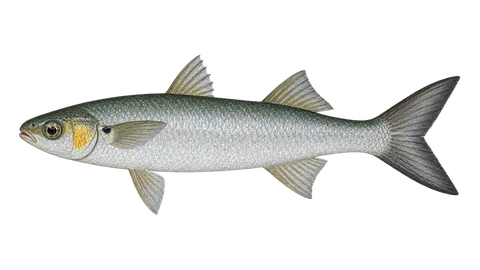
A round, sturdy body, broad head flattened on top, small mouth with no visible teeth, thick fatty eyelid over the eye and two well-separated dorsal fins. Grey-blue back with 6 to 7 dark stripes along the flanks. Difference from the parati: the mullet is larger, has clear stripes and an anal fin with 8 soft rays; the parati has almost no stripes, has a golden spot on the gill cover, and its soft dorsal and anal fins are covered in scales.
Loading the next 7 days…
Each card shows the day's index (0 to 100) and, below it, a strip with the index for each hour, from 0h to 23h. from poor to excellent.
The whole Brazilian coast. The big migratory stock is in the South and Southeast: it breeds in Lagoa dos Patos (RS) and the Plata estuary and spawns at sea between RS, SC, PR and SP, from May to July. In the North and Northeast it is known as curimã.
Habitat: Estuaries, coastal lagoons, mangrove channels, tidal rivers, piers, beaches and inlets.
native to the basins
coast
states
Amapá, Pará, Maranhão, Piauí, Ceará, Rio Grande do Norte, Paraíba, Pernambuco, Alagoas, Sergipe, Bahia, Espírito Santo, Rio de Janeiro, São Paulo, Paraná, Santa Catarina, Rio Grande do Sul
The mullet run runs from May to July in the South and Southeast, peaking in June, pushed by cold fronts. The rest of the year the fishing is in estuaries, with smaller fish. In the Northeast, the curimã is fished all year. The commercial season and quotas change every year by ordinance.
Daytime. Active by day. The run passes the beaches mostly in the morning, with a south wind. At piers and channels it bites more in the first hours and late in the afternoon.
Unlike most fish, the cold helps: each cold front pushes new schools north. Off-season heat delays the run.
The passage of a cold front, with a south wind and rising pressure, is the trigger for the schools on the beach.
Traditional fishers associate big-tide moons with schools leaving the lagoons; moderate effect.
Heavy rain muddies the estuary water, but doesn't stop the mullet, which is tolerant.
Full lagoons and estuaries and saltier water favor them staying; a flood pushes the mullet toward the inlet.
A school in the surf is very sensitive to noise and shade: beach seining demands silence and a lookout.
A south wind brings the run; a northeast wind for several days holds the schools offshore.
On the rising tide it enters channels, creeks and riverbanks to feed on mud; on the falling tide it heads down to the inlet. Fish with the water moving; at slack water the chum spreads and the fish disperse. At the river mouths, the school heads out to sea on the falling tide.
Surface and mid-water in schools; in the estuary, shallow bottom of 0.5 to 3 m.
lures
natural baits
accessories
Chum lightly and always in the current, and use a very sensitive float. The mullet nibbles softly and has a soft mouth: short hookset and gentle fight.
Spring and neap tides, high and low tide, slack water, rising and falling tide, tide tables and solunar theory: what really matters and how to use it without fanaticism.
guideQuick killing, bleeding, the right amount of ice, a well-used cooler, filleting and transport within the law. Fish handled well on the boat is worth twice as much at the table.
guidePaternoster, 2-to-3-hook rig, pyramid sinker, feeder float for mullet and a rig for pompano, with practical measurements and the shock leader that prevents accidents.
Summary of the regulations we found, with the source for each. Rules change; before keeping or transporting fish, check with the state environmental agency.
Conservation: Not on the national list of threatened species. The South and Southeast stock is managed with annual quotas because of overfishing.
Prohibited to fish for, keep on board or land mullet under 35 cm total length on the coast of ES, RJ, SP, PR, SC and RS.
On the Southeast and South coast, any type of fishing is prohibited at the mouths of estuaries and lagoons (1,000 m outside the bar, 200 m inside, and 1,000 m along the adjacent shores) from March 15 to August 15; the cast net is the exception. State compilations cite an end on September 15 after the 2015 Management Plan: confirm the period in force.
In Santa Catarina, from May 1 to July 30, several types of gear (gillnets, live bait, cast nets and others) are prohibited within 800 m of beaches licensed for beach seining and within 300 m of rocky shores. Check the list of gear and changes (IN Ibama 13/2009).
For 2026, commercial mullet fishing in the Southeast and South was regulated with a global limit and quotas by gear type (purse seine, ringed gillnet, coastal gillnet, beach seine and Lagoa dos Patos), with changes during the season. Rules are published every year: check the ordinance for the season in force.
Prohibits all fishing modalities at the estuarine-lagoon mouths of the Southeast and South: up to 1,000 m out to sea, 200 m upstream, and 1,000 m along the banks. Lagoons and estuaries with their own rules are excluded. The mullet season in open sea is regulated by annual portarias for the commercial fleet.
Source: IN IBAMA nº 171/2008, art. 2º
Source: IN MMA nº 53/2005 (coast from ES to RS; total length)
Fish with loose scales and fragile slime: wet your hands, hold it briefly and release it quickly. Releasing spawning mullet helps the next year's run.
Grilled over embers, in taquara bamboo or stuffed with farofa, a winter tradition in the South. Dried or smoked roe (botarga) is a delicacy.
Length-weight relationship W = a·Lb (a = 0.01047, b = 2.95; FishBase (estimativa bayesiana, comprimento total)). It's an average: a fat or lean fish can vary by 10% to 20%.
estimated weight
—
The season weights (months), the time of day and the sensitivities (cold, pressure, moon, wind, rain, tide, strong light, murky water and noise) are the app's editorial estimates, based on the literature below and on the field experience of anglers and guides. They are not official data nor a measurement made for this species, and they may vary by region and year. Closed seasons and legal rules appear in the rules section, with the norm and a link.
Your location is saved only on this device and feeds the forecast, the map and the "today" on the home page.