Skip to content
fishing forecast

alligator gar

Atractosteus spatula · Lepisosteidae · predator

Freshwater

The giant of the gar family, over 2 m and 100 kg. In Mexico it lives in rivers, lagoons and reservoirs of the Gulf coastal plain, from Tamaulipas to Veracruz, and is caught on natural bait.

Also called: peixe-jacaré, catán, alligator gar

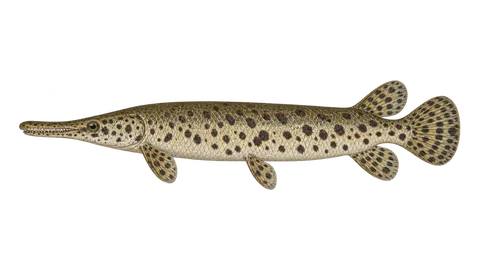
Scientific illustration of Alligator gar
common size
100–200 cm
maximum
260 cm
common weight
5–50 kg
record/max.
137.0 kg
depth
0.5–8 m
ideal water
22–30 °C
location

Sample location: choose yours to see the forecast for where you fish.

period

Reading the weather across 3 global models and 31 simulations…

the species

everything about the alligator gar

overview

who is the alligator gar

The largest of all the gars: up to 2.6 m and 137 kg, and it can live over 90 years. Native to the Mississippi basin and the Gulf of Mexico coastal plain, from the USA to Veracruz. In Mexico it is the catán, common in slow rivers, lagoons, swamps and reservoirs of the northeast, such as Vicente Guerrero in Tamaulipas, where it is also fished commercially. It gulps air at the surface when the water warms and loses oxygen, and rarely enters the sea. It hunts by ambush, motionless like a log, and eats fish, crabs and even waterbirds. Its hard, tooth-filled mouth makes hooksets difficult: sport fishing uses natural bait on a float and a lot of patience.

fun facts

  • It can live past 90 years: a 2024 radiocarbon dating study estimated 95 years for one specimen.
  • It has facultative air breathing: it rises to the surface to gulp air, which lets it live in warm, oxygen-poor water.
how to recognize it

identification

Long, cylindrical body covered in hard diamond-shaped scales, with the dorsal and anal fins set back near the tail. The snout is broad and short for an alligator gar, and adults have two rows of large teeth on each side of the jaw. Olive-brown back with a pale band, white to yellowish belly, dark spots on the fins. The pejelagarto (Atractosteus tropicus), farther south, is much smaller and has its body and fins covered in dark spots.

distribution

where found

open on the large map

Not found in Brazil. Mississippi River basin and the Gulf of Mexico coastal plain, from the USA to Veracruz. In Mexico, rivers, lagoons and reservoirs in the northeast and along the Gulf coast, such as Vicente Guerrero reservoir (Tamaulipas).

Habitat: Deep pools and eddies of large rivers, lagoons, swamps and still, warm reservoirs; sometimes in brackish water of coastal lagoons.

calendar and clock

when to fish

best season

time of yearbest: May–Sep
JanFebSeaAprMayJunJulAugSepOctNovDec

Best in the warm months, from spring to early autumn. In winter it turns sluggish and feeds little.

best time of day

0h6h12h18h sunrise ~6amsunset ~6pm

Dawn and dusk. Most active at dawn, at dusk and at night; during the day it usually stays still at the surface or mid-water, basking in the sun near logs and vegetation.

weather, water and behavior

what affects the alligator gar
sensitivity The little bars show how much each factor affects this species. Five full: it feels it a lot.

cold and cold fronts

Cold water keeps the fish still on the bottom; wait for warm, stable days.

atmospheric pressure

Little direct effect.

moon

Little effect; it hunts more on calm nights.

rain

Rain that raises the river spreads the fish into the flooded areas.

water level

Low water concentrates fish in the deep pools; high water takes the catán to lagoons and floodplains (várzeas), where it spawns.

noise

Wary fish in shallow water: approach quietly and don't knock on the hull.

wind

Strong wind makes it hard to see fish rolling at the surface.

depth

From 0.5 to 4 m in lagoons and eddies; in reservoirs, near logs and river mouths.

technique, gear and bait

how to fish

rod
7' to 8', medium-heavy to heavy action, 30 to 65 lb
spinning / baitcasting reel
large baitcasting reel (size 400 to 500) or spinning reel 6000 to 8000 with a strong drag
line
braid 65 to 100 lb
leader
steel cable or fluorocarbon 100 to 150 lb, 50 to 80 cm
hook
treble hook 2/0 to 4/0 or circle hook 8/0 to 10/0 on cut bait

lures

  • rope lure (frayed nylon strands that tangle in the teeth)
  • large mid-water swimbait

natural baits

  • pieces of dead fish (carp, tilapia, sardine) on a float; live fish as bait is prohibited in Mexico's inland waters

accessories

  • thick gloves
  • long pliers and hook cutter
  • large float

tip from an angler

When the float starts moving off, let the catán run and set the hook only when it stops and makes a second run: it turns the prey in its mouth before swallowing.

what the law says

rules for the alligator gar

Summary of the regulations we found, with the source for each. Rules change; before keeping or transporting fish, check with the state environmental agency.
Conservation: Not listed in the NOM-059-SEMARNAT-2010 list of species at risk (2010 text).

Mexico: up to 5 freshwater fish per day, no live fish as bait

5 fish per angler per day

In Mexico's federal-jurisdiction inland waters, the limit is 5 fish per angler per day, with one rod in use per angler. Using live fish as bait in inland waters is banned, and fish caught in sport fishing may not be sold. Each reservoir's committee may reduce the bag limit and set sizes.

Source: Amendment to NOM-017-PESC-1994, published in the DOF on Nov 25, 2013, items 4.6 b, 4.7 c and 4.9.2 (Sagarpa/Conapesca)

Vicente Guerrero reservoir (Tamaulipas): catán at least 120 cm

120 cm (total length)

At Vicente Guerrero reservoir, its diversion weir and the main channel, the minimum catch size for catán is 1,200 mm total length. Smaller fish must be returned alive to the water.

Source: NOM-060-SAG/PESC-2014, Annex 1, item XXXIX.VII d, DOF May 27, 2014

catch and release
catch and release Releasing the fish alive, quickly and with a wet hand. During a closed season it isn't always allowed: what the regulation says applies.

Use gloves and long pliers; support the whole body and don't lift the fish by the snout. It breathes air at the surface: don't leave it tied or trapped underwater. Release quickly.

in the kitchen

White, firm flesh, eaten in Mexico. The roe of alligator gars is toxic and should not be eaten.

calculator

how much it weighs without taking it out of the water

Length-weight relationship W = a·Lb (a = 0.00229, b = 3.19; FishBase (estimativa bayesiana para a família e o formato do corpo)). It's an average: a fat or lean fish can vary by 10% to 20%.

estimated weight

—

sources and references

The season weights (months), the time of day and the sensitivities (cold, pressure, moon, wind, rain, tide, strong light, murky water and noise) are the app's editorial estimates, based on the literature below and on the field experience of anglers and guides. They are not official data nor a measurement made for this species, and they may vary by region and year. Closed seasons and legal rules appear in the rules section, with the norm and a link.

  1. scientific FishBase — Atractosteus spatula (ficha da espécie)Names, distribution, biology, length-weight relationship, country list and references. Page checked on Oct 13, 2026.
  2. scientific IUCN Red List — Atractosteus spatula (avaliação global: Pouco Preocupante, LC, 14/11/2018)Global assessment. Link given on the FishBase entry (Red List, version 2025-2).
  3. official DOF — NOM-060-SAG/PESC-2014, Pesca responsável em corpos de água continentais de jurisdição federal do México (publicada em 27/05/2014)Minimum sizes by family (item 4.3), sport fishing rules (4.7) and each reservoir's rules in Annex 1.
  4. official DOF — Modificação da NOM-017-PESC-1994, para regular a pesca deportivo-recreativa em águas de jurisdição federal do México (publicada em 25/11/2013)Daily limits at sea (item 4.9.1) and in fresh water (4.9.2), one rod in inland waters (4.6 b), ban on live fish as bait in inland waters (4.7 c) and on fishing in closed areas and seasons (4.10).
  5. scientific Andrews, A. H. et al. (2024). Alligator gar as a centenarian species: extending lifespan estimates using bomb radiocarbon and laser ablation-accelerator mass spectrometry. Marine and Freshwater Research 75(8): MF24024.DOI checked in Crossref.
  6. official Semarnat — NOM-059-SEMARNAT-2010, espécies nativas da flora e fauna silvestres do México em risco (texto de 2010)Searched the genus Atractosteus in the annex of the 2010 standard, with no result. The list was revised in 2019, and that revision was not checked.
don't confuse

similar species