Skip to content
fishing forecast

tiger shark

Galeocerdo cuvier · Galeocerdonidae · predator

SeaEstuaryIUCN global: NT · near threatened

One of the largest predatory sharks, with a short snout and dark stripes that fade with age. In Brazil it is not a threatened species, but the right thing is to release it: it grows slowly and has few pups per year.

Also called: tubarão-tigre, tintureira, jaguara, cação-tigre

Scientific illustration of Tiger shark
common size
200–400 cm
maximum
750 cm
common weight
50–300 kg
record/max.
807.4 kg
depth
0–140 m
ideal water
22–28 °C
location

Sample location: choose yours to see the forecast for where you fish.

period

Reading the weather across 3 global models and 31 simulations…

the species

everything about the tiger shark

overview

who is the tiger shark

The tiger shark lives in tropical and temperate seas worldwide, over the continental shelf, around oceanic islands, reefs and estuary mouths, and makes forays into open sea. In Brazil it occurs along the whole coast, especially in the Northeast, where it has been studied for decades because of the incidents at Recife. It hunts mostly at night and eats almost anything: fish, other sharks, rays, turtles, birds, squid and even trash. It exceeds 5 m and hundreds of kilograms. In sport fishing it appears on deep bottom boat trips with large baits and in catch-and-release tournaments in the Caribbean and Mexico. It is not on the national list of threatened species, but its global assessment is Near Threatened: what matters for the angler is a short fight and release in the water.

fun facts

  • Tiger bars are strong in pups and almost disappear in large adults.
  • Large litters for a shark: 10 to more than 80 pups, born at about 50 to 100 cm.
  • Cans, pieces of metal and burlap sacks have already been found in the stomachs of tiger sharks.
how to recognize it

identification

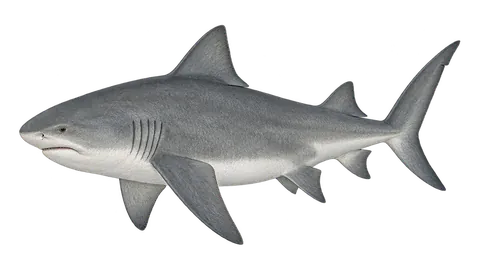
Very short, wide snout, almost square from above, huge mouth. Gray to brown back with dark vertical bars and spots, strong in juveniles and faded in large adults. Tail with a long, pointed upper lobe and a low keel on the caudal peduncle. Wide, serrated teeth, shaped like a rooster's comb. The bull shark also has a short snout, but it is plain gray without stripes, and has a taller first dorsal fin.

distribution

where found

open on the large map

Along the whole Brazilian coast, most common from the Northeast to the Southeast and at oceanic islands such as Fernando de Noronha. In the western Atlantic it ranges from the USA to Uruguay, including the Caribbean and the Gulf of Mexico; in the Pacific, from California to Peru.

Habitat: Continental shelf, reefs, shoals, oceanic islands, estuary mouths and ports; makes forays into open sea.

coast

North CoastNortheast CoastSoutheast CoastSouth Coastcoastalshelf

states

Amapá, Pará, Maranhão, Piauí, Ceará, Rio Grande do Norte, Paraíba, Pernambuco, Alagoas, Sergipe, Bahia, Espírito Santo, Rio de Janeiro, São Paulo, Paraná, Santa Catarina, Rio Grande do Sul

calendar and clock

when to fish

best season

time of yearbest: Jul–Aug and Jan–Mar
JanFebSeaAprMayJunJulAugSepOctNovDec

Estimate: it occurs year-round in the tropics. In Recife, a long-term study recorded more tiger sharks near the coast from January to March and from June to September, with a drop from October.

best time of day

0h6h12h18h sunrise ~6amsunset ~6pm

Night and twilight. Hunts mostly at night and at dusk; by day it usually stays deeper and farther from the beach.

weather, water and behavior

what affects the tiger shark
sensitivity The little bars show how much each factor affects this species. Five full: it feels it a lot.

cold and cold fronts

Warm-water species: in water below about 20 °C it becomes less active and moves away.

atmospheric pressure

Little direct effect.

moon

Dark nights and new-moon nights tend to be the busiest near the coast.

rain

Turbid rain water attracts prey to river mouths; the tiger hunts well in dirty water.

water level

Not applicable at sea.

noise

Not very sensitive; it often follows boats and the smell of fish.

wind

Rough seas hinder bottom boat fishing.

tide

Spring tides move prey at estuary mouths and reef channels.

depth

From the surface to about 140 m most of the time; it can go down to hundreds of meters.

technique, gear and bait

how to fish

rod
stand-up 50 to 80 lb
spinning / baitcasting reel
lever-drag baitcasting reel 30 to 50 with strong drag and plenty of line
line
braided 80 to 130 lb or monofilament 80 lb
leader
steel cable 2 to 3 m (the teeth cut any nylon) joined by a splice to 3 to 5 m of 300 lb monofilament
hook
circle 14/0 to 18/0, barbless or with the barb crushed; a single hook

natural baits

  • whole fish or large chunk (bonito, Spanish mackerel, jack)
  • large squid

accessories

  • cutting pliers for steel cable
  • long hook remover
  • luvas
  • fighting belt

tip from an angler

Fishing for release only. With a circle hook, don't set the hook: let the line tighten. Bring the shark alongside the boat as fast as possible, without bringing it aboard, and cut the cable close to the mouth if the hook is deep. Never fish for shark from a beach where there are bathers.

what the law says

rules for the tiger shark

Summary of the regulations we found, with the source for each. Rules change; before keeping or transporting fish, check with the state environmental agency.
Conservation: Not on the national list (Portaria GM/MMA 1.667/2026). Global assessment: Near Threatened (IUCN, Aug 10, 2018). The general rules of recreational fishing and the finning ban apply.

Finning prohibited: shark only whole, with its fins

fins naturally attached to the body

In Brazil, finning is prohibited (cutting off the fins and discarding the body). Every shark or ray landed must arrive with its fins attached to the body; it is prohibited to carry on board an animal without fins or with loose fins, and to transfer sharks between vessels. It applies to any shark that may be kept.
Source: Instrução Normativa Interministerial MPA/MMA nº 14, of Nov 26, 2012, art. 3º (Ministry of Fisheries and Aquaculture and Ministry of Environment)

Mexico: no more than 1 shark per angler per day

1 specimen per angler per day (counts as 5 against the quota of 10)

In recreational sport fishing in Mexican saltwaters, the limit for sharks is one specimen per angler per day, which counts as five toward the total limit of ten fish. Fish caught in sport fishing may not be sold. Catch and release does not count toward the limit: prefer releasing.

Source: NOM-017-PESC-1994 (recreational sport fishing), amendment published in the DOF, item 4.9.1 b (Sagarpa/Conapesca)

Colombia: sharks are not a fishery resource

commercial or sport extraction not permittedconfirm with the agency

In 2021 Colombia stopped considering sharks and marine rays a fishery resource and began treating them as a hydrobiological resource; the recitals of Decree 281/2021 state that they may not be extracted for commercial or sport purposes, and the decree created an environmental protection plan. Later AUNAP rules dealt with incidental catch in artisanal fishing; we did not check the consolidated text. When in doubt, release it into the water.

Source: Decreto nº 281, of Mar 18, 2021 (Ministry of Environment and Sustainable Development), which adds Section 27 to Decree 1076/2015; Resolución AUNAP nº 0380/2021

catch and release
catch and release Releasing the fish alive, quickly and with a wet hand. During a closed season it isn't always allowed: what the regulation says applies.

Do not lift it out of the water or drag it on the sand: the weight of the body injures the organs. Short fight; release it alongside the boat with the shark in the water and cut the cable close to the mouth if the hook cannot be removed. Never put your hand near the mouth or hold it by the gills.

in the kitchen

Not recommended: large sharks accumulate mercury in their flesh, and the 'cação' sold in Brazil mixes threatened species. Release it.

calculator

how much it weighs without taking it out of the water

Length-weight relationship W = a·Lb (a = 0.00724, b = 3.09; FishBase (estimativa bayesiana para a família e o formato do corpo, comprimento total)). It's an average: a fat or lean fish can vary by 10% to 20%.

estimated weight

—

sources and references

The seasonal weights (months), time of day and sensitivities (cold, pressure, moon, wind, rain, tide, strong light, murky water and noise) are the app's editorial estimates, based on the literature below and on field experience of anglers and guides. The months indicate the time of year when the angler usually finds the species near the coast, not a catch season. They are not official data or measurements made for this species and may vary by region and year. Legal rules appear in the rules section, with the regulation and link.

  1. scientific FishBase — Galeocerdo cuvier (ficha da espécie)Names, distribution, biology, length-weight relationship, country list and references. Page checked on Oct 13, 2026.
  2. official Portaria GM/MMA nº 1.667, de 27 de abril de 2026 — Lista Nacional Oficial de Espécies da Fauna Ameaçadas de Extinção (peixes e invertebrados aquáticos)The species is not on the list (search by scientific name in the text published in the DOU, checked 13/10/2026).
  3. official ICMBio/SALVE — Ficha de Galeocerdo cuvier (avaliação nacional do risco de extinção)National assessment by ICMBio, published in 2025. DOI checked on Crossref; the entry's text did not open during checking.
  4. scientific IUCN Red List — Galeocerdo cuvier (avaliação global: Quase Ameaçada, NT, 10/08/2018)Global assessment. Link given on the FishBase entry (Red List, version 2025-2).
  5. scientific Compagno, L. J. V. (1984). FAO species catalogue. Vol. 4. Sharks of the world. Part 2 — Carcharhiniformes. FAO Fisheries Synopsis 125(4/2): 251-655. Roma: FAO.
  6. scientific Afonso, A. S.; Andrade, H. A.; Hazin, F. H. V. (2014). Structure and dynamics of the shark assemblage off Recife, northeastern Brazil. PLoS ONE 9(7): e102369.Seasonality of the tiger shark near the coast of Recife (most abundant from January to September). Open-access article, checked 13/10/2026.
  7. scientific Hazin, F. H. V.; Afonso, A. S.; Castilho, P. C.; Ferreira, L. C.; Rocha, B. C. L. M. (2013). Regional movements of the tiger shark, Galeocerdo cuvier, off northeastern Brazil: inferences regarding shark attack hazard. Anais da Academia Brasileira de Ciências 85(3): 1053-1062.DOI checked in Crossref.
  8. scientific Afonso, A. S.; Hazin, F. H. V. (2014). Post-release survival and behavior and exposure to fisheries in juvenile tiger sharks, Galeocerdo cuvier, from the South Atlantic. Journal of Experimental Marine Biology and Ecology 454: 55-62.DOI checked in Crossref.
  9. scientific Gallagher, A. J.; Serafy, J. E.; Cooke, S. J.; Hammerschlag, N. (2014). Physiological stress response, reflex impairment, and survival of five sympatric shark species following experimental capture and release. Marine Ecology Progress Series 496: 207-218.Great hammerhead, bull shark, blacktip shark, lemon shark and tiger shark in southern Florida and the Bahamas. DOI checked on Crossref.
  10. official Instrução Normativa Interministerial MPA/MMA nº 14, de 26 de novembro de 2012 — desembarque, transporte, armazenamento e comércio de tubarões e raias (proibição do finning)Text of Sislegis/MAPA (DOU of Nov 28, 2012), checked 13/10/2026.
  11. official México — Modificación a la NOM-017-PESC-1994 (pesca deportivo-recreativa), DOFOfficial text in the Official Gazette of the Federation (DOF); item 4.9.1 checked 13/10/2026.
  12. official Colômbia — Decreto 281 de 2021 (proteção e conservação de tubarões, raias marinhas e quimeras), Gestor Normativo da Função PúblicaText checked 13/10/2026. Later AUNAP changes on incidental catch were not checked.
  13. scientific Almerón-Souza, F. et al. (2018). Molecular identification of shark meat from local markets in Southern Brazil based on DNA barcoding: evidence for mislabeling and trade of endangered species. Frontiers in Genetics 9: 138.DOI checked in Crossref.
don't confuse

similar species