

venezuelan grouper
Mycteroperca cidi
Grouper of shallow reefs of the South American Caribbean, reaching 114 cm. It is sold fresh and has little presence in recreational fishing.
- maximum
- 114 cm
- record/max.
- 15.0 kg
- depth
- 5–8 m
how to recognize it
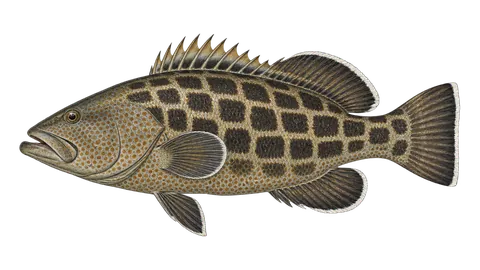
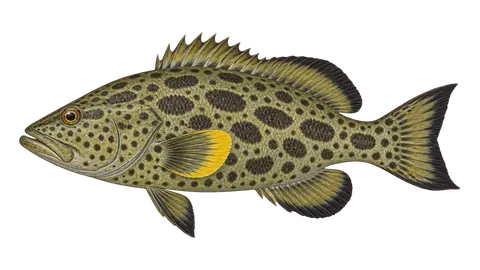
Adults greyish brown and juveniles greenish brown, with irregular brown blotches over the body. The soft dorsal and anal fins have a white edge and a dark band just below. The forehead is convex between the eyes, and the preopercle has large serrations at the angle. It looks like the black grouper (Mycteroperca bonaci) and the yellowfin grouper (Mycteroperca venenosa), which live in the same region, so juvenile colour is the best clue.
Also called: badejo-venezuelano, cherna blanca, cuna blanca, venezuelan grouper
don't confuse with:
We don't have tips on season, bait or technique for this species yet.
where found
open on the large mapWhere to look: Shallow reefs and sand bottoms with seagrass; large adults between 20 and 40 m.
It occurs in the Caribbean, mainly off the coast of Venezuela, with records in Jamaica, Colombia and Trinidad.
rules for the venezuelan grouper
Rules change; before keeping or transporting fish, check with the state environmental agency.
We found no species-specific rule beyond the region's general rules.
how much it weighs without taking it out of the water
estimated weight
—
how we calculate
Length-weight relationship W = a·Lb (a = 0.00912, b = 3.05; FishBase (relação peso-comprimento bayesiana, estimativa pelo gênero e formato do corpo)). It's an average: a fat or lean fish can vary by 10% to 20%.
more about the venezuelan grouper
Fish of the family Epinephelidae, the family of the groupers. It reaches 114 cm and 15 kg. Juveniles live in shallow waters, over sand near reefs and seagrass. Large adults are fished between 20 and 40 m. It eats fish and crustaceans, like the other groupers. It occurs mainly off the coast of Venezuela and has recent records in Jamaica. It goes fresh to market and is of no great importance to recreational fishing.
Family: Epinephelidae · predator
in the kitchen
It is sold fresh at the market.
similar species
sources and references (2)
Essential profile: size, length-weight, depth, countries and conservation come from FishBase and the cited regulations, and the texts were written from those sources. Season, time of day, sensitivities, technique and baits and lures are not included yet, because we did not find a good source for this species.
- scientific FishBase: Mycteroperca cidi (ficha da espécie)Size, length-weight, depth, habitat, distribution, biology, and IUCN status. Page checked on Oct 13, 2026.
- scientific FishBase: nomes populares de Mycteroperca cidiNames by country and language.