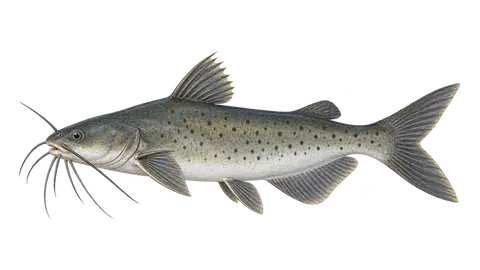
The largest catfish in North America, reaching 1.65 m and 68 kg. Native to Mexico, it lives in large rivers and reservoirs and is fished at night with pieces of fish on the bottom.
Catfish of large rivers and reservoirs in the Mississippi basin, from the Gulf slope to the Rio Grande and Mexico. It prefers clear water with current in the main channels and the deep parts of reservoirs, over mud, sand or gravel. It spends the day on the bottom in deep areas and at night moves up into the current to feed on invertebrates, mussels and fish; the big ones are almost entirely fish-eaters. The male digs the nest under logs or banks and guards the eggs. In Mexico it occurs in reservoirs in Chihuahua and Chiapas and is commercially fished. For sport anglers it is a heavy fish with a long, slow fight, caught on natural bait left still on the bottom.
fun facts
It is the largest catfish in North America: FishBase records up to 165 cm and 68 kg.
It was introduced into basins on the Atlantic slope of the USA, where it became a problem for native fish.
how to recognize it
identification
Robust body, scaleless, blue-gray to lead-gray on the back and white on the belly, without spots. Four pairs of barbels and a deeply forked tail. The anal fin is long, with a straight edge (30 to 36 rays). The channel catfish (Ictalurus punctatus) has dark spots as juveniles and medium-sized fish, and a shorter, rounded anal fin.
how blue catfish fishing looks
Loading the next 7 days…
Each card shows the day's index (0 to 100) and, below it, a strip with the index for each hour, from 0h to 23h. from poor to excellent.
Not found in Brazil. Native to the Mississippi basin and the Gulf of Mexico slope (USA) to the Rio Grande and Mexico. The Mexican inland waters standard cites it in reservoirs in Chihuahua (such as Luis L. León) and Chiapas.
Habitat: Main channels and eddies of medium and large rivers, and deep parts of reservoirs, over mud, sand and gravel, with clear water and current.
calendar and clock
when to fish
best season
time of yearbest: Apr–Sep
JanFebSeaAprMayJunJulAugSepOctNovDec
Fishable all year; the warm months are best. Watch for state closures, such as Chihuahua's from April to June.
best time of day
Night and twilight. Feeds mainly from dusk until before dawn, when it rises from deep holes into the current and shallows. During the day it stays on the bottom.
weather, water and behavior
what affects the blue catfish
sensitivity The little bars show how much each factor affects this species. Five full: it feels it a lot.
cold and cold fronts
Tolerates cold water better than other catfish and feeds in winter, more slowly.
atmospheric pressure
Moderate effect; stable weather is best.
moon
Dark nights tend to be better in shallow water.
rain
Rain that increases the current triggers feeding.
water level
Rising water with current brings fish to river mouths and dam outflows.
noise
Not very sensitive on the bottom, but avoid knocking the hull over the hole.
wind
Wind that pushes water toward one shore concentrates small fish and catfish there.
depth
From 5 to 20 m by day; from 2 to 6 m at night, on shoals and channel edges.
spinning reel 5000 to 8000 or round baitcasting reel with a ratchet
line
monofilament 30 to 50 lb or braided line 50 to 80 lb
leader
monofilament 50 to 80 lb, 50 cm
hook
circle hook 5/0 to 10/0
lures
rarely used
natural baits
pieces of fresh, oily fish (tilapia, carp, sardine)
chicken liver
in Mexico, live fish as bait is prohibited in inland waters
accessories
sliding sinker of 60 to 150 g
rod holder
headlamp
tip from an angler
Use fresh cut bait and a circle hook: leave the rod in the holder and only reel in when the rod bends firmly, without jerking.
what the law says
rules for the blue catfish
Summary of the regulations we found, with the source for each. Rules change; before keeping or transporting fish, check with the state environmental agency. Conservation: Outside its native range, in the USA, it is considered an invasive species in Atlantic coast rivers.
Mexico: up to 5 freshwater fish per day, no live fish as bait
5 fish per angler per day
In Mexico's federal-jurisdiction inland waters, the limit is 5 fish per angler per day, with one rod in use per angler. Using live fish as bait in inland waters is banned, and fish caught in sport fishing may not be sold. Each reservoir's committee may reduce the bag limit and set sizes.
For all catfish of the family Ictaluridae, including the blue catfish (bagre azul or puyón), the minimum catch size is 340 mm total length, except in the reservoirs listed in Annex 1 of the standard, which have their own size (in Luis L. León reservoir, Chihuahua, 320 mm).
Chihuahua (MX): catfish closed season, Apr 2 to Jun 25
fishing prohibited from April 2 to June 2502/04 to 25/06
In federally governed waters of the state of Chihuahua, fishing for blue catfish and channel catfish (Ictalurus furcatus and I. punctatus) is prohibited from April 2 to June 25 each year. It applies only in Chihuahua.
catch and release Releasing the fish alive, quickly and with a wet hand. During a closed season it isn't always allowed: what the regulation says applies.
Heavy fish: support the belly with both hands, watch out for the spines of the dorsal and pectoral fins. Release it in the water, holding it until it swims off on its own.
in the kitchen
White, firm flesh; fried, breaded or in stew. Medium-sized fish are the best for the table.
calculator
how much it weighs without taking it out of the water
Length-weight relationship W = a·Lb (a = 0.00513, b = 3.12; FishBase). It's an average: a fat or lean fish can vary by 10% to 20%.
estimated weight
—
sources and references
The season weights (months), the time of day and the sensitivities (cold, pressure, moon, wind, rain, tide, strong light, murky water and noise) are the app's editorial estimates, based on the literature below and on the field experience of anglers and guides. They are not official data nor a measurement made for this species, and they may vary by region and year. Closed seasons and legal rules appear in the rules section, with the norm and a link.