Skip to content
catalog Centrarchidae · omnivore

bluegill

Lepomis macrochirus

Freshwater

One of North America's most common sunfish: small, deep-bodied, and brightly colored, with a black "ear" on the gill cover. Introduced to Cuba, Panama, Puerto Rico, and Venezuela, it strikes small baits and flies near vegetation.

Also called: bluegill, bluegill sunfish, sunfish

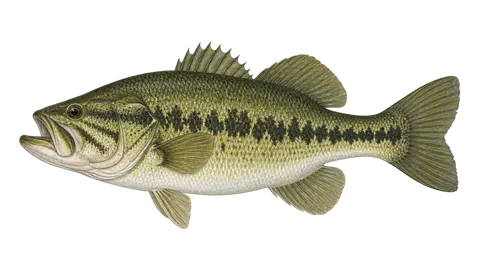
Scientific illustration of Bluegill
common size
12–22 cm
maximum
41 cm
common weight
0.0–0.2 kg
record/max.
2.2 kg
depth
0.3–6 m
ideal water
20–30 °C
overview

who is the bluegill

Bluegill is a deep-bodied, laterally compressed centrarchid native to eastern North America and northern Mexico, now spread to many countries as a sport fish and as forage for largemouth bass. FishBase records introductions in Mexico, Cuba, Panama, Puerto Rico, Venezuela, and El Salvador, and notes adverse ecological effects in some of these countries; in Brazil there is a record of introduction without an established population. It lives in lakes, ponds, reservoirs, and slow rivers, in shallow, warm water with lots of vegetation, and eats insects, snails, small crustaceans, and small fish. Males build nests in colonies in shallow water and guard them. It rarely exceeds 25 cm, but it fights well for its size and is the gateway to light-tackle fishing.

fun facts

  • Males dig nests in colonies and make grunting sounds to attract females.
  • It was spread around the world partly as forage for largemouth bass, in addition to being fished for on its own.
  • The maximum age recorded in FishBase is 10 years.
how to recognize it

identification

Deep-bodied and laterally compressed, olive-green on the back, with bluish and purplish sheens on the flanks and faint vertical bars. The most reliable sign is the "ear": the gill cover flap is almost all black, sometimes with an iridescent blue edge; there is also a dark spot at the rear of the dorsal fin. It has a small mouth and long, pointed pectoral fins, and the breeding male has an orange chest. It is told apart from the green sunfish (Lepomis cyanellus), which has a large mouth, and from the pumpkinseed (L. gibbosus), which has a red spot on the edge of the ear.

how bluegill fishing looks

Loading the next 7 days…

Each card shows the day's index (0 to 100) and, below it, a strip with the index for each hour, from 0h to 23h. from poor to excellent.

distribution

where found

open on the large map

Does not occur naturally in Brazil. Native to eastern North America, from the St. Lawrence basin and the Great Lakes to the Gulf and northern Mexico. Introduced, according to FishBase, to Mexico (outside its native range), Cuba, Panama (1955), Puerto Rico (1915), Venezuela (1955 to 1959), and El Salvador (1957, probably without an established population).

Habitat: Lakes, ponds, reservoirs, and slow rivers, in shallow, warm water with lots of vegetation; backwaters, oxbows, and submerged timber. Tolerates slightly brackish water, up to about 10 ppt.

calendar and clock

when to fish

best season

time of yearbest: Apr–Oct
JanFebSeaAprMayJunJulAugSepOctNovDec

In the tropics it bites all year; in northern Mexico and high-altitude lakes, cold winters reduce activity. Spawning runs from April to September, in water of about 21 to 32 °C: males defend shallow nests in colonies and strike small baits.

best time of day

0h6h12h18h sunrise ~6amsunset ~6pm

Daytime, with peaks at dawn and dusk. FishBase records more activity at dawn and dusk, and the Texas literature describes feeding during the day. On hot days, the best times are the two ends of the day.

weather, water and behavior

what affects the bluegill
sensitivity The little bars show how much each factor affects this species. Five full: it feels it a lot.

cold and cold fronts

Cold water slows activity; the best days are those with water above about 20 °C.

atmospheric pressure

A sudden change in weather reduces activity for a few hours.

moon

Small effect.

rain

Light rain doesn't bother them; very murky water reduces the visibility of the lure.

water level

A stable level keeps fish close to the vegetation; a rapid rise scatters them.

noise

Moderate: approach the shallow nests carefully.

wind

A light breeze on the bank gathers insects and gets the fish active.

depth

From the surface to 3 m, near vegetation, submerged timber, and rocks; during nesting season, at 0.3 to 1 m.

technique, gear and bait

how to fish

rod
ultralight 5' to 6'6", fast action, 2 to 6 lb; or fly #3 to #5
spinning / baitcasting reel
spinning reel 500 to 1000
line
monofilament 0.16 to 0.20 mm (2 to 6 lb)
leader
fluorocarbon 2 to 4 lb
hook
size 10 to 6, fine

lures

  • micro jig 1/64 to 1/16 oz
  • spinner No. 0 to 1
  • dry fly or nymph size 10 to 14
  • popper size 10 to 12

natural baits

  • minhoca
  • grilo
  • larvas
  • piece of shrimp

accessories

  • small float
  • fine pliers
  • landing net

tip from an angler

Cast near the vegetation and submerged timber and let the lure fall slowly: the strike is usually light.

what the law says

rules for the bluegill

Summary of the regulations we found, with the source for each. Rules change; before keeping or transporting fish, check with the state environmental agency.
Conservation: Assessed on Aug 21, 2018 as Least Concern. Outside its native range, FishBase classifies it as a potential pest and records adverse ecological effects in the countries where it was introduced.

Mexico: bluegill (mojarra de agallas azules) with a minimum size of 135 mm

135 mm (total length)

The responsible fishing standard for federal inland waters sets a minimum catch size of 135 mm total length for Lepomis macrochirus. The reservoirs in Annex 1 of the standard may have their own size.

Source: NOM-060-SAG/PESC-2014, item 4.3.3, DOF May 27, 2014 (Sagarpa/Conapesca)

Mexico: up to 5 freshwater fish per day, one rod, and no live fish as bait

5 fish per angler per day; one rod in use; no live fish as bait

In Mexico's federal inland waters, recreational fishing for freshwater species is limited to 5 fish per angler per day (this also applies to bluegill). Each reservoir's committee may lower the bag limit and set sizes. Only one rod per angler may be in use, and using live fish as bait is prohibited. Fish kept may not be sold, and any fish over the limit must be returned alive to the water. No permit is required to fish from the bank; a permit is required from a boat.

Source: Amendment to NOM-017-PESC-1994, DOF Nov 25, 2013, items 4.3, 4.6 b, 4.7 c, 4.9.2, 4.9.5 and 4.11 (Sagarpa/Conapesca)

Mexico: releasing or stocking live fish in natural water requires authorization

introducing live aquatic species only with authorization from Conapesca and a technical opinion from Inapescaconfirm with the agency

The introduction of live aquatic species, at any life stage, for aquaculture or stocking may only be allowed by Conapesca, with a technical opinion from Inapesca, and also requires an environmental resolution from Semarnat and a health resolution from the competent authorities. Moving live fish from one body of water to another, or releasing fish from ponds or aquariums into rivers and reservoirs, counts as introduction and would require that process.

Source: NOM-060-SAG/PESC-2014, items 4.13 and 4.14, DOF May 27, 2014 (Sagarpa/Conapesca)

catch and release
catch and release Releasing the fish alive, quickly and with a wet hand. During a closed season it isn't always allowed: what the regulation says applies.

Use a barbless hook and fine pliers: the mouth is small. If the fish swallows the hook, cut the line close to the mouth. Where the species is introduced, do not move live fish to another water body.

in the kitchen

White, delicate flesh from a small fish: usually fried whole or in thin fillets.

calculator

how much it weighs without taking it out of the water

Length-weight relationship W = a·Lb (a = 0.0138, b = 3.13; FishBase (relação peso-comprimento bayesiana, estimativa da própria espécie)). It's an average: a fat or lean fish can vary by 10% to 20%.

estimated weight

—

sources and references

The season factors (months), the time of day, and the sensitivities (cold, pressure, moon, wind, rain, tide, strong light, murky water, and noise) are editorial estimates by the app, based on the literature cited below and on field experience of anglers and guides. They are not official data or measurements made for this species and may vary by region and year. Closed seasons and legal rules appear in the rules section, with the standard and link. Depth, gear, and baits are editorial recommendations, based on the species' habits and on common light-tackle practice.

  1. scientific FishBase: Lepomis macrochirus (ficha da espécie)Size, length-weight, depth, habitat, distribution, biology, and IUCN status. Page checked on Oct 13, 2026.
  2. scientific FishBase: nomes populares de Lepomis macrochirusNames by country and language.
  3. scientific IUCN Red List: Lepomis macrochirus (avaliação global: Pouco Preocupante, LC, 21/08/2018)Global assessment. Link given on the FishBase entry (Red List, version 2025-2).
  4. scientific FishBase: introduções de Lepomis macrochirusList of countries of introduction and whether the population became established: Puerto Rico (1915, established), Panama (1955, established), Venezuela (1955 to 1959, probably established), El Salvador (1957, probably not), Cuba and Mexico (established), Brazil (not established). The table does not give the reasons for the introductions. Page checked on Oct 13, 2026.
  5. scientific Fishes of Texas: Lepomis macrochirus (bluegill)Identification, size, habitat, diet, spawning (April to September, 21 to 32 °C), longevity, and native range. Page checked on Oct 13, 2026.
  6. scientific USGS: Nonindigenous Aquatic Species, Lepomis macrochirus (bluegill)Native range (including northern Mexico) and use in stocking for sport fishing and as forage. The page's introduction records cover only the USA and its territories; for Latin America the profile uses FishBase. Page checked on Oct 13, 2026.
  7. official DOF: Modificação da NOM-017-PESC-1994, que regula a pesca esportivo-recreativa em águas de jurisdição federal do México (publicada em 25/11/2013)Items 4.3, 4.4, 4.6 b, 4.7 c, 4.9.2, 4.9.5, and 4.11: permit, one rod per angler in inland waters, ban on live fish as bait, limit of 5 freshwater fish per day, release of the fish over the limit, and ban on sale. Text checked on Oct 13, 2026.
  8. official DOF: NOM-060-SAG/PESC-2014, pesca responsável em corpos de água continentais de jurisdição federal do México (publicada em 27/05/2014)Item 4.3.3 (minimum size of 135 mm for Lepomis macrochirus) and items 4.13 and 4.14 (introduction of live species). The countries of introduction outside Mexico (Cuba, Panama, Puerto Rico, Venezuela, and El Salvador) had no rules confirmed for this profile. Text checked on Oct 13, 2026.
don't confuse

similar species