

largemouth bass
Micropterus salmoides
Exotic North American predator, found in reservoirs in the South and Southeast. Technical fishing with artificial lures. Never release it into a new environment.
- common size
- 25–45 cm
- maximum
- 97 cm
- common weight
- 0.5–2.5 kg
- record/max.
- 10.1 kg
- depth
- 0.5–8 m
- ideal water
- 20–27 °C
how to recognize it
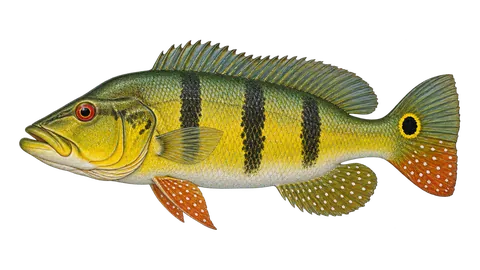
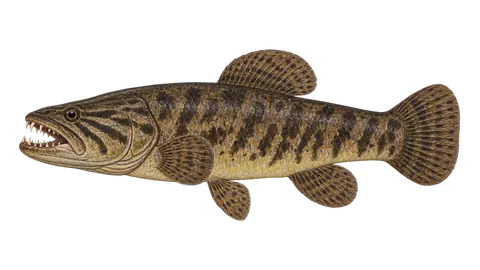
Sturdy olive-green body, greenish-silver flanks with a dark, irregular lateral band from snout to tail. Huge mouth: the upper jaw extends past the eye. Dorsal fin with a spiny part and a soft part, nearly separate. Peacock bass has an ocellus on the tail and vertical bars. Trahira has no spines on the dorsal fin.
Also called: black bass, bass, achigã, perca-americana
don't confuse with:
where found
open on the large mapWhere to look: Reservoirs and small farm ponds with structure: snags, rocks, cutbanks, submerged vegetation and points.
Exotic, native to North America. Small reservoirs and farm ponds in PR, SC and RS (including the highland plateau), reservoirs in SP and southern MG, and cooler rivers.
introduced in
states
Paraná, Santa Catarina, Rio Grande do Sul, São Paulo, Minas Gerais
when to fish
next 7 days
Loading the next 7 days…
best season
Spring and summer. In spring (September to November) it moves into shallow water to build nests. In winter it stays deep and slow.
best time of day
Daytime, with peaks at dawn and dusk. Peaks at dawn and late afternoon; on cloudy days it strikes all day.
what affects the largemouth bass
cold and cold fronts
Tolerates cold water, but slows down below 15 °C.
atmospheric pressure
Very sensitive to cold fronts: after the front passes, drop the lure and slow down.
moon
Small effect; spring nests follow the moon in some reservoirs.
rain
Drizzle and overcast weather are often excellent.
water level
A rising level that floods the vegetation pulls the black bass into the shallows.
noise
Wary in clear water; long casts.
wind
The windward bank concentrates the lure and black bass.
depth
Shallow early and late in the afternoon; 3 to 8 m in strong sun and in the cold.
how to fish
lures
- silicone worm (Texas and wacky rig)
- spinnerbait
- crankbait
- skirted jig
- popper and small zara
- frog
natural baits
- live lambari
- minhocuçu
tip from an angler
Work slowly near snags and walls. After a cold front, use silicone on the bottom, almost still.
- rod
- 6' to 6'6", fast action, 8 to 17 lb
- spinning / baitcasting reel
- low-profile baitcasting reel 100 or spinning reel 2500
- line
- braided 15 to 20 lb
- leader
- fluorocarbon 12 to 16 lb
- hook
- offset 2/0 to 4/0 for silicone; treble hooks on hard lures
accessories
- alicate
- polarized glasses
catch and release
Where it is already established, follow local rules. Never transport it alive to another lake or river.
rules for the largemouth bass
Rules change; before keeping or transporting fish, check with the state environmental agency.
Releasing it into the natural environment without a license is an offense
releasing or introducing fish into rivers, reservoirs and lakes is prohibitedPRSCRSSPMGconfirm with the agency details
Introducing an exotic species, or one outside its natural range, without a technical opinion and a license is a federal environmental offense. This includes releasing a fish from a tank, pay lake or aquarium into a river or reservoir. In MG, the IEF states that stocking without a license is prohibited.
Source: Lei federal nº 9.605/1998, art. 31, and Decreto federal nº 6.514/2008, art. 25
PR: exotics allowed; returning them to the water is restricted
exotics may be caught freely; confirm the release rulePRconfirm with the agency details
In PR, non-native fish may be caught in the interior basins. Portaria IAT 650/2025 sets a rule on releasing non-natives, with an exception for catch-and-release events aimed at them. Confirm with IAT before returning the fish to the water.
Conservation: Considered invasive; harms lambaris and young native fish.
how much it weighs without taking it out of the water
estimated weight
—
how we calculate
Length-weight relationship W = a·Lb (a = 0.01047, b = 3.08; FishBase). It's an average: a fat or lean fish can vary by 10% to 20%.
more about the largemouth bass
North American predator, introduced to Brazil for sport fishing and now established in reservoirs, small farm ponds and cooler rivers of the South and Southeast. It is exotic and a voracious predator: it eats lambaris, young native fish, frogs and shrimp, and can wipe out small species from entire lakes. That is why releasing black bass where it doesn't exist is a serious environmental offense. For anglers it is the fish of technical lure fishing: silicone worm, spinnerbait, crankbait and topwater. It strikes hard, jumps and shakes its head.
Family: Centrarchidae · predator
fun facts
- The male digs the nest and guards eggs and fry, attacking anything that comes near.
- It is the fish that launched the big artificial-lure bass tournaments in the United States.
in the kitchen
White, firm meat; fried or grilled fillet.
similar species
sources and references (4)
The season weights (months), the time of day and the sensitivities (cold, pressure, moon, wind, rain, tide, strong light, murky water and noise) are the app's editorial estimates, based on the literature below and on the field experience of anglers and guides. They are not official data nor a measurement made for this species, and they may vary by region and year. Closed seasons and legal rules appear in the rules section, with the norm and a link.
- scientific FishBase — Micropterus salmoides (ficha da espécie)Names, distribution, biology, length-weight relationship and references. Page checked on October 13, 2026.
- scientific IUCN Red List — Micropterus salmoides (avaliação global: Pouco Preocupante, LC, 14/11/2018)Global assessment. Link given on the FishBase entry (Red List, version 2025-2).
- technical CABI Compendium — Micropterus salmoides (largemouth bass). Qin, J. (2024).Technical sheet for an invasive species (DOI checked in Crossref).
- scientific IUCN SSC Invasive Species Specialist Group — Global Invasive Species Database: Micropterus salmoidesPage checked on Oct 13, 2026.