Skip to content
catalog Scombridae · predator

bullet tuna

Auxis rochei

EstuarySea

A small tuna with a rounded body, dark blue back and nearly vertical dark bars on the area without scales. It travels in schools near the coast and islands and serves as bait and food for larger fish.

Also called: bonito-cachorro-bala, bonito-cachorro, bonito, bullet tuna, bullet mackerel

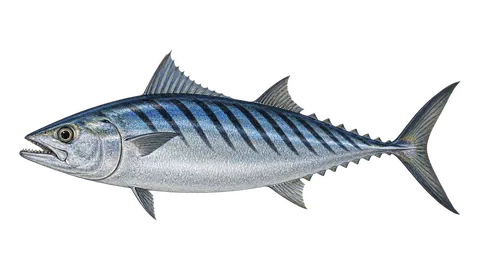
Scientific illustration of Bullet tuna
common size
30–45 cm
maximum
50 cm
common weight
0.3–1.1 kg
record/max.
— kg
depth
0–50 m
ideal water
22–28 °C
overview

who is the bullet tuna

The bonito-cachorro-bala is a small tuna, a very close relative of the bonito-cachorro (Auxis thazard): for a long time the two were treated as one species. It lives in coastal waters and around islands in all tropical and subtropical seas, including the Mediterranean, and migrates over long distances. It forms schools that eat small fish, mainly anchovies, crustaceans (especially larvae) and squid. Eggs and larvae are pelagic, and each spawning releases 31,000 to 103,000 eggs. It reaches 50 cm fork length and about 5 years. Because it is abundant, it is an important forage species for larger fish. It is caught by trolling and with purse seines, and sold fresh, frozen, dried, salted, smoked and canned.

fun facts

  • FishBase notes that many authors used the name Auxis thazard to include this species, believing there was only one.
  • In the eastern Pacific lives the subspecies Auxis rochei eudorax.
  • Each spawn releases 31,000 to 103,000 eggs, according to FishBase.
how to recognize it

identification

Robust, elongated, rounded body, bare outside the corselet. Bluish back, dark purple to almost black on the head, with 15 or more broad, nearly vertical dark bars on the area without scales; white belly. Pectoral and pelvic fins purple, with black insides, and a short pectoral fin that does not reach the vertical of the start of the scaleless area. The corselet is well developed, more than six scales wide below the second dorsal fin. In the bonito-cachorro the markings are nearly horizontal wavy lines, and the corselet is narrower.

how bullet tuna fishing looks

Loading the next 7 days…

Each card shows the day's index (0 to 100) and, below it, a strip with the index for each hour, from 0h to 23h. from poor to excellent.

distribution

where found

open on the large map

Atlantic, Indian and Pacific oceans, including the Mediterranean; in the eastern Pacific the population is treated as the subspecies Auxis rochei eudorax. In Latin America, from Cuba and Mexico to Uruguay and Argentina, in the Caribbean and the Ecuadorian Pacific. In Brazil, along the whole coast, on the shelf and around islands.

Habitat: Coastal and shelf waters and the surroundings of islands, near the surface, in schools.

coast

North CoastNortheast CoastSoutheast CoastSouth Coastcoastalshelf

states

Amapá, Pará, Maranhão, Piauí, Ceará, Rio Grande do Norte, Paraíba, Pernambuco, Alagoas, Sergipe, Bahia, Espírito Santo, Rio de Janeiro, São Paulo, Paraná, Santa Catarina, Rio Grande do Sul

calendar and clock

when to fish

best season

time of yearbest: Dec–Feb
JanFebSeaAprMayJunJulAugSepOctNovDec

More common in the warm season, with water above about 22 °C; in cold weather the school moves away from shore. FishBase indicates the species is a long-distance migrant.

best time of day

0h6h12h18h sunrise ~6amsunset ~6pm

Daytime, with peaks at dawn and dusk. Hunts by day in schools at the surface, most active in the first and last hours of light, when the bait rises.

weather, water and behavior

what affects the bullet tuna
sensitivity The little bars show how much each factor affects this species. Five full: it feels it a lot.

cold and cold fronts

A warm-water species: the school scatters when the water cools suddenly.

atmospheric pressure

A cold front with rough seas scatters the bait and shuts down fishing for a day or two.

moon

Small effect.

rain

Little effect in open sea; dirty river water pushes the school away from shore.

water level

Not applicable at sea. The equivalent is the presence of bait on the surface.

noise

An engine over the school makes it sink; approach from outside and cast at the edge.

wind

Light chop helps hide the line; strong wind hides the feeding activity and makes casting harder.

tide

Near the coast, tidal current at points and bay mouths gathers the bait.

depth

From the surface down to a few tens of metres, following the bait.

technique, gear and bait

how to fish

rod
6'6" to 7', 10 to 20 lb
spinning / baitcasting reel
spinning reel 2500 to 4000
line
braided 15 to 20 lb
leader
fluorocarbon 20 to 30 lb, 1 m
hook
single hook 1/0 to 2/0 or the treble hooks of the baits

lures

  • spoon and jig 15 to 40 g
  • small trolling feather
  • small midwater plug

natural baits

  • sardine strips

accessories

  • alicate
  • insulated cooler with ice

tip from an angler

When the school rises, cast ahead and reel in fast: a small, shiny bait works better than a large one.

what the law says

rules for the bullet tuna

Summary of the regulations we found, with the source for each. Rules change; before keeping or transporting fish, check with the state environmental agency.
Conservation: Not on the Brazilian national list (Ministerial Ordinance GM/MMA No. 1.667/2026).

Mexico: up to 5 per species and 10 saltwater fish per day

5 specimens of the species per angler per day, within the limit of 10 saltwater fish

In sport and recreational fishing in Mexican federal waters, each angler may keep up to 10 marine fish per day, no more than 5 of the same species. The bonito-cachorro-bala (melvera) is not among the species with their own limits (billfish, sharks, giant seatrout, tarpon, dorado, roosterfish and baya). Fish over the bag limit must go back alive, and sport-caught fish may not be sold. Fishing from a boat requires a permit, and sport fishing is banned in closed zones and seasons.
Source: Amendment to NOM-017-PESC-1994 (recreational sport fishing in federal waters of Mexico), signed Oct 14, 2013, items 4.3, 4.9.1, 4.9.5, 4.10 and 4.11 (Sagarpa/Conapesca)

catch and release
catch and release Releasing the fish alive, quickly and with a wet hand. During a closed season it isn't always allowed: what the regulation says applies.

It dies easily if handled a lot: if you release it, do it quickly, without lifting it out of the water, preferably with a barbless hook.

in the kitchen

Dark, strongly flavored flesh; bleed and ice it straight away. Sold fresh, frozen, dried, salted, smoked and canned.

calculator

how much it weighs without taking it out of the water

Length-weight relationship W = a·Lb (a = 0.00933, b = 3.06; FishBase (relação peso-comprimento bayesiana, estimativa da própria espécie)). It's an average: a fat or lean fish can vary by 10% to 20%.

estimated weight

—

sources and references

The season weights (months), the time of day and the sensitivities (cold, pressure, moon, wind, rain, tide, strong light, murky water and noise) are the app's editorial estimates, based on the literature below and on field experience from anglers and guides. They are not official data or measurements made for this species and may vary by region and year. Closed seasons and legal rules appear in the rules section, with the rule and link. The fishing depth range, the common size and the ideal water temperature range, when FishBase does not give a value, are editorial estimates based on the species' biology.

  1. scientific FishBase: Auxis rochei (ficha da espécie)Size, length-weight, depth, habitat, distribution, biology, and IUCN status. Page checked on Oct 13, 2026.
  2. scientific FishBase: nomes populares de Auxis rocheiNames by country and language. The name bonito-cachorro-bala was adopted in this profile from English (bullet tuna), to set the species apart from bonito-cachorro (Auxis thazard), which also goes by bonito-cachorro.
  3. official Portaria GM/MMA nº 1.667, de 27 de abril de 2026: Lista Nacional Oficial de Espécies da Fauna Ameaçadas de Extinção (peixes e invertebrados aquáticos)The species is not on the list. Checked in the DOU of April 28, 2026.
  4. official NOM-017-PESC-1994, Para regular las actividades de pesca deportivo-recreativa en las aguas de jurisdicción federal de los Estados Unidos Mexicanos (modificação de 2013)Daily limit of 10 marine fish and 5 per species (item 4.9.1), return of the excess (4.9.5), closed seasons (4.10) and sales ban (4.11). Text checked in the DOF on Oct 13, 2026.
  5. official Instrução Normativa MMA nº 53, de 22 de novembro de 2005: tamanhos mínimos de captura no Sudeste e SulThe species is not listed in Annexes I and II; we found no specific federal minimum size.
don't confuse

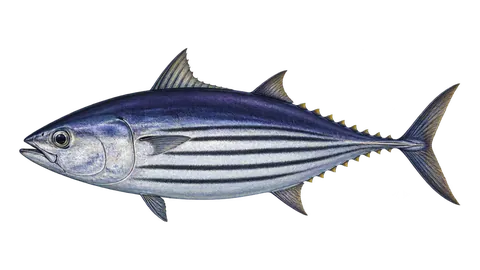
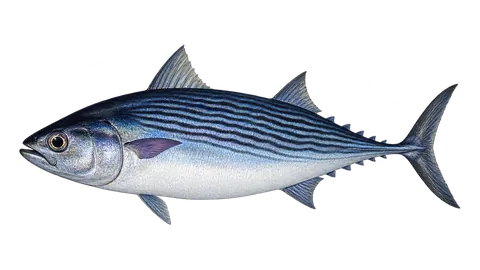
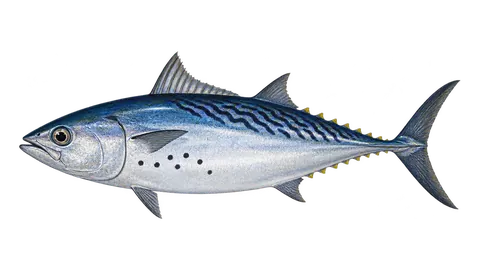
similar species