little tunny
Euthynnus alletteratus
The bonito that comes closest to shore, common near islands and reefs. It fights hard for its size and livens up any boat trip.
Also called: bonito, bonito-pintado, little tunny

- common size
- 40–75 cm
- maximum
- 122 cm
- common weight
- 2–7 kg
- record/max.
- 16.5 kg
- depth
- 0–50 m
- ideal water
- 21–28 °C
who is the little tunny
The spotted bonito is the tuna that comes closest to shore. It travels in schools over the shelf, often just a few kilometers from beaches, islands, and reefs, and is common along the whole Brazilian coast. It hunts sardines, anchovies, and squid at the surface, forming feeding frenzies with birds overhead. It rarely exceeds 8 kg, but it is strong, fast, and tough, ideal for light tackle, casting jigs, and fly. Many anglers use it as bait for large fish. The flesh is dark and strong and must be bled soon after capture.
fun facts
- In the United States it is called false albacore and is one of the most sought-after targets for fly fishing at sea.
- The black spots below the pectoral vary from 2 to 5 and are not always equally clear.
identification
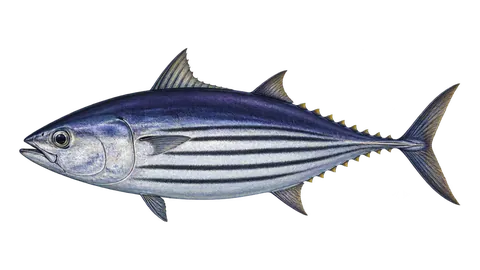
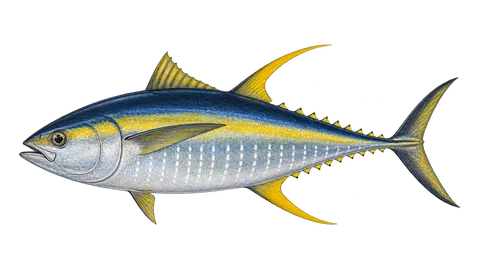
Steel-blue back with dark wavy markings, like worms, only from the middle of the first dorsal fin backward. Between the pectoral and pelvic fins, 2 to 5 black spots. Silver, plain belly. Skipjack tuna has a plain back and dark stripes on the belly. Bonito-cachorro has two widely separated dorsal fins and a smaller body. Juvenile yellowfin tuna has yellow fins and finlets.
Loading the next 7 days…
Each card shows the day's index (0 to 100) and, below it, a strip with the index for each hour, from 0h to 23h. from poor to excellent.
where found
The whole coast, from the shelf to near islands and rocky shores. Common at Ilhabela, Ubatuba, and Santos-SP, Rio de Janeiro and Cabo Frio-RJ, Vitória and Guarapari-ES, Salvador-BA, Recife-PE, and Natal-RN.
Habitat: Continental shelf and coastal areas of clean water, 0 to 50 m, at island edges, reefs, and water fronts.
coast
states
Amapá, Pará, Maranhão, Piauí, Ceará, Rio Grande do Norte, Paraíba, Pernambuco, Alagoas, Sergipe, Bahia, Espírito Santo, Rio de Janeiro, São Paulo, Paraná, Santa Catarina, Rio Grande do Sul
when to fish
best season
In the Southeast it is most common from late spring to autumn, November to May. In the Northeast it appears all year.
best time of day
Daytime, with peaks at dawn and dusk. Feeding frenzies are most frequent at dawn and late afternoon. On cloudy days it can stay at the surface all day.
what affects the little tunny
sensitivity The little bars show how much each factor affects this species. Five full: it feels it a lot.
cold and cold fronts
Below 19 °C it becomes rare near the coast.
atmospheric pressure
A cold front muddies the water near the islands; wait two or three days of calm sea.
moon
Small effect.
rain
Light rain doesn't bother. Thunderstorm with lightning: head back.
water level
Not applicable at sea. The equivalent is the color and clarity of the water: look for blue, clean water and current lines.
noise
It sinks with a loud motor and the boat over the school. Approach from the front and stop short.
wind
Moderate wind helps; strong wind hides the feeding frenzies and hurts casting.
tide
Near islands, the moving tide concentrates bait at the points and the bonito follows.
depth
Surface down to 50 m. Look for diving birds and boiling water.
how to fish
- rod
- 6'6" to 7'6", 10 to 20 lb
- spinning / baitcasting reel
- 3000 to 5000 spinning reel
- line
- braided line 15 to 30 lb
- leader
- fluorocarbon 25 to 40 lb, 1 m
- hook
- 1/0 to 3/0 single or treble hook; assist hook on jigs
lures
- 20 to 40 g casting jigs
- colheres
- 7 to 10 cm stickbaits
- streamers and epoxy flies on fly (line 8 to 9)
natural baits
- live sardine or anchovy
accessories
- alicate
- insulated cooler with ice
tip from an angler
Small bait is everything: when the school is feeding on anchovies, switch to slim 20 to 30 g jigs and retrieve as fast as you can.
rules for the little tunny
Summary of the regulations we found, with the source for each. Rules change; before keeping or transporting fish, check with the state environmental agency.
We found no species-specific rule beyond the region's general rules.
catch and release
catch and release Releasing the fish alive, quickly and with a wet hand. During a closed season it isn't always allowed: what the regulation says applies.
Release it quickly, without touching the gills, head down in the water with a push. Out of the water it dies in a short time.
in the kitchen
Dark, strong flesh. Bleed and chill it right away. Best grilled, pickled, or as bait.
how much it weighs without taking it out of the water
Length-weight relationship W = a·Lb (a = 0.01, b = 3.06; FishBase (estimativa bayesiana, comprimento total)). It's an average: a fat or lean fish can vary by 10% to 20%.
estimated weight
—
sources and references
The season weights (months), the time of day and the sensitivities (cold, pressure, moon, wind, rain, tide, strong light, murky water and noise) are the app's editorial estimates, based on the literature below and on the field experience of anglers and guides. They are not official data nor a measurement made for this species, and they may vary by region and year. Closed seasons and legal rules appear in the rules section, with the norm and a link.
- scientific FishBase — Euthynnus alletteratus (ficha da espécie)Names, distribution, biology, length-weight relationship and references. Page checked on October 13, 2026.
- official Portaria GM/MMA nº 1.667, de 27 de abril de 2026 — Lista Nacional Oficial de Espécies da Fauna Ameaçadas de Extinção (peixes e invertebrados aquáticos)Most recent national list. The species is not on it (search by scientific name in the text published in the DOU, checked on October 13, 2026).
- official ICMBio/SALVE — Ficha de Euthynnus alletteratus (avaliação nacional do risco de extinção)ICMBio national assessment, published in 2025. DOI checked on Crossref.
- scientific IUCN Red List — Euthynnus alletteratus (avaliação global: Pouco Preocupante, LC, 01/03/2022)Global assessment. Link given on the FishBase entry (Red List, version 2025-2).
- scientific Collette, B. B.; Nauen, C. E. (1983). FAO species catalogue. Vol. 2. Scombrids of the world. FAO Fisheries Synopsis 125(2). Roma: FAO.
- technical ICCAT Manual, cap. 2.1.10.5 — Little tunny (Euthynnus alletteratus). International Commission for the Conservation of Atlantic Tunas.Biology and fishery of the species in the Atlantic.
- scientific Carpenter, K. E. (org.) (2002). The living marine resources of the Western Central Atlantic. Vol. 3: Bony fishes part 2 (Opistognathidae to Molidae). FAO Species Identification Guide for Fishery Purposes. Roma: FAO.Scombridae chapter (Collette, B. B.).