Skip to content
catalog Sciaenidae · predator

ground croaker

Bairdiella ronchus

EstuarySea

Small coastal croaker, gray and silver, with fine stripes on the flanks and a strong spine on the anal fin. It lives over mud and sand bottoms from the Caribbean to Brazil and is used as pot fish.

Also called: bororó, ground croaker, ground drummer

Scientific illustration of Ground croaker
common size
18–30 cm
maximum
42 cm
common weight
0.1–0.3 kg
record/max.
0.7 kg
depth
16–40 m
ideal water
24–29 °C
overview

who is the ground croaker

The bororó is a small croaker of coastal and brackish waters, living over mud and sand bottoms between 16 and 40 m. It feeds on fish and crustaceans, matures at about 16 cm and rarely exceeds 25 cm on the hook; the recorded maximum is 41.5 cm and 714 g. It occurs from the Caribbean to Brazil, between 23°N and 29°S, and is important as a table fish and as a commercial catch in several regions. For the sport angler it is a bottom fish of channels and small boats, which takes shrimp and fish pieces and fights little, but often comes in good numbers when the school is down below.

fun facts

  • The second anal spine is as strong as the first soft ray, a good sign for identifying the species.
  • It matures small, at about 16 cm, and lays eggs (it is oviparous).
  • The name in English, ground croaker, reminds us that croakers make sounds with their swim bladder.
how to recognize it

identification

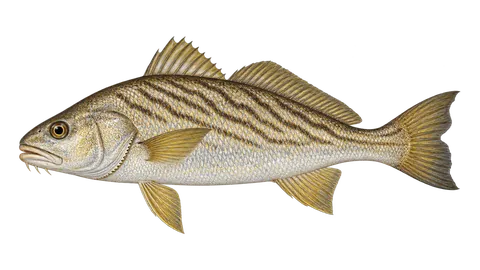
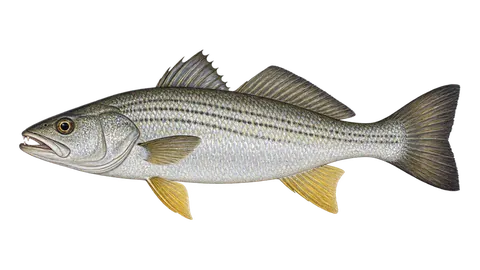
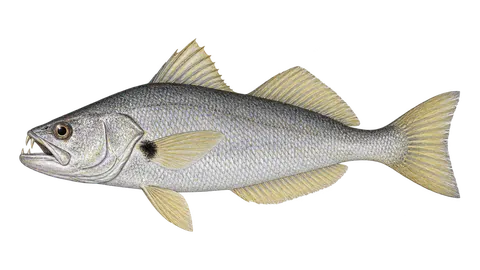
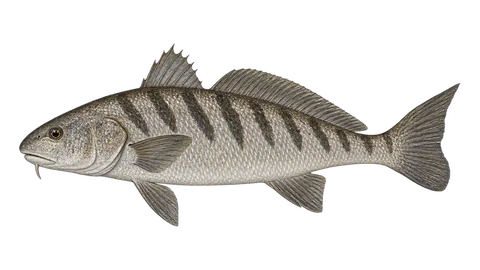
Short, deep body for a croaker, gray on top and silver below, with fine dark streaks: oblique above the lateral line and longitudinal below it. Dorsal and caudal fins grayish with a dark margin; anal fin speckled at the front. Mouth oblique and slightly low, chin without a barbel but with five pores. The preopercle is serrated, with some strong spines at the angle, and the second anal spine is very strong, as big as the first soft ray. The papa-terra has a barbel on the chin, and the pescadas have a more elongated body.

how ground croaker fishing looks

Loading the next 7 days…

Each card shows the day's index (0 to 100) and, below it, a strip with the index for each hour, from 0h to 23h. from poor to excellent.

distribution

where found

open on the large map

Western Atlantic: from the Caribbean to Brazil, between 23°N and 29°S. In Latin America, from Mexico and Belize to Colombia, Venezuela and the Guianas, plus the Antilles (Cuba, Haiti, Dominican Republic, Jamaica and Puerto Rico). In Brazil, on mud and sand shelf bottoms, from north to south.

Habitat: Coastal and brackish waters over mud and sand bottoms, between 16 and 40 m.

coast

North CoastNortheast CoastSoutheast CoastSouth Coastcoastal
calendar and clock

when to fish

best season

time of year
JanFebSeaAprMayJunJulAugSepOctNovDec

Present year-round in warm waters. The sources consulted set no closed season; fishing depends more on current and clear water than on the season.

best time of day

0h6h12h18h sunrise ~6amsunset ~6pm

Any time. The sources do not detail the time of day. In bottom fishing it usually bites all day, with more activity when the water is moving.

weather, water and behavior

what affects the ground croaker
sensitivity The little bars show how much each factor affects this species. Five full: it feels it a lot.

cold and cold fronts

Tropical species: a sharp drop in temperature pushes the school into deeper water.

atmospheric pressure

Effect poorly documented; a choppy sea after a cold front hurts boat fishing more.

moon

Little effect.

rain

Tolerates brackish water, but floods that lower the salinity scatter the schools.

water level

Not applicable at sea.

noise

Not very sensitive.

wind

Strong wind raises chop and makes it hard to keep the boat over the bottom.

tide

A medium current, ebbing or flooding, brings the school to the sinker.

depth

Usually 16 to 40 m, over mud and sand.

technique, gear and bait

how to fish

rod
6'0" to 7'0", 10 to 20 lb
spinning / baitcasting reel
spinning reel 2500 to 4000
line
0.30 mm monofilament or 15 lb braid
leader
20 lb monofilament, 40 cm
hook
No. 2 to 1/0 hook in a two-hook dropper rig

natural baits

  • shrimp
  • sardine strips
  • lula
  • piece of fish

accessories

  • 30 to 80 g sinker
  • two-hook dropper rig
  • alicate

tip from an angler

Keep the bait on the bottom, with the sinker still in the current; the mouth is small, so a small hook catches more.

what the law says

rules for the ground croaker

Summary of the regulations we found, with the source for each. Rules change; before keeping or transporting fish, check with the state environmental agency.
Conservation: Not on the Brazilian national list (Ministerial Ordinance GM/MMA No. 1.667/2026).

Mexico: up to 5 per species and 10 saltwater fish per day

5 specimens of the species per angler per day, within the limit of 10 saltwater fish

In recreational sport fishing in Mexican federal waters, each angler may keep up to 10 marine fish per day, with a maximum of 5 of the same species. The bororó (corvineta ruyo) is not among the species with their own limit (billfish, sharks, giant croaker, tarpon, dorado, pez gallo and baya). Anything over the limit goes back alive into the water, and sport-caught fish may not be sold. Fishing from a boat requires a permit, and sport fishing is banned in closed zones and seasons.

Source: Amendment to NOM-017-PESC-1994 (recreational sport fishing in federal waters of Mexico), signed Oct 14, 2013, items 4.3, 4.9.1, 4.9.5, 4.10 and 4.11 (Sagarpa/Conapesca)

Cuba: minimum size for croaker of 18 cm (fork length)

18 cm (fork length)confirm with the agency

The Cuban minimum-size resolution for shelf fish lists croaker of the genus Bairdiella (Bairdiella sp.) at 18 cm fork length and 120 g. Catching, landing, transporting and selling below that size is prohibited, and the ban also covers recreational sport fishing. The table cites the genus, not B. ronchus in particular. The rule dates from 2009: confirm with the Ministry of the Food Industry whether it has been updated.

Source: Resolución No. 126/09 of the Ministry of the Food Industry of Cuba (signed May 20, 2009; Official Gazette of Jun 10, 2009), art. 1º and Annex

catch and release
catch and release Releasing the fish alive, quickly and with a wet hand. During a closed season it isn't always allowed: what the regulation says applies.

Remove the hook with pliers, watch the spines on the anal fin and the opercle, and release it quickly if you won't eat it.

in the kitchen

FishBase calls it an important table fish; it is fried whole, in steaks or in broth.

calculator

how much it weighs without taking it out of the water

Length-weight relationship W = a·Lb (a = 0.00933, b = 3.08; FishBase (relação peso-comprimento bayesiana, estimativa da própria espécie)). It's an average: a fat or lean fish can vary by 10% to 20%.

estimated weight

—

sources and references

The season weights (months), the time of day and the sensitivities (cold, pressure, moon, wind, rain, tide, strong light, murky water and noise) are the app's editorial estimates, based on the literature below and on field experience from anglers and guides. They are not official data or measurements made for this species and may vary by region and year. Closed seasons and legal rules appear in the rules section, with the rule and link. The fishing depth range, the common size and the ideal water temperature range, when FishBase does not give a value, are editorial estimates based on the species' biology.

  1. scientific FishBase: Bairdiella ronchus (ficha da espécie)Size, length-weight, depth, habitat, distribution, biology, and IUCN status. Page checked on Oct 13, 2026.
  2. scientific FishBase: nomes populares de Bairdiella ronchusNames by country and language.
  3. official Portaria GM/MMA nº 1.667, de 27 de abril de 2026: Lista Nacional Oficial de Espécies da Fauna Ameaçadas de Extinção (peixes e invertebrados aquáticos)The species is not on the list. Checked in the DOU of April 28, 2026.
  4. official NOM-017-PESC-1994, Para regular las actividades de pesca deportivo-recreativa en las aguas de jurisdicción federal de los Estados Unidos Mexicanos (modificação de 2013)Daily limit of 10 marine fish and 5 per species (item 4.9.1), return of the excess (4.9.5), closed seasons (4.10) and sales ban (4.11). Text checked in the DOF on Oct 13, 2026.
  5. official Resolución No. 126/09 (Cuba): tallas mínimas para especies marinas de la plataformaAnnex: croaker (Bairdiella sp., 18 cm; Micropogonias sp., 22 cm), fork length. Repeals Resolution 561/96 and extends the ban to recreational sport fishing. Copy from FAOLEX; we found no later rule.
  6. official Instrução Normativa MMA nº 53, de 22 de novembro de 2005: tamanhos mínimos de captura no Sudeste e SulThe species is not listed in Annexes I and II; we found no specific federal minimum size.
don't confuse

similar species