Skip to content
catalog Sciaenidae · predator

southern kingfish

Menticirrhus americanus

SeaEstuary

The fish of the surf. Digs in the sand for tatuí and corrupto, and it is the school of surf casting.

Also called: papa-terra, betara, betara-preta, embetara

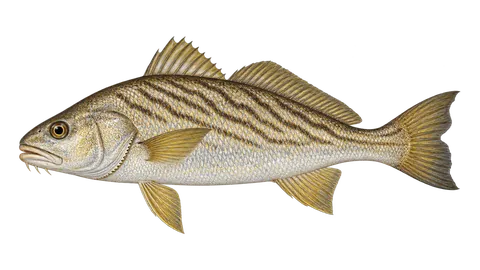
Scientific illustration of Southern kingfish
common size
20–35 cm
maximum
50 cm
common weight
0.1–0.5 kg
record/max.
1.1 kg
depth
0.5–20 m
ideal water
19–27 °C
overview

who is the southern kingfish

The betara, or papa-terra, is the beach fish par excellence. It lives in the surf zone and in the channels of sandy beaches along the whole coast, digging the bottom for tatuí, corruptos, polychaetes and small crustaceans. It moves in small groups and follows the rising water: the first hours of the rising tide and the backwash after a series of waves are the right moments. It is small, 20 to 40 cm, but fights well on beach tackle and forms schools. It is the school of surf casting: it teaches you to read the beach, find gutters and feel the bite. White, delicate meat, one of the best fries on the coast.

fun facts

  • Adults have almost no swim bladder, so they don't 'drum' like the croaker.
  • It eats a lot of tatuí: a beach with tatuí is a betara beach.
how to recognize it

identification

Elongated, rounded body, rounded snout that projects past the mouth, which is underneath, and a single short thick barbel on the chin. Silvery grey to dark, with dark V-shaped oblique bands on the flanks. Tail with a pointed upper lobe and a rounded lower one. Difference from the croaker: only one barbel and a rounded body. The white betara (M. littoralis) is paler and without clear bands.

how southern kingfish fishing looks

Loading the next 7 days…

Each card shows the day's index (0 to 100) and, below it, a strip with the index for each hour, from 0h to 23h. from poor to excellent.

distribution

where found

open on the large map

The whole Brazilian coast on sandy beaches, especially the open-sea beaches of the Southeast and South.

Habitat: Surf zone and channels (gutters) of sandy beaches, inlet mouths and bays with sandy bottoms.

coast

North CoastNortheast CoastSoutheast CoastSouth Coastcoastal

states

Amapá, Pará, Maranhão, Piauí, Ceará, Rio Grande do Norte, Paraíba, Pernambuco, Alagoas, Sergipe, Bahia, Espírito Santo, Rio de Janeiro, São Paulo, Paraná, Santa Catarina, Rio Grande do Sul

calendar and clock

when to fish

best season

time of yearbest: Oct–Apr
JanFebSeaAprMayJunJulAugSepOctNovDec

In the South and Southeast the best season runs from spring to autumn, peaking at the end of summer; in winter it declines but still shows up on calm-sea days. In the Northeast, all year.

best time of day

0h6h12h18h sunrise ~6amsunset ~6pm

Daytime, with peaks at dawn and dusk. Bites by day, with peaks at dawn, at dusk and in the first hours of the rising tide.

weather, water and behavior

what affects the southern kingfish
sensitivity The little bars show how much each factor affects this species. Five full: it feels it a lot.

cold and cold fronts

A cold front cools the shore and drives the betara away for a few days.

atmospheric pressure

Best with stable weather and a moderate sea; after a front, with a rough sea, it's poor.

moon

Small effect; big tides dig the gutters deeper.

rain

Light rain doesn't bother it.

water level

Surf changes the sandbars: after it, look for new gutters.

noise

Not very sensitive; don't wade into the gutter you're going to fish.

wind

Strong onshore wind makes foam and drags the sinker; a land breeze leaves the sea flat and the betara wary.

tide

The rising tide is the betara's tide: the first three hours, with water flowing into the gutters, produce best. On the falling tide, fish the mouths of the return channels. At low-tide slack it disappears from the shore.

depth

Gutters 0.5 to 3 m inside the surf.

technique, gear and bait

how to fish

rod
3.9 to 4.2 m (13 to 14 ft), 60 to 150 g
spinning / baitcasting reel
5000 to 6000 surf reel
line
monofilament 0.28 to 0.33 mm
leader
0.50 mm shock leader; rig of 2 or 3 hooks
hook
maruseigo or chinu no. 1 to 1/0

natural baits

  • tatuí (sand crab)
  • corrupto
  • beach worm (polychaete)
  • shrimp
  • marisco

accessories

  • grapnel sinker 60 to 120 g
  • corrupto pump
  • tatuí sieve
  • rod holder

tip from an angler

Collect tatuí on the same beach where you'll fish. Cast short, into the gutter just past the first break: the betara feeds close to the shore.

what the law says

rules for the southern kingfish

Summary of the regulations we found, with the source for each. Rules change; before keeping or transporting fish, check with the state environmental agency.
Conservation: Not on the national list of threatened species.

Reference federal minimum size (20 cm)

20 cm (TL)ESRJSPPRSCRSSoutheast CoastSouth Coastconfirm with the agency

IN MMA 53/2005 sets 20 cm for the betara (papa-terra) on the coast from ES to RS, but names the white betara (Menticirrhus littoralis) specifically. The black betara (M. americanus) does not appear in the annex: use 20 cm as a reference and confirm with the competent agency.
Source: Instrução Normativa MMA nº 53/2005 (Annex II), MMA

catch and release
catch and release Releasing the fish alive, quickly and with a wet hand. During a closed season it isn't always allowed: what the regulation says applies.

Small fish swallow the hook deep: use a circle hook or a long-shank hook, unhook with pliers and release it in the foam.

in the kitchen

White, delicate meat. Fried whole or as breaded fillets (à milanesa).

calculator

how much it weighs without taking it out of the water

Length-weight relationship W = a·Lb (a = 0.00813, b = 3.07; FishBase (estimativa bayesiana, comprimento total)). It's an average: a fat or lean fish can vary by 10% to 20%.

estimated weight

—

sources and references

The season weights (months), the time of day and the sensitivities (cold, pressure, moon, wind, rain, tide, strong light, murky water and noise) are the app's editorial estimates, based on the literature below and on the field experience of anglers and guides. They are not official data nor a measurement made for this species, and they may vary by region and year. Closed seasons and legal rules appear in the rules section, with the norm and a link.

  1. scientific FishBase — Menticirrhus americanus (ficha da espécie)Names, distribution, biology, length-weight relationship and references. Page checked on October 13, 2026.
  2. official Portaria GM/MMA nº 1.667, de 27 de abril de 2026 — Lista Nacional Oficial de Espécies da Fauna Ameaçadas de Extinção (peixes e invertebrados aquáticos)Most recent national list. The species is not on it (search by scientific name in the text published in the DOU, checked on October 13, 2026).
  3. scientific IUCN Red List — Menticirrhus americanus (avaliação global: Pouco Preocupante, LC, 11/07/2023)Global assessment. Link given on the FishBase entry (Red List, version 2025-2).
  4. scientific Carpenter, K. E. (org.) (2002). The living marine resources of the Western Central Atlantic. Vol. 3: Bony fishes part 2 (Opistognathidae to Molidae). FAO Species Identification Guide for Fishery Purposes. Roma: FAO.Chapter Sciaenidae (Chao, N. L.).
  5. scientific Menezes, N. A.; Buckup, P. A.; Figueiredo, J. L.; Moura, R. L. (orgs.) (2003). Catálogo das espécies de peixes marinhos do Brasil. São Paulo: Museu de Zoologia da USP. 160 p.List of the marine species recorded in Brazil. Printed work; the URL is the bibliographic record in FishBase, which cites the catalogue for the species.
  6. scientific Carvalho-Filho, A. (1999). Peixes: costa brasileira. 3ª ed. São Paulo: Melro. 320 p.Printed work; the URL is the bibliographic record on FishBase, which cites this work for the species.
don't confuse

similar species