Skip to content
catalog Monacanthidae · omnivore

unicorn leatherjacket filefish

Aluterus monoceros

Sea

Sandy-gray filefish, with a convex snout in adults, common in the Atlantic from Brazil to Argentina and sold in Rio de Janeiro markets as peixe-porco. It turns up by chance in bottom fishing; it is not a sport target and there are reports of ciguatera.

Also called: cangulo-comum, peixe-porco, gudunho, pira-aca, unicorn leatherjacket, unicorn filefish

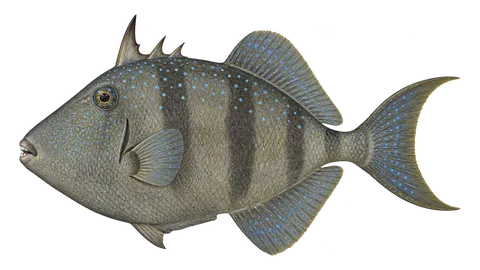
Scientific illustration of Unicorn leatherjacket filefish
common size
25–40 cm
maximum
76 cm
common weight
0.2–0.8 kg
record/max.
2.7 kg
depth
1–80 m
ideal water
22–28 °C
overview

who is the unicorn leatherjacket filefish

The common filefish (unicorn filefish, peixe-porco in Rio de Janeiro) is a circumtropical monacanthid that in the western Atlantic ranges from Massachusetts to Argentina. It lives from 1 to 80 m, near reefs and on slopes, and adults stay alone, in pairs or in small groups, usually within 10 m. Juveniles are pelagic and appear under floating objects, sometimes alongside jellyfish; adults can form schools under floating algae mats in the rainy season and make nests on sand fields beside reefs, in deep water. It eats bottom organisms. It reaches 76 cm and 2.7 kg, with a common length of 40 cm. It is sold in Brazil, and there are reports of ciguatera in the species.

fun facts

  • In a study of 100 fish bought in markets in Niterói and Rio, 16 had Anisakis or Contracaecum larvae (Dias et al., 2010).
  • Forms well-defined pairs and may build nests on sand fields beside reefs, in deep water (FishBase).
  • The epithet monoceros and the English name unicorn recall the spine on the dorsal fin above the eye; in Spanish, "puerco unicornio".
how to recognize it

identification

Oval body, very flattened on the sides, sandy to gray with brown spots on the upper side; soft dorsal and anal fins pale yellow to brown, and the caudal fin membrane dark brown to black. The snout is convex in adults, and the rudimentary pelvic spine disappears in large specimens. The scrawled filefish (Aluterus scriptus) has blue lines and spots and a concave snout. The triggerfish of the genus Balistes (B. capriscus) has three spines on the first dorsal and large plate-like scales.

how unicorn leatherjacket filefish fishing looks

Loading the next 7 days…

Each card shows the day's index (0 to 100) and, below it, a strip with the index for each hour, from 0h to 23h. from poor to excellent.

distribution

where found

open on the large map

Circumtropical; in the western Atlantic, from Massachusetts (USA) to Argentina (FishBase). In Brazil it occurs along the whole coast, near reefs and on coastal hard bottoms and the shelf; it is sold in markets in Rio de Janeiro and Niterói (Dias et al., 2010).

Habitat: From 1 to 80 m, near reefs and on slopes; adults stay alone, in pairs or in small groups, usually within 10 m, and juveniles are pelagic, under floating objects.

coast

North CoastNortheast CoastSoutheast CoastSouth Coastcoastalshelf
calendar and clock

when to fish

best season

time of year
JanFebSeaAprMayJunJulAugSepOctNovDec

Caught all year; it is incidental catch and follows no fishing season. Schools under floating algae appear in the rainy season, according to FishBase.

best time of day

0h6h12h18h sunrise ~6amsunset ~6pm

Daytime. Feeds by day on the bottom and near reefs; bites happen in the sunlight hours, with small bait on the bottom.

weather, water and behavior

what affects the unicorn leatherjacket filefish
sensitivity The little bars show how much each factor affects this species. Five full: it feels it a lot.

cold and cold fronts

Warm-water species: a sharp drop in temperature makes the fish retreat.

atmospheric pressure

Small effect; the problem with the front is the rough sea and dirty water.

moon

Little influence on a species that feeds by day.

rain

Heavy rain and muddy water reduce visibility.

water level

Does not apply at sea. The equivalent is clear water near the reefs.

noise

Moderate sensitivity, like that of shallow reef fish.

wind

Strong wind stirs up sand and reduces visibility; floating algae mats drift with it.

tide

Moderate current helps carry the bait's scent.

depth

Adults usually within 10 m; the species is recorded down to 80 m.

technique, gear and bait

how to fish

rod
6' to 7', medium action, 12 to 20 lb
spinning / baitcasting reel
spinning reel 3000 to 4000
line
braided 15 to 20 lb
leader
fluorocarbon 20 to 30 lb, 1 m
hook
small hook, No. 4 to 1/0 (the mouth is small)

lures

  • rarely used: the fish eats bottom organisms

natural baits

  • shrimp
  • squid pieces
  • pieces of blue crab or crab

accessories

  • long-nose pliers
  • luvas

tip from an angler

The mouth is small: use a small hook and bait cut into small pieces, and be careful with the spines when releasing.

what the law says

rules for the unicorn leatherjacket filefish

Summary of the regulations we found, with the source for each. Rules change; before keeping or transporting fish, check with the state environmental agency.
Conservation: Not on the Brazilian national list (Portaria GM/MMA nº 1.667/2026). The IUCN rates it Least Concern (2014 assessment). Note the name: the 20 cm fork-length minimum size of IN MMA No. 53/2005 applies to the Balistes triggerfish (B. capriscus and B. vetula), not to the common filefish.

Mexico: up to 5 per species and 10 saltwater fish per day

5 specimens of the species per angler per day, within the limit of 10 saltwater fish

In recreational sport fishing in Mexican federal waters, each angler may keep up to 10 marine fish per day, with a maximum of 5 of the same species. The common filefish (lija barbuda) is not among the species reserved for sport fishing (marlins, sailfish, swordfish, dorado, pez gallo and tarpon) and has no limit of its own. Anything over the limit goes back alive into the water, and sport-caught fish are for personal consumption, not for sale. Anglers fishing from a boat need a Conapesca permit.

Source: Amendment to NOM-017-PESC-1994 (recreational sport fishing in federal waters of Mexico), published in the DOF on Nov 25, 2013, items 4.9.1 and 4.9.5 (Sagarpa/Conapesca)

Colombia: AUNAP license and catch and release as the main practice

personal AUNAP license; keep only fish that meets the minimum size, for personal useconfirm with the agency

Colombian sport fishing requires the personal, non-transferable AUNAP license (natural persons, nationals or foreigners). The resolution sets catch and release as the main practice and only allows keeping specimens that meet the minimum sizes, for personal use. We found no specific minimum size or marine quota for this species; confirm with AUNAP before taking any fish home.

Source: Resolución AUNAP nº 0549, of Mar 18, 2022 (sport fishing), arts. 6º and 8º

catch and release
catch and release Releasing the fish alive, quickly and with a wet hand. During a closed season it isn't always allowed: what the regulation says applies.

In shallow fishing, release it quickly with long-nose pliers, without squeezing the flattened body and watching the spines. Avoid keeping large specimens because of the ciguatera risk.

in the kitchen

It is sold in Rio de Janeiro and Niterói markets as peixe-porco. A study of 100 market fish found anisakid larvae in 16 and cestodes in 51, so cook it well and remove the guts promptly. There are reports of ciguatera in the species.

calculator

how much it weighs without taking it out of the water

Length-weight relationship W = a·Lb (a = 0.01905, b = 2.89; FishBase (relação peso-comprimento bayesiana, estimativa da própria espécie)). It's an average: a fat or lean fish can vary by 10% to 20%.

estimated weight

—

sources and references

The season weights (months), the time of day and the sensitivities (cold, pressure, moon, wind, rain, tide, strong light, murky water and noise) are the app's editorial estimates, based on the literature below and on the field experience of anglers and guides. They are not official data nor a measurement made for this species, and they may vary by region and year. Closed seasons and legal rules appear in the rules section, with the norm and a link.

  1. scientific FishBase: Aluterus monoceros (ficha da espécie)Size, length-weight, depth, habitat, distribution, biology, and IUCN status. Page checked on Oct 13, 2026.
  2. scientific FishBase: nomes populares de Aluterus monocerosNames by country and language.
  3. official Portaria GM/MMA nº 1.667, de 27 de abril de 2026: Lista Nacional Oficial de Espécies da Fauna Ameaçadas de Extinção (peixes e invertebrados aquáticos)The species is not on the list. Checked in the DOU of April 28, 2026.
  4. official Portaria MPA nº 532, de 23 de setembro de 2025: nomes científicos e nomes comuns das principais espécies de peixes de interesse comercialAnnex: "Aluterus spp.", names "Cangulo", "Peixe-Porco", "Peroá" and "Porquinho" (checked in the Annex text). The names "common filefish", "gudunho" and "pira-aca" come from FishBase.
  5. scientific Dias, F. J. E.; São Clemente, S. C.; Knoff, M. (2010). Nematoides anisaquídeos e cestoides Trypanorhyncha de importância em saúde pública em Aluterus monoceros no Estado do Rio de Janeiro. Rev. Bras. Parasitol. Vet. 19(2): 94-97.One hundred fish from markets in Niterói and Rio (May to August 2006): anisakid larvae in 16 and cestodes in 51. Page checked Oct 13, 2026.
  6. official NOM-017-PESC-1994 e sua modificação: pesca deportivo-recreativa em águas de jurisdição federal do MéxicoItem 4.9.1: up to 10 marine fish per angler per day, no more than 5 per species. The original text (DOF May 9, 1995) was also read at https://platiica.economia.gob.mx/normalizacion/wp-content/uploads/sites/2/PDF_Normas_Publicas/017-pesc.pdf.
  7. official Resolução AUNAP nº 0549, de 18 de março de 2022: lineamentos para a pesca esportiva e recreativa na ColômbiaSummary of articles 6 (license) and 8 (catch and release, minimum sizes). We did not check the per-species quota and size values, which depend on the full text.
  8. official Instrução Normativa MMA nº 53, de 22 de novembro de 2005: tamanhos mínimos de captura no litoral do ES ao RSThe species is not in Annexes I and II (checked in the consolidated reproduction of the rule), so there is no federal minimum size under that rule. We found no other federal minimum-size rule or specific quota for the species.
don't confuse

similar species