

- common size
- 25–40 cm
- maximum
- 76 cm
- common weight
- 0.2–0.8 kg
- record/max.
- 2.7 kg
- depth
- 1–80 m
- ideal water
- 22–28 °C

the right time
to be on the water
Choose the place and the species. The index, from 0 to 100, combines weather, sun, moon and tide with each fish's habits. Up to 28 days, with each day's confidence.
Loading the forecast…
—
Looking for alerts within 30 km…
Looking for what anglers have logged near here…
what you need to fish herelicense, certification and boat documents
fish likely at this spot
Tap a fish to see its forecast.
hour by hour
slide your finger or mouse over the chart to see each hoursee hour-by-hour table
why this index at —?
choose the day
the fishing month at a glance
what's the best window for the crew?
Choose how many fishing days. We compare each stretch by its average index, discount days with a warning or closed season, and show the 3 best.
trend for the coming weeks
Line: the middle value of 31 simulations of the American GEFS model. Band: where 8 out of 10 fall. Narrow, firm trend; wide, high uncertainty.
everything about the unicorn leatherjacket filefish
how to recognize it
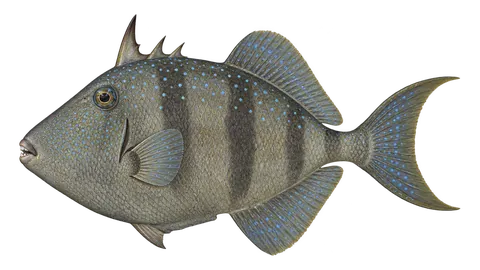
Oval body, very flattened on the sides, sandy to gray with brown spots on the upper side; soft dorsal and anal fins pale yellow to brown, and the caudal fin membrane dark brown to black. The snout is convex in adults, and the rudimentary pelvic spine disappears in large specimens. The scrawled filefish (Aluterus scriptus) has blue lines and spots and a concave snout. The triggerfish of the genus Balistes (B. capriscus) has three spines on the first dorsal and large plate-like scales.
Also called: cangulo-comum, peixe-porco, gudunho, pira-aca, unicorn leatherjacket, unicorn filefish
where found
open on the large mapWhere to look: From 1 to 80 m, near reefs and on slopes; adults stay alone, in pairs or in small groups, usually within 10 m, and juveniles are pelagic, under floating objects.
Circumtropical; in the western Atlantic, from Massachusetts (USA) to Argentina (FishBase). In Brazil it occurs along the whole coast, near reefs and on coastal hard bottoms and the shelf; it is sold in markets in Rio de Janeiro and Niterói (Dias et al., 2010).
coast
when to fish
best season
Caught all year; it is incidental catch and follows no fishing season. Schools under floating algae appear in the rainy season, according to FishBase.
best time of day
Daytime. Feeds by day on the bottom and near reefs; bites happen in the sunlight hours, with small bait on the bottom.
what affects the unicorn leatherjacket filefish
cold and cold fronts
Warm-water species: a sharp drop in temperature makes the fish retreat.
atmospheric pressure
Small effect; the problem with the front is the rough sea and dirty water.
moon
Little influence on a species that feeds by day.
rain
Heavy rain and muddy water reduce visibility.
water level
Does not apply at sea. The equivalent is clear water near the reefs.
noise
Moderate sensitivity, like that of shallow reef fish.
wind
Strong wind stirs up sand and reduces visibility; floating algae mats drift with it.
tide
Moderate current helps carry the bait's scent.
depth
Adults usually within 10 m; the species is recorded down to 80 m.
how to fish
lures
- rarely used: the fish eats bottom organisms
natural baits
- shrimp
- squid pieces
- pieces of blue crab or crab
tip from an angler
The mouth is small: use a small hook and bait cut into small pieces, and be careful with the spines when releasing.
- rod
- 6' to 7', medium action, 12 to 20 lb
- spinning / baitcasting reel
- spinning reel 3000 to 4000
- line
- braided 15 to 20 lb
- leader
- fluorocarbon 20 to 30 lb, 1 m
- hook
- small hook, No. 4 to 1/0 (the mouth is small)
accessories
- long-nose pliers
- luvas
catch and release
In shallow fishing, release it quickly with long-nose pliers, without squeezing the flattened body and watching the spines. Avoid keeping large specimens because of the ciguatera risk.
rules for the unicorn leatherjacket filefish
Rules change; before keeping or transporting fish, check with the state environmental agency.
Mexico: up to 5 per species and 10 saltwater fish per day
5 specimens of the species per angler per day, within the limit of 10 saltwater fish details
In recreational sport fishing in Mexican federal waters, each angler may keep up to 10 marine fish per day, with a maximum of 5 of the same species. The common filefish (lija barbuda) is not among the species reserved for sport fishing (marlins, sailfish, swordfish, dorado, pez gallo and tarpon) and has no limit of its own. Anything over the limit goes back alive into the water, and sport-caught fish are for personal consumption, not for sale. Anglers fishing from a boat need a Conapesca permit.
Colombia: AUNAP license and catch and release as the main practice
personal AUNAP license; keep only fish that meets the minimum size, for personal useconfirm with the agency details
Colombian sport fishing requires the personal, non-transferable AUNAP license (natural persons, nationals or foreigners). The resolution sets catch and release as the main practice and only allows keeping specimens that meet the minimum sizes, for personal use. We found no specific minimum size or marine quota for this species; confirm with AUNAP before taking any fish home.
Source: Resolución AUNAP nº 0549, of Mar 18, 2022 (sport fishing), arts. 6º and 8º
Conservation: Not on the Brazilian national list (Portaria GM/MMA nº 1.667/2026). The IUCN rates it Least Concern (2014 assessment). Note the name: the 20 cm fork-length minimum size of IN MMA No. 53/2005 applies to the Balistes triggerfish (B. capriscus and B. vetula), not to the common filefish.
how much it weighs without taking it out of the water
estimated weight
—
how we calculate
Length-weight relationship W = a·Lb (a = 0.01905, b = 2.89; FishBase (relação peso-comprimento bayesiana, estimativa da própria espécie)). It's an average: a fat or lean fish can vary by 10% to 20%.
more about the unicorn leatherjacket filefish
The common filefish (unicorn filefish, peixe-porco in Rio de Janeiro) is a circumtropical monacanthid that in the western Atlantic ranges from Massachusetts to Argentina. It lives from 1 to 80 m, near reefs and on slopes, and adults stay alone, in pairs or in small groups, usually within 10 m. Juveniles are pelagic and appear under floating objects, sometimes alongside jellyfish; adults can form schools under floating algae mats in the rainy season and make nests on sand fields beside reefs, in deep water. It eats bottom organisms. It reaches 76 cm and 2.7 kg, with a common length of 40 cm. It is sold in Brazil, and there are reports of ciguatera in the species.
Family: Monacanthidae · omnivore
fun facts
- In a study of 100 fish bought in markets in Niterói and Rio, 16 had Anisakis or Contracaecum larvae (Dias et al., 2010).
- Forms well-defined pairs and may build nests on sand fields beside reefs, in deep water (FishBase).
- The epithet monoceros and the English name unicorn recall the spine on the dorsal fin above the eye; in Spanish, "puerco unicornio".
in the kitchen
It is sold in Rio de Janeiro and Niterói markets as peixe-porco. A study of 100 market fish found anisakid larvae in 16 and cestodes in 51, so cook it well and remove the guts promptly. There are reports of ciguatera in the species.
similar species



sources and references (8)
The season weights (months), the time of day and the sensitivities (cold, pressure, moon, wind, rain, tide, strong light, murky water and noise) are the app's editorial estimates, based on the literature below and on the field experience of anglers and guides. They are not official data nor a measurement made for this species, and they may vary by region and year. Closed seasons and legal rules appear in the rules section, with the norm and a link.
- scientific FishBase: Aluterus monoceros (ficha da espécie)Size, length-weight, depth, habitat, distribution, biology, and IUCN status. Page checked on Oct 13, 2026.
- scientific FishBase: nomes populares de Aluterus monocerosNames by country and language.
- official Portaria GM/MMA nº 1.667, de 27 de abril de 2026: Lista Nacional Oficial de Espécies da Fauna Ameaçadas de Extinção (peixes e invertebrados aquáticos)The species is not on the list. Checked in the DOU of April 28, 2026.
- official Portaria MPA nº 532, de 23 de setembro de 2025: nomes científicos e nomes comuns das principais espécies de peixes de interesse comercialAnnex: "Aluterus spp.", names "Cangulo", "Peixe-Porco", "Peroá" and "Porquinho" (checked in the Annex text). The names "common filefish", "gudunho" and "pira-aca" come from FishBase.
- scientific Dias, F. J. E.; São Clemente, S. C.; Knoff, M. (2010). Nematoides anisaquídeos e cestoides Trypanorhyncha de importância em saúde pública em Aluterus monoceros no Estado do Rio de Janeiro. Rev. Bras. Parasitol. Vet. 19(2): 94-97.One hundred fish from markets in Niterói and Rio (May to August 2006): anisakid larvae in 16 and cestodes in 51. Page checked Oct 13, 2026.
- official NOM-017-PESC-1994 e sua modificação: pesca deportivo-recreativa em águas de jurisdição federal do MéxicoItem 4.9.1: up to 10 marine fish per angler per day, no more than 5 per species. The original text (DOF May 9, 1995) was also read at https://platiica.economia.gob.mx/normalizacion/wp-content/uploads/sites/2/PDF_Normas_Publicas/017-pesc.pdf.
- official Resolução AUNAP nº 0549, de 18 de março de 2022: lineamentos para a pesca esportiva e recreativa na ColômbiaSummary of articles 6 (license) and 8 (catch and release, minimum sizes). We did not check the per-species quota and size values, which depend on the full text.
- official Instrução Normativa MMA nº 53, de 22 de novembro de 2005: tamanhos mínimos de captura no litoral do ES ao RSThe species is not in Annexes I and II (checked in the consolidated reproduction of the rule), so there is no federal minimum size under that rule. We found no other federal minimum-size rule or specific quota for the species.
how we calculatewhere each number comes from
The weather comes from three independent global models, cross-checked hour by hour: when they agree, confidence goes up; when they diverge, the band between them shows on the chart. Beyond 16 days, we use the GEFS ensemble of 31 simulations: if 20 of the 31 predict rain, the chance of rain is 65%. Sun and moon are calculated astronomically, with no uncertainty.
The index adds up, weighted for each species: time of day (species curve anchored to real sunrise and sunset), moon (transits, rise and set, phase), pressure (3 h trend and 24 h swing), water temperature (in rivers, estimated from air temperature; at sea, estimated by an ocean model), wind, rain, clouds, tide and the month in the species' cycle.
sources for this lookup
how accurate the forecast is
Accuracy measured in the reference project (4 regions, 93 days, forecast vs. observed): maximum temperature is off by 0.6 °C on average the next day and 1.7 °C at 7 days; rain of 5 mm or more is detected 76% of the time the next day and 57% at 7 days. Detection isn't everything: the false alarm rate isn't published here yet, and 93 days in 4 regions is still a small sample. We now also measure every day, at the app's destinations: