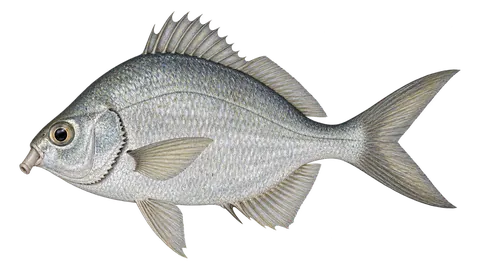
spotfin mojarra
Eucinostomus argenteus
Small silver mojarra from beaches, mangroves and bays. Great for starting out with a cane pole and as an excellent live bait.
Also called: carapicu, carapicu-pena, acarapicu, escrivão

- common size
- 10–16 cm
- maximum
- 21 cm
- common weight
- 0.0–0.1 kg
- record/max.
- 0.1 kg
- depth
- 0.2–12 m
- ideal water
- 23–30 °C
who is the spotfin mojarra
The carapicu is a small mojarra with an elongated, silver body. It lives in schools over sand and mud bottoms in bays, sheltered beaches, mangroves and estuaries, even going into fresh water. It is omnivorous and picks small invertebrates off the bottom with its protractile mouth. Juveniles grow up in lagoons and mangroves. It rarely exceeds 20 cm and has little commercial value, but it is one of the fish children and beginners catch most often at piers and bridges. It is also used as live bait for larger fish, such as snook and red snapper. It occurs on both sides of the Americas: in the Atlantic, from the United States to southeastern Brazil.
fun facts
- It is used as live bait in artisanal fishing for red snappers.
- It also occurs in the Pacific, from California to Peru.
identification
Elongated silver body with a slightly greenish back and a darkened tip on the dorsal fin. Protractile mouth. Differs from the carapeba by its lower, more elongated body, small size and smooth preopercle, without serrations. Several very similar Eucinostomus species share the same name; telling them apart requires looking at details of the snout scales.
Loading the next 7 days…
Each card shows the day's index (0 to 100) and, below it, a strip with the index for each hour, from 0h to 23h. from poor to excellent.
where found
From Amapá to Santa Catarina, in sheltered beaches, bays, mangroves and estuaries.
Habitat: Sheltered beaches, bays, mangroves, estuaries and coastal lagoons with sand or mud bottoms; enters fresh water at river mouths.
coast
states
Amapá, Pará, Maranhão, Piauí, Ceará, Rio Grande do Norte, Paraíba, Pernambuco, Alagoas, Sergipe, Bahia, Espírito Santo, Rio de Janeiro, São Paulo, Paraná, Santa Catarina
when to fish
best season
Can be fished all year in the North and Northeast; in the Southeast and South, best from spring to autumn.
best time of day
Daytime. Active by day, in schools that circle along the edges.
what affects the spotfin mojarra
sensitivity The little bars show how much each factor affects this species. Five full: it feels it a lot.
cold and cold fronts
Disappears from the shallows in cold water.
atmospheric pressure
Not very sensitive.
moon
No significant effect.
rain
Very muddy water drives schools away.
water level
Follows the tide along the edges.
noise
The school flees shadows and noise, but returns soon.
wind
Strong wind gets in the way of light bait.
tide
The flood tide brings schools toward the shore.
depth
Shallows from 0.2 to 3 m.
how to fish
- rod
- cane pole 2 to 4 m or ultralight rod 5'0" to 6'0"
- spinning / baitcasting reel
- spinning reel 500 to 2000
- line
- monofilament 0.14 to 0.20 mm
- leader
- not needed
- hook
- maruseigo 12 to 16 or lambari fishing hook
natural baits
- shrimp in tiny pieces
- sea worm (polychaete)
- fish paste
accessories
- quill or stick float
- aerated bucket for live bait
tip from an angler
For live bait, keep it in a bucket with an aerator and change the water often; the spotfin mojarra dies fast in warm, still water.
rules for the spotfin mojarra
Summary of the regulations we found, with the source for each. Rules change; before keeping or transporting fish, check with the state environmental agency.
Conservation: Not on the national list (Portaria GM/MMA 1.667/2026). We found no specific federal rule for this species.
We found no species-specific rule beyond the region's general rules.
catch and release
catch and release Releasing the fish alive, quickly and with a wet hand. During a closed season it isn't always allowed: what the regulation says applies.
Wet your hand and release it quickly. If you're going to use it as bait, take only what you need.
in the kitchen
Small and bony, but good fried whole and crispy.
how much it weighs without taking it out of the water
Length-weight relationship W = a·Lb (a = 0.01023, b = 3.07; FishBase (estimativa bayesiana, comprimento total)). It's an average: a fat or lean fish can vary by 10% to 20%.
estimated weight
—
sources and references
The season weights (months), the time of day and the sensitivities (cold, pressure, moon, wind, rain, tide, strong light, murky water and noise) are the app's editorial estimates, based on the literature below and on the field experience of anglers and guides. They are not official data nor a measurement made for this species, and they may vary by region and year. Closed seasons and legal rules appear in the rules section, with the norm and a link.
- scientific FishBase — Eucinostomus argenteus (ficha da espécie)Names, distribution, biology, length-weight relationship and references. Page checked on October 13, 2026.
- official Portaria GM/MMA nº 1.667, de 27 de abril de 2026 — Lista Nacional Oficial de Espécies da Fauna Ameaçadas de Extinção (peixes e invertebrados aquáticos)Most recent national list. The species is not on it (search by scientific name in the text published in the DOU, checked on October 13, 2026).
- official ICMBio/SALVE — Ficha de Eucinostomus argenteus (avaliação nacional do risco de extinção)ICMBio national assessment, published in 2025. DOI checked on Crossref.
- scientific IUCN Red List — Eucinostomus argenteus (avaliação global: Pouco Preocupante, LC, 01/03/2010)Global assessment. Link given on the FishBase entry (Red List, version 2025-2).
- scientific Carpenter, K. E. (org.) (2002). The living marine resources of the Western Central Atlantic. Vol. 3: Bony fishes part 2 (Opistognathidae to Molidae). FAO Species Identification Guide for Fishery Purposes. Roma: FAO.Gerreidae chapter (Gilmore Jr., R. G.), cited by FishBase for the species.
- scientific Menezes, N. A.; Buckup, P. A.; Figueiredo, J. L.; Moura, R. L. (orgs.) (2003). Catálogo das espécies de peixes marinhos do Brasil. São Paulo: Museu de Zoologia da USP. 160 p.List of marine species recorded in Brazil. Printed work; the URL is the bibliographic record in FishBase, which cites this work for the species.