

caitipa mojarra
Diapterus rhombeus
Tall silver fish from mangroves and coastal lagoons. Fights well on light tackle and is excellent grilled over coals.
- common size
- 15–25 cm
- maximum
- 42 cm
- common weight
- 0.1–0.3 kg
- record/max.
- 1.0 kg
- depth
- 0.3–15 m
- ideal water
- 23–30 °C
how to recognize it
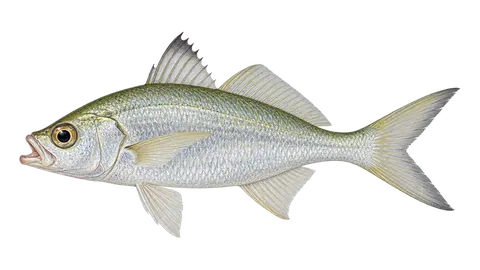
Tall, lozenge-shaped, very compressed and silver body, with no clear spots. Small mouth that projects downward like a tube. Serrated edge of the preopercle and a strong second anal spine. Differs from the spotfin mojarra (carapicu) by its taller body, larger size and serrated preopercle, and from the Brazilian mojarra (carapeba-listrada, Eugerres brasilianus) by lacking dark stripes along the scales.
Also called: carapeba, carapeba-branca, acarapeba, carapeva, peixe-prata
don't confuse with:
where found
open on the large mapWhere to look: Mangroves, coastal lagoons, estuary channels and sheltered beaches with mud or sand bottoms; juveniles in brackish and hypersaline lagoons.
From Amapá to Santa Catarina, in mangroves, coastal lagoons and estuaries; most abundant from the North to the Southeast.
coast
states
Amapá, Pará, Maranhão, Piauí, Ceará, Rio Grande do Norte, Paraíba, Pernambuco, Alagoas, Sergipe, Bahia, Espírito Santo, Rio de Janeiro, São Paulo, Paraná, Santa Catarina
when to fish
next 7 days
Loading the next 7 days…
best season
In the North and Northeast it can be fished all year; in the Southeast and South it's best in the warm months.
best time of day
Daytime, with peaks at dawn and dusk. Feeds during the day, peaking early morning and late afternoon, when schools move in close.
what affects the caitipa mojarra
cold and cold fronts
Cold water scares schools out of the shallows in the South and Southeast.
atmospheric pressure
A cold front shuts down biting.
moon
Small effect.
rain
Heavy rain and very muddy water get in the way.
water level
In the lagoons, the inlet opening changes salinity and redistributes the schools.
noise
The school spooks at noise and shadow; approach slowly.
wind
Strong wind makes fishing with light bait difficult.
tide
The flood tide brings schools to the mangrove edges.
depth
From 0.3 to 3 m in most fishing spots.
how to fish
natural baits
- small shrimp or pieces
- sea worm (polychaete)
- corrupto
- marisco
tip from an angler
Use thin line and small bait. Chum with crushed shrimp shell to hold the school.
- rod
- cane pole or rod 5'0" to 6'6", 4 to 12 lb
- spinning / baitcasting reel
- spinning reel 1000 to 2500
- line
- monofilament 0.18 to 0.25 mm or braided line 8 to 12 lb
- leader
- fluorocarbon 0.25 to 0.30 mm
- hook
- maruseigo 8 to 12 or chinu 1 to 3
accessories
- small float
- light sinker
- landing net
catch and release
Wet your hand before grabbing it, hold it from below and release it quickly. It has loose scales and loses slime easily.
rules for the caitipa mojarra
Rules change; before keeping or transporting fish, check with the state environmental agency.
We found no species-specific rule beyond the region's general rules.
Conservation: Not on the national list (Portaria GM/MMA 1.667/2026). We found no specific federal rule for this species.
how much it weighs without taking it out of the water
estimated weight
—
how we calculate
Length-weight relationship W = a·Lb (a = 0.01202, b = 3.03; FishBase (estimativa bayesiana, comprimento total)). It's an average: a fat or lean fish can vary by 10% to 20%.
more about the caitipa mojarra
The carapeba (caitipa mojarra) is a mojarra with a tall, compressed body, common in mangroves, coastal lagoons and estuaries, and also over shallow mud and sand bottoms in nearshore waters. It lives in schools and eats small invertebrates that it picks off the bottom with its protractile mouth, which projects downward like a tube. Juveniles are abundant in brackish and even hypersaline lagoons. Artisanal fishers catch it with nets and cast nets, and recreational anglers with a cane pole and shrimp bait from piers, bridges and canoes. Despite its modest size, it pulls hard on light tackle. It ranges from the southern Gulf of Mexico and the Antilles to Brazil, where it appears along almost the whole coast.
Family: Gerreidae · omnivore
fun facts
- Its mouth extends like a tube to pick food off the bottom.
- Juveniles tolerate water saltier than the sea, in hypersaline lagoons.
in the kitchen
White, tasty meat; very good grilled over coals, fried whole or escabeche.
similar species
sources and references (6)
The season weights (months), the time of day and the sensitivities (cold, pressure, moon, wind, rain, tide, strong light, murky water and noise) are the app's editorial estimates, based on the literature below and on the field experience of anglers and guides. They are not official data nor a measurement made for this species, and they may vary by region and year. Closed seasons and legal rules appear in the rules section, with the norm and a link.
- scientific FishBase — Diapterus rhombeus (ficha da espécie)Names, distribution, biology, length-weight relationship and references. Page checked on Oct 13, 2026. The maximum weight in this profile was calculated from the length-weight relationship for 42 cm; FishBase only gives the weight of a trawl sample.
- official Portaria GM/MMA nº 1.667, de 27 de abril de 2026 — Lista Nacional Oficial de Espécies da Fauna Ameaçadas de Extinção (peixes e invertebrados aquáticos)Most recent national list. The species is not on it (search by scientific name in the text published in the DOU, checked on October 13, 2026).
- official ICMBio/SALVE — Ficha de Diapterus rhombeus (avaliação nacional do risco de extinção)ICMBio national assessment, published in 2025. DOI checked on Crossref.
- scientific IUCN Red List — Diapterus rhombeus (avaliação global: Pouco Preocupante, LC, 01/03/2010)Global assessment. Link given on the FishBase entry (Red List, version 2025-2).
- scientific Carpenter, K. E. (org.) (2002). The living marine resources of the Western Central Atlantic. Vol. 3: Bony fishes part 2 (Opistognathidae to Molidae). FAO Species Identification Guide for Fishery Purposes. Roma: FAO.Gerreidae chapter (Gilmore Jr., R. G.), cited by FishBase for the species.
- scientific Menezes, N. A.; Buckup, P. A.; Figueiredo, J. L.; Moura, R. L. (orgs.) (2003). Catálogo das espécies de peixes marinhos do Brasil. São Paulo: Museu de Zoologia da USP. 160 p.List of marine species recorded in Brazil. Printed work; the URL is the bibliographic record in FishBase, which cites this work for the species.