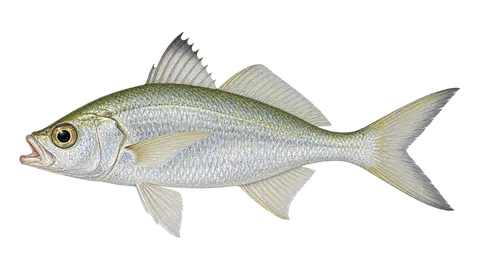
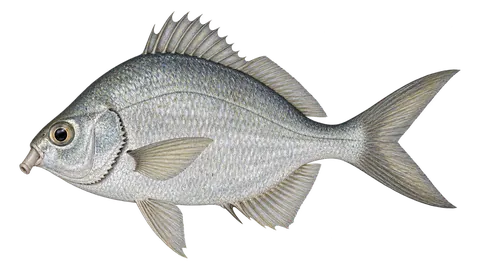
yellow fin mojarra
Gerres cinereus
Silvery, slender fish with light bars and yellow pelvic fins, from sandy beaches, grass beds and mangrove channels. Reaches 41 cm and is light-tackle fishing; there are ciguatera records.
Also called: carapicu-açu, carapeba, yellowfin mojarra

- common size
- 20–30 cm
- maximum
- 41 cm
- common weight
- 0.1–0.4 kg
- record/max.
- 0.5 kg
- depth
- 1–15 m
- ideal water
- 24–30 °C
who is the yellow fin mojarra
The yellowfin mojarra (carapicu-açu) lives in the western Atlantic, from Bermuda, Florida and the Bahamas to the northern Gulf of Mexico, around the Caribbean, in the Antilles and along the South American coast to Rio de Janeiro. It inhabits shallow coastal waters, 1 to 15 m, on open sand and surf zones, grass beds, near reefs and in mangrove channels, and enters brackish and sometimes fresh water. It may form small groups and is easy to approach. It eats worms, molluscs and crustaceans, as well as insects, and is seen pushing its mouth into the sand to stir the bottom. It reaches 41 cm and 530 g, and FishBase gives 30 cm as the common length. It is sold fresh but is low-value, and also goes into fishmeal and bait. FishBase records ciguatera cases.
fun facts
- It pushes its mouth into the sand and blows the sand out through its gills to find worms and crustaceans.
- It enters brackish water and even fresh water.
- FishBase records its occasional use as bait.
identification
Silvery, compressed, slender body, with about seven faint pink bars on the sides and yellow pelvic fins; according to the literature, the dorsal, pelvic and caudal fins are bright yellow or golden, and the tail is deeply forked. The mouth projects slightly downward, and the anal fin has 3 spines and 7 rays. The carapicu (Eucinostomus argenteus) is smaller, and the carapeba (Diapterus rhombeus) has a deeper body.
Loading the next 7 days…
Each card shows the day's index (0 to 100) and, below it, a strip with the index for each hour, from 0h to 23h. from poor to excellent.
where found
In Brazil, FishBase and the literature give it from the North coast to Rio de Janeiro, in shallow waters over sand, grass beds, reefs and mangrove channels, sometimes well inside estuaries. Outside Brazil, it ranges from Bermuda and Florida to the Gulf of Mexico and around the Caribbean.
Habitat: Shallow coastal waters, 1 to 15 m, over open sand, grass beds, reefs and mangrove channels; enters brackish and sometimes fresh water.
coast
when to fish
best season
Warm-water fish, active all year on the tropical coast. The literature cites spawning all year, peaking in August. We found no specific closed season in Brazil.
best time of day
Daytime. Forages by day in small groups, pushing its mouth into the sand to stir the bottom.
what affects the yellow fin mojarra
sensitivity The little bars show how much each factor affects this species. Five full: it feels it a lot.
cold and cold fronts
Warm-water fish; a cold front knocks out activity.
atmospheric pressure
Small effect.
moon
Large tides carry the fish to channels and sand edges.
rain
Heavy rain muddies the water and carries the fish farther from the river mouth.
water level
Not applicable at sea.
noise
Easy to approach, but noise in the water scares the school.
wind
Rough seas and strong surf make beach fishing difficult.
tide
Rising tide brings the school to the sand and grass edges; the falling tide gathers it in the channels.
depth
Shallow, 1 to 15 m.
how to fish
- rod
- 5' to 6', 4 to 10 lb
- spinning / baitcasting reel
- spinning reel 1000 to 2500
- line
- monofilament 0.20 to 0.30 mm or braid 6 to 10 lb
- leader
- fluorocarbon 0.25 to 0.35 mm, 40 to 60 cm
- hook
- small single hook, No. 6 to 10
natural baits
- shrimp pieces
- minhoca
- mussel
accessories
- small sinker
- alicate
- landing net
tip from an angler
Fish on the sand bottom with small pieces of shrimp or worm, with the tide moving; the mouth is small, so use a small hook.
rules for the yellow fin mojarra
Summary of the regulations we found, with the source for each. Rules change; before keeping or transporting fish, check with the state environmental agency.
Conservation: Not on the Brazilian national list (Ministerial Ordinance GM/MMA No. 1.667/2026).
We found no species-specific rule beyond the region's general rules.
catch and release
catch and release Releasing the fish alive, quickly and with a wet hand. During a closed season it isn't always allowed: what the regulation says applies.
Small, delicate fish: wet your hands, use a barbless hook and release quickly, without leaving the fish out of water.
in the kitchen
FishBase says it is sold fresh but is low-value, and also goes into fishmeal. There are reports of ciguatera with this species: follow local health advice before eating reef-caught specimens.
how much it weighs without taking it out of the water
Length-weight relationship W = a·Lb (a = 0.01318, b = 3.04; FishBase (relação peso-comprimento bayesiana, estimativa da própria espécie)). It's an average: a fat or lean fish can vary by 10% to 20%.
estimated weight
—
sources and references
The season weights (months), the time of day and the sensitivities (cold, pressure, moon, wind, rain, tide, strong light, murky water and noise) are the app's editorial estimates, based on the literature below and on field experience from anglers and guides. They are not official data or measurements made for this species and may vary by region and year. Closed seasons and legal rules appear in the rules section, with the rule and link. The common size and weight ranges, water temperature and typical depth are also editorial estimates, anchored in FishBase data.
- scientific FishBase: Gerres cinereus (ficha da espécie)Size, length-weight, depth, habitat, distribution, biology and IUCN status. Page checked Oct 13, 2026. Common size and weight ranges, water temperature and typical depth are editorial estimates based on FishBase data. Profile name: 'carapicu-açu' and 'carapeba' are the Portuguese names FishBase lists for the species.
- scientific FishBase: nomes populares de Gerres cinereusNames by country and language.
- official Portaria GM/MMA nº 1.667, de 27 de abril de 2026: Lista Nacional Oficial de Espécies da Fauna Ameaçadas de Extinção (peixes e invertebrados aquáticos)The species is not on the list. Checked in the DOU of April 28, 2026.
- technical Wikipedia: Yellowfin mojarra (Gerres cinereus)Secondary source, used for the fin bars and colours, the habit of stirring the bottom and the spawning season. The same page covers Pacific populations, which were not used here. Data not checked against a primary source.