Skip to content
catalog Carangidae · predator

white trevally

Pseudocaranx dentex

EstuarySea

Silvery blue runner with a yellow stripe and a dark spot on the gill cover, which travels in schools near the bottom, along rocks and shoals. Good fighter on light gear and highly prized at the table.

Also called: garapoá, white trevally, silver trevally

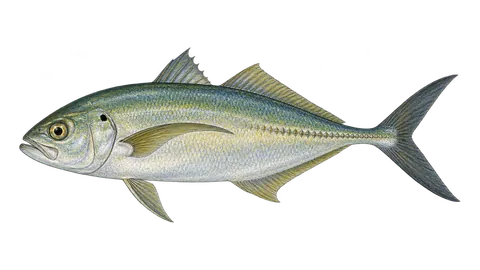
Scientific illustration of White trevally
common size
30–50 cm
maximum
122 cm
common weight
0.3–1.5 kg
record/max.
18.1 kg
depth
10–25 m
ideal water
17–24 °C
overview

who is the white trevally

The garapoá is a spindle-shaped carangid that lives in schools over the shelf, usually near hard bottoms and reefs, but also in bays and estuaries. In the western Atlantic it ranges from North Carolina and Bermuda to southern Brazil; FishBase also extends it to the Mediterranean, the eastern Atlantic islands and the Indo-Pacific, where the taxonomy of the group is debated. Juveniles use estuaries, bays and the shallow shelf; adults form schools near the bottom and also in midwater and at the surface. They eat plankton, which they filter by swimming with their mouths open or suck in, and bottom invertebrates. FishBase gives up to 122 cm and 18.1 kg for the species across its entire range, with the common size around 40 cm. It is a commercial, sport and aquaculture fish in Japan, and ranks among the best table fish.

fun facts

  • Spawns in small batches over several weeks, and the eggs float.
  • FishBase records a maximum age of 49 years for the species, which indicates a long-lived fish.
  • An old account cited by FishBase calls it 'the Saint Helena salmon', for the quality of its flesh.
how to recognize it

identification

Spindle-shaped, slightly flattened body, blue-green on top and silvery white below, with a yellow band along the middle of the flank and a diffuse dark spot on the gill cover. The straight part of the lateral line has a row of scutes (bony scales), and the tail is deeply forked. It looks like the jacks (Caranx); the yellow flank band, the diffuse gill-cover spot and the habit of schooling near the bottom help tell it apart.

how white trevally fishing looks

Loading the next 7 days…

Each card shows the day's index (0 to 100) and, below it, a strip with the index for each hour, from 0h to 23h. from poor to excellent.

distribution

where found

open on the large map

FishBase places the species, in the western Atlantic, from North Carolina and Bermuda to southern Brazil. In Brazil, the app associates it with the Southeast and South coasts, where the water is cooler. FishBase includes Mexico in the species' country list.

Habitat: Schools over hard bottoms, shoals and rocky areas of the shelf, usually at 10 to 25 m; juveniles in estuaries, bays and shallow shelf waters.

coast

Southeast CoastSouth Coastcoastalshelf
calendar and clock

when to fish

best season

time of yearbest: Jun–Aug
JanFebSeaAprMayJunJulAugSepOctNovDec

Prefers cooler water: in the Southeast and South it tends to show up best from autumn to winter, when the water cools. In summer it moves to deeper bottoms.

best time of day

0h6h12h18h sunrise ~6amsunset ~6pm

Daytime, with peaks at dawn and dusk. Active by day, with most movement at dawn and late afternoon.

weather, water and behavior

what affects the white trevally
sensitivity The little bars show how much each factor affects this species. Five full: it feels it a lot.

cold and cold fronts

Tolerates colder water than other blue runners; strong summer heat pushes it deeper.

atmospheric pressure

Not very sensitive.

moon

Small effect; large tides move the bait on the bottom more.

rain

Fresh, muddy runoff water drives the school out of the bays.

water level

Not applicable at sea.

noise

Wary school near the bottom: the engine running overhead makes the fish rise or move off.

wind

Rough seas make it hard to keep the boat over the rock.

tide

With the current running, the school stays at the corner of the rock, feeding on what the water brings.

depth

Usually 10 to 25 m; reaches more than 200 m according to FishBase.

technique, gear and bait

how to fish

rod
6'0" to 7'0", 10 to 20 lb (jigging: 6'0", 15 to 30 lb)
spinning / baitcasting reel
3000 to 5000 reel or small reel with smooth drag
line
braided line 15 to 30 lb
leader
fluorocarbon 25 to 40 lb, 1 to 1.5 m
hook
circle hook 1/0 to 3/0 or jig assist hook

lures

  • metal jig 20 to 80 g
  • micro jig
  • jig head with shad

natural baits

  • sardine strips
  • squid strips
  • shrimp

accessories

  • alicate
  • luva
  • bucket of water for release

tip from an angler

Locate the school on the sounder near the rock and let the bait drop to the bottom; at the first fish, the school usually rises and keeps biting.

what the law says

rules for the white trevally

Summary of the regulations we found, with the source for each. Rules change; before keeping or transporting fish, check with the state environmental agency.
Conservation: Not on the Brazilian national list (Portaria GM/MMA nº 1.667/2026). We found no specific minimum size or federal closed season for the species.

Mexico: up to 5 per species and 10 saltwater fish per day

5 specimens of the species per angler per day, within the limit of 10 saltwater fish

In recreational fishing in Mexican federal waters, each angler may keep up to 10 marine fish per day, no more than 5 of the same species. The garapoá has no limit of its own in the rule. Fish over the limit go back into the water alive, and a retained fish may not be sold. Anyone fishing from a boat needs a permit from Conapesca.
Source: Amendment to NOM-017-PESC-1994 (recreational sport fishing in federal waters of Mexico), DOF Nov 25, 2013, items 4.9.1, 4.9.5 and 4.11 (Sagarpa/Conapesca)

catch and release
catch and release Releasing the fish alive, quickly and with a wet hand. During a closed season it isn't always allowed: what the regulation says applies.

Handles release well if done quickly: wet hands, pliers to remove the hook, and release it head first, facing down. Fish brought up from deep water may arrive with a swollen swim bladder.

in the kitchen

White, firm and highly prized flesh; baked whole, over charcoal or in steaks. FishBase lists it among the best table fish and reports that it is sold fresh and farmed in Japan.

calculator

how much it weighs without taking it out of the water

Length-weight relationship W = a·Lb (a = 0.0138, b = 2.96; FishBase (relação peso-comprimento bayesiana, estimativa da própria espécie)). It's an average: a fat or lean fish can vary by 10% to 20%.

estimated weight

—

sources and references

The season weights (months), the time of day and the sensitivities (cold, pressure, moon, wind, rain, tide, strong light, murky water and noise) are the app's editorial estimates, based on the literature below and on field experience from anglers and guides. They are not official data or measurements made for this species and may vary by region and year. Closed seasons and legal rules appear in the rules section, with the rule and link. Common sizes and weights are ranges around the common length reported by FishBase, with the weight calculated from the length-weight relationship.

  1. scientific FishBase: Pseudocaranx dentex (ficha da espécie)Size, length-weight, depth, habitat, distribution, biology, and IUCN status. Page checked on Oct 13, 2026.
  2. scientific FishBase: nomes populares de Pseudocaranx dentexNames by country and language. The list includes several Portuguese names without indicating the country of each one; the app adopts garapoá, which appears among the Brazilian names in the batch. Xaréu-branco and xaréu-bicudo also appear on the list.
  3. official Portaria GM/MMA nº 1.667, de 27 de abril de 2026: Lista Nacional Oficial de Espécies da Fauna Ameaçadas de Extinção (peixes e invertebrados aquáticos)The species is not on the list. Checked in the DOU of April 28, 2026.
  4. official Instrução Normativa MMA nº 53, de 22 de novembro de 2005: tamanho mínimo de captura de espécies marinhas e estuarinas do litoral Sudeste e SulAnnex II, from ES to RS. Checked Oct 13, 2026: the species is not in Annex II (there is no federal minimum size for it).
  5. official DOF: Modificação da NOM-017-PESC-1994, para regular a pesca deportivo-recreativa em águas de jurisdição federal do México (DOF de 25/11/2013)Daily quotas at sea (item 4.9.1), return of the excess (4.9.5), ban on selling the fish (4.11) and ban on fishing in closed zones and seasons (4.10 a). Text checked Oct 13, 2026.
don't confuse

similar species