

- common size
- 30–50 cm
- maximum
- 122 cm
- common weight
- 0.3–1.5 kg
- record/max.
- 18.1 kg
- depth
- 10–25 m
- ideal water
- 17–24 °C

the right time
to be on the water
Choose the place and the species. The index, from 0 to 100, combines weather, sun, moon and tide with each fish's habits. Up to 28 days, with each day's confidence.
Loading the forecast…
—
Looking for alerts within 30 km…
Looking for what anglers have logged near here…
what you need to fish herelicense, certification and boat documents
fish likely at this spot
Tap a fish to see its forecast.
hour by hour
slide your finger or mouse over the chart to see each hoursee hour-by-hour table
why this index at —?
choose the day
the fishing month at a glance
what's the best window for the crew?
Choose how many fishing days. We compare each stretch by its average index, discount days with a warning or closed season, and show the 3 best.
trend for the coming weeks
Line: the middle value of 31 simulations of the American GEFS model. Band: where 8 out of 10 fall. Narrow, firm trend; wide, high uncertainty.
everything about the white trevally
how to recognize it
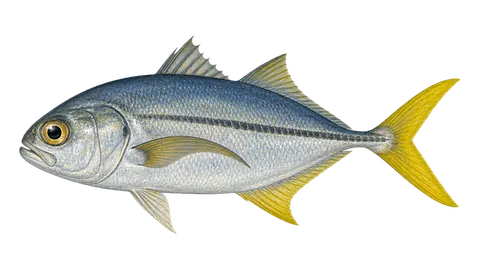
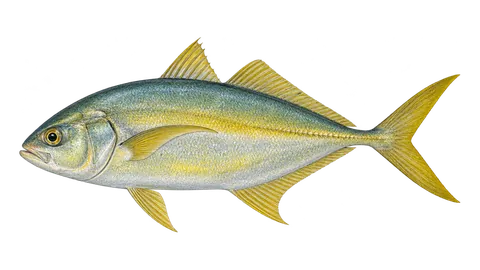
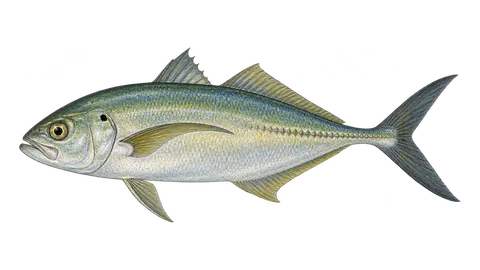
Spindle-shaped, slightly flattened body, blue-green on top and silvery white below, with a yellow band along the middle of the flank and a diffuse dark spot on the gill cover. The straight part of the lateral line has a row of scutes (bony scales), and the tail is deeply forked. It looks like the jacks (Caranx); the yellow flank band, the diffuse gill-cover spot and the habit of schooling near the bottom help tell it apart.
Also called: garapoá, white trevally, silver trevally
don't confuse with:
where found
open on the large mapWhere to look: Schools over hard bottoms, shoals and rocky areas of the shelf, usually at 10 to 25 m; juveniles in estuaries, bays and shallow shelf waters.
FishBase places the species, in the western Atlantic, from North Carolina and Bermuda to southern Brazil. In Brazil, the app associates it with the Southeast and South coasts, where the water is cooler. FishBase includes Mexico in the species' country list.
coast
when to fish
best season
Prefers cooler water: in the Southeast and South it tends to show up best from autumn to winter, when the water cools. In summer it moves to deeper bottoms.
best time of day
Daytime, with peaks at dawn and dusk. Active by day, with most movement at dawn and late afternoon.
what affects the white trevally
cold and cold fronts
Tolerates colder water than other blue runners; strong summer heat pushes it deeper.
atmospheric pressure
Not very sensitive.
moon
Small effect; large tides move the bait on the bottom more.
rain
Fresh, muddy runoff water drives the school out of the bays.
water level
Not applicable at sea.
noise
Wary school near the bottom: the engine running overhead makes the fish rise or move off.
wind
Rough seas make it hard to keep the boat over the rock.
tide
With the current running, the school stays at the corner of the rock, feeding on what the water brings.
depth
Usually 10 to 25 m; reaches more than 200 m according to FishBase.
how to fish
lures
- metal jig 20 to 80 g
- micro jig
- jig head with shad
natural baits
- sardine strips
- squid strips
- shrimp
tip from an angler
Locate the school on the sounder near the rock and let the bait drop to the bottom; at the first fish, the school usually rises and keeps biting.
- rod
- 6'0" to 7'0", 10 to 20 lb (jigging: 6'0", 15 to 30 lb)
- spinning / baitcasting reel
- 3000 to 5000 reel or small reel with smooth drag
- line
- braided line 15 to 30 lb
- leader
- fluorocarbon 25 to 40 lb, 1 to 1.5 m
- hook
- circle hook 1/0 to 3/0 or jig assist hook
accessories
- alicate
- luva
- bucket of water for release
catch and release
Handles release well if done quickly: wet hands, pliers to remove the hook, and release it head first, facing down. Fish brought up from deep water may arrive with a swollen swim bladder.
rules for the white trevally
Rules change; before keeping or transporting fish, check with the state environmental agency.
Mexico: up to 5 per species and 10 saltwater fish per day
5 specimens of the species per angler per day, within the limit of 10 saltwater fish details
In recreational fishing in Mexican federal waters, each angler may keep up to 10 marine fish per day, no more than 5 of the same species. The garapoá has no limit of its own in the rule. Fish over the limit go back into the water alive, and a retained fish may not be sold. Anyone fishing from a boat needs a permit from Conapesca.
Conservation: Not on the Brazilian national list (Portaria GM/MMA nº 1.667/2026). We found no specific minimum size or federal closed season for the species.
how much it weighs without taking it out of the water
estimated weight
—
how we calculate
Length-weight relationship W = a·Lb (a = 0.0138, b = 2.96; FishBase (relação peso-comprimento bayesiana, estimativa da própria espécie)). It's an average: a fat or lean fish can vary by 10% to 20%.
more about the white trevally
The garapoá is a spindle-shaped carangid that lives in schools over the shelf, usually near hard bottoms and reefs, but also in bays and estuaries. In the western Atlantic it ranges from North Carolina and Bermuda to southern Brazil; FishBase also extends it to the Mediterranean, the eastern Atlantic islands and the Indo-Pacific, where the taxonomy of the group is debated. Juveniles use estuaries, bays and the shallow shelf; adults form schools near the bottom and also in midwater and at the surface. They eat plankton, which they filter by swimming with their mouths open or suck in, and bottom invertebrates. FishBase gives up to 122 cm and 18.1 kg for the species across its entire range, with the common size around 40 cm. It is a commercial, sport and aquaculture fish in Japan, and ranks among the best table fish.
Family: Carangidae · predator
fun facts
- Spawns in small batches over several weeks, and the eggs float.
- FishBase records a maximum age of 49 years for the species, which indicates a long-lived fish.
- An old account cited by FishBase calls it 'the Saint Helena salmon', for the quality of its flesh.
in the kitchen
White, firm and highly prized flesh; baked whole, over charcoal or in steaks. FishBase lists it among the best table fish and reports that it is sold fresh and farmed in Japan.
similar species
sources and references (5)
The season weights (months), the time of day and the sensitivities (cold, pressure, moon, wind, rain, tide, strong light, murky water and noise) are the app's editorial estimates, based on the literature below and on field experience from anglers and guides. They are not official data or measurements made for this species and may vary by region and year. Closed seasons and legal rules appear in the rules section, with the rule and link. Common sizes and weights are ranges around the common length reported by FishBase, with the weight calculated from the length-weight relationship.
- scientific FishBase: Pseudocaranx dentex (ficha da espécie)Size, length-weight, depth, habitat, distribution, biology, and IUCN status. Page checked on Oct 13, 2026.
- scientific FishBase: nomes populares de Pseudocaranx dentexNames by country and language. The list includes several Portuguese names without indicating the country of each one; the app adopts garapoá, which appears among the Brazilian names in the batch. Xaréu-branco and xaréu-bicudo also appear on the list.
- official Portaria GM/MMA nº 1.667, de 27 de abril de 2026: Lista Nacional Oficial de Espécies da Fauna Ameaçadas de Extinção (peixes e invertebrados aquáticos)The species is not on the list. Checked in the DOU of April 28, 2026.
- official Instrução Normativa MMA nº 53, de 22 de novembro de 2005: tamanho mínimo de captura de espécies marinhas e estuarinas do litoral Sudeste e SulAnnex II, from ES to RS. Checked Oct 13, 2026: the species is not in Annex II (there is no federal minimum size for it).
- official DOF: Modificação da NOM-017-PESC-1994, para regular a pesca deportivo-recreativa em águas de jurisdição federal do México (DOF de 25/11/2013)Daily quotas at sea (item 4.9.1), return of the excess (4.9.5), ban on selling the fish (4.11) and ban on fishing in closed zones and seasons (4.10 a). Text checked Oct 13, 2026.
how we calculatewhere each number comes from
The weather comes from three independent global models, cross-checked hour by hour: when they agree, confidence goes up; when they diverge, the band between them shows on the chart. Beyond 16 days, we use the GEFS ensemble of 31 simulations: if 20 of the 31 predict rain, the chance of rain is 65%. Sun and moon are calculated astronomically, with no uncertainty.
The index adds up, weighted for each species: time of day (species curve anchored to real sunrise and sunset), moon (transits, rise and set, phase), pressure (3 h trend and 24 h swing), water temperature (in rivers, estimated from air temperature; at sea, estimated by an ocean model), wind, rain, clouds, tide and the month in the species' cycle.
sources for this lookup
how accurate the forecast is
Accuracy measured in the reference project (4 regions, 93 days, forecast vs. observed): maximum temperature is off by 0.6 °C on average the next day and 1.7 °C at 7 days; rain of 5 mm or more is detected 76% of the time the next day and 57% at 7 days. Detection isn't everything: the false alarm rate isn't published here yet, and 93 days in 4 regions is still a small sample. We now also measure every day, at the app's destinations: