The Nassau grouper is Critically Endangered worldwide. It is prohibited in Puerto Rico and has closed seasons and size limits in Belize, the Bahamas and Mexico: learn to recognize it so you can release it.
Also called: garoupa-de-nassau, garoupa-de-trindade, Nassau grouper
The Nassau grouper is the best-known grouper in the Caribbean and was once the most important species in the commercial fishery of the Antilles. It lives on coral and rock reefs, from the shoreline to about 90 m, almost always near hiding places; juveniles stay in seagrass beds. It eats fish and crabs. On a few winter nights of the Northern Hemisphere, tied to the moon, it travels to fixed spawning sites, where up to 30,000 fish have gathered. Fishing on these aggregations collapsed populations, and many disappeared. The IUCN rates it Critically Endangered, the US prohibits all catch, including in Puerto Rico, and several Caribbean countries close fishing during spawning. In Brazil its presence is not confirmed. If you hook one, release it quickly and carefully.
fun facts
It is considered the tamest and most curious of the groupers, which left it exposed to fishing.
Up to 30,000 fish have gathered at a single spot in spawning aggregations.
how to recognize it
identification
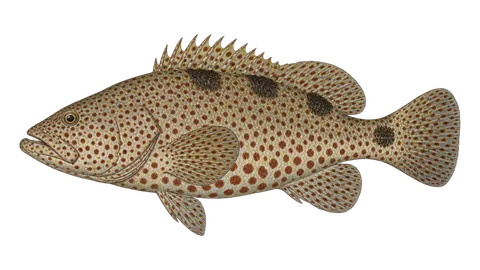
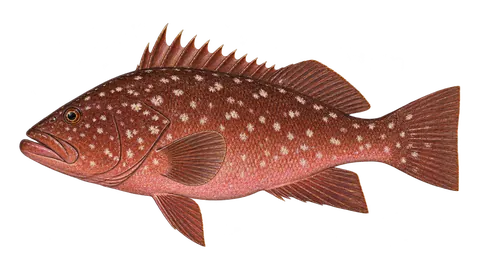
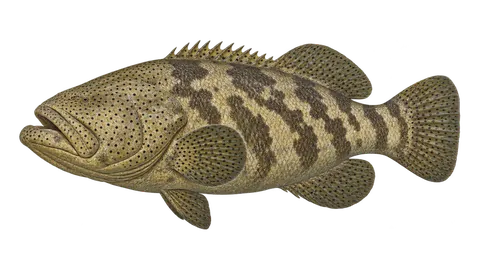
Background color beige to gray, with five dark vertical bars; the third and fourth branch and form a W on the flank. A large black saddle mark at the top of the tail peduncle, black spots below and behind the eye, and a dark tuning-fork-shaped band on top of the head. It changes color within minutes. The rock hind (garoupa-gato) has red spots; the red grouper (garoupa-são-tomé) is reddish and lacks the saddle on the peduncle.
how nassau grouper fishing looks
Loading the next 7 days…
Each card shows the day's index (0 to 100) and, below it, a strip with the index for each hour, from 0h to 23h. from poor to excellent.
Bermuda, Florida, the Bahamas, the Yucatán Peninsula and the whole Caribbean; in the Gulf of Mexico, only on the Campeche Bank, the Dry Tortugas and Key West. FishBase lists Brazil based on the FAO catalog, but we found no confirmed recent record or national ICMBio assessment: treat the species as absent or extremely rare on the Brazilian coast.
Habitat: Coral and rock reefs with hiding places, from the shore to about 90 m; juveniles in seagrass beds.
calendar and clock
when to fish
best season
time of year
JanFebSeaAprMayJunJulAugSepOctNovDec
Not a fish to target. Caribbean closed seasons cover the spawning period, from December to March depending on the country.
best time of day
Daytime. Mainly active by day, near its hiding places.
weather, water and behavior
what affects the nassau grouper
sensitivity The little bars show how much each factor affects this species. Five full: it feels it a lot.
cold and cold fronts
A tropical reef fish; cold water reduces its activity.
atmospheric pressure
Little direct effect.
moon
Spawning aggregations occur on moon-linked nights in the Northern Hemisphere winter; this is the most protected period.
rain
Little effect.
water level
Not applicable at sea.
noise
It is the least wary of the groupers, which left it exposed to fishing.
the bottom-fishing rod you are using; it is not a target species
spinning / baitcasting reel
any reel, with a drag that lets you bring the fish up quickly
line
braided line 40 to 65 lb (a short fight helps release)
leader
fluorocarbon 60 to 80 lb
hook
barbless circle hook, which catches at the corner of the mouth
accessories
descender (fish descender)
long-nose pliers
wet towel
tip from an angler
Fishing on a Caribbean reef: if you hook a Nassau grouper, don't keep it on board. Remove the hook with the fish in the water, or release it with a descender.
what the law says
rules for the nassau grouper
Summary of the regulations we found, with the source for each. Rules change; before keeping or transporting fish, check with the state environmental agency. Conservation: Critically Endangered (CR) in the global assessment. In the US, including Puerto Rico, it is listed as threatened under the Endangered Species Act, and all catch is prohibited. We found no confirmed record or national assessment in Brazil.
Puerto Rico: fishing prohibited
fishing, possession and sale prohibited
In Puerto Rico it is prohibited to fish for, possess, sell or offer for sale the Nassau grouper (cherna criolla), which must go back to the sea, alive or dead. In federal waters around the island, beyond 9 miles, fishing and possession are also prohibited, and a hooked fish must be released immediately with minimal harm.
catch and sale prohibited Dec 1 to Feb 2801/12 to 28/02confirm with the agency
In the Bahamas, from December 1 to February 28, no one may catch, land, process, sell or offer for sale Nassau grouper, except with written authorization for research. Groupers landed during the period must have their head, tail and skin intact. The closed season was set in law in 2015. The text of the regulation was not checked: the rules come from official notices and news reports. Confirm with the Department of Marine Resources.
Mexico: grouper closed season from Feb 1 to Mar 31
catch prohibited from Feb 1 to Mar 3101/02 to 31/03
In Mexico, catching all grouper species, a group in which the official standard includes the Nassau grouper (cherna criolla), is prohibited from February 1 to March 31 in federal waters of the Gulf of Mexico and the Caribbean off Tabasco, Campeche, Yucatán and Quintana Roo, up to the Belize border. Bottom longlines are also prohibited during the period.
catch and release Releasing the fish alive, quickly and with a wet hand. During a closed season it isn't always allowed: what the regulation says applies.
If you hook one, keep the fish in the water, remove the hook with pliers and release it. If it came up from depth with barotrauma, use a descender. No long photos out of the water.
in the kitchen
It should not be eaten: catch is prohibited or limited over much of its range.
calculator
how much it weighs without taking it out of the water
Length-weight relationship W = a·Lb (a = 0.01148, b = 3.05; FishBase (estimativa bayesiana, comprimento total)). It's an average: a fat or lean fish can vary by 10% to 20%.
estimated weight
—
sources and references
The season weights (months), the time of day and the sensitivities (cold, pressure, moon, wind, rain, tide, strong light, murky water and noise) are the app's editorial estimates, based on the literature below and on the field experience of anglers and guides. They are not official data nor a measurement made for this species, and they may vary by region and year. Closed seasons and legal rules appear in the rules section, with the norm and a link.
scientificFishBase — Epinephelus striatus (ficha da espécie)Names, distribution, biology, length-weight relationship, country list and references. Page checked October 13, 2026. The country list includes Brazil based on Heemstra and Randall (1993); since we found no recent Brazilian record, the profile does not mark Brazil.
officialBelize Fisheries Department — Fisheries RegulationsNassau grouper: prohibited to catch, buy, sell or possess fish under 20 inches or over 30 inches; closed season Dec 1 to Mar 31. Checked October 13, 2026.