

french grunt
Haemulon flavolineatum
A yellow grunt that forms large schools over coral reefs and rocks. It has commercial use and is sold fresh, but it requires care because of ciguatera.
- maximum
- 30 cm
- depth
- 0–60 m
how to recognize it
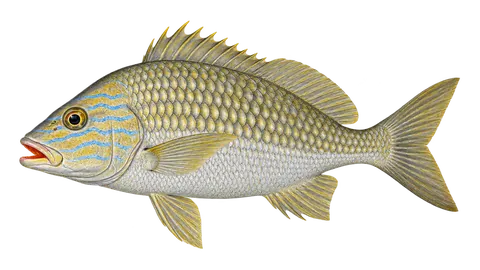
Yellow over most of the body, paler on the belly, with a short, deep body. The easiest sign is the scales: those below the lateral line are large and set in oblique rows, much larger than those above. No other grunt in the region has enlarged scales below the lateral line, which separates this species from the rest.
Also called: goibi, biquara, cambuba, ronco condenado, french grunt
don't confuse with:
where found
open on the large mapWhere to look: Rocky and coral reefs, in schools, 0 to 60 m deep.
Western Atlantic, from Bermuda and South Carolina to Brazil, throughout the Caribbean and along the coast of Central America. In Brazil it is rarely recorded, especially along the Northeast coast.
coast
how to fish
natural baits
- shrimp in tiny pieces
- minhoca-de-mar
- mussel
tip from an angler
Travels in large schools over stony and coral reefs, often under ledges and overhangs; juveniles stay in seagrass near the beach. Eats small crustaceans: small bait and small hook on the bottom, next to the reef.
- rod
- light rod of 1.8 to 2.4 m
- spinning / baitcasting reel
- spinning reel 1000 to 2000
- line
- monofilament 0.25 mm
- leader
- fluorocarbon 0.30 mm, 40 to 60 cm
- hook
- size 8 to 4
catch and release
No dangerous spines. The concern is ciguatera: there are reports of poisoning from this species, so avoid eating specimens from reefs of doubtful origin.
rules for the french grunt
Rules change; before keeping or transporting fish, check with the state environmental agency.
We found no species-specific rule beyond the region's general rules.
Conservation: Not on the Brazilian national list (Ministerial Ordinance GM/MMA No. 1.667/2026).
how much it weighs without taking it out of the water
estimated weight
—
how we calculate
Length-weight relationship W = a·Lb (a = 0.01349, b = 3.0; FishBase (relação peso-comprimento bayesiana, estimativa da própria espécie)). It's an average: a fat or lean fish can vary by 10% to 20%.
more about the french grunt
A fish of the family Haemulidae, reaching 30 cm. It occurs in the western Atlantic, from Bermuda, South Carolina and the northern Gulf of Mexico to Brazil, throughout the Caribbean and along the coast of Central America. It lives in large schools over rocky and coral reefs, often under overhangs or near branching corals, from 0 to 60 m deep. Juveniles are abundant in shallow seagrass near the shore. It feeds mainly on small crustaceans. In fishing it has commercial use, is sold fresh and serves as bait, with the caveat of ciguatera.
Family: Haemulidae · predator
in the kitchen
It is sold fresh in markets, but there are reports of ciguatera with this species, so avoid eating reef fish of doubtful origin.
similar species

sources and references (4)
Essential profile: size, weight-length, depth, countries and conservation come from FishBase and the cited regulations, and the texts were written from those sources. Technique, baits and hook were estimated from the diet described in FishBase and the size of the species. Season, time of day and sensitivities are not included yet, because we did not find a good source for this species.
- scientific FishBase: Haemulon flavolineatum (ficha da espécie)Size, length-weight, depth, habitat, distribution, biology, and IUCN status. Page checked on Oct 13, 2026.
- scientific FishBase: nomes populares de Haemulon flavolineatumNames by country and language.
- official Portaria GM/MMA nº 1.667, de 27 de abril de 2026: Lista Nacional Oficial de Espécies da Fauna Ameaçadas de Extinção (peixes e invertebrados aquáticos)The species is not on the list. Checked in the DOU of April 28, 2026.
- scientific FishBase: Haemulon flavolineatumHabitat and diet (small crustaceans) from FishBase; bait and hook estimated by size (common 17 cm, up to 30 cm); no fishing source with a hook was found.