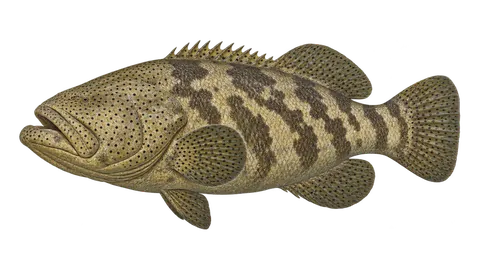
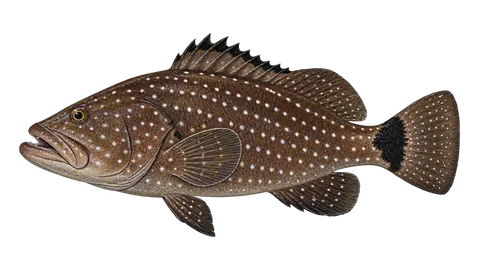
Giant deep-water grouper reaching 230 cm and 198 kg. Endangered in Brazil, where catching it is banned; in Mexico, grouper fishing closes from February to March.
The mero-negro (Warsaw grouper) lives in the western Atlantic, from Massachusetts to the Gulf of Mexico and the Caribbean, and reaches Rio de Janeiro and São Paulo. It sits on rocky bottoms from 55 to 525 m, and juveniles sometimes appear on jetties and shallow reefs. It is solitary and eats crabs, shrimp, lobsters and fish. It reaches 230 cm and 198 kg and can live more than 90 years (91 is the longest recorded age). FishBase considers it rare in the Antilles (Cuba, Haiti and Trinidad). The IUCN lists it as Near Threatened, but in Brazil it is on the national list as Endangered and catching it is banned. In Mexico, where it is called mero negro (or fiat), it appears in the NOM for groupers of the Gulf and Caribbean.
fun facts
The maximum age recorded by FishBase is 91 years.
The eastern Pacific records attributed to the species appear to be misidentifications of Hyporthodus exsul.
Juveniles sometimes appear on jetties and shallow reefs, far from the adults' habitat.
how to recognize it
identification
Robust body, dark reddish-brown or greyish-brown to nearly black on the back, and dull reddish-grey below. Large head, with a clearly convex forehead and the mouth (maxilla) reaching well past the eye. It has only 10 dorsal spines, one fewer than most groupers, and the rear edge of the preopercle is angular and rounded, with 1 or 2 small spines on the lower edge. The mero (goliath grouper, Epinephelus itajara), also giant, is mottled dark and has small eyes. The yellowedge grouper has yellow fin edges.
how warsaw grouper fishing looks
Loading the next 7 days…
Each card shows the day's index (0 to 100) and, below it, a strip with the index for each hour, from 0h to 23h. from poor to excellent.
In Brazil, FishBase cites Rio de Janeiro and São Paulo, on rocky bottoms of the outer shelf and slope. Outside Brazil, it ranges from Massachusetts to the Gulf of Mexico and the Caribbean, where it is rare in Cuba, Haiti and Trinidad.
Habitat: Rocky bottoms from 55 to 525 m; juveniles sometimes on jetties and shallow reefs.
coast
Southeast Coastshelfoceanic
states
Rio de Janeiro, São Paulo
calendar and clock
when to fish
best season
time of year
JanFebSeaAprMayJunJulAugSepOctNovDec
Living deep, it hardly feels the seasons. It may not be fished in Brazil, and in Mexico grouper fishing closes from February to March.
best time of day
Any time. On bottoms of 55 to 525 m daylight matters little; current and sea state matter more.
weather, water and behavior
what affects the warsaw grouper
sensitivity The little bars show how much each factor affects this species. Five full: it feels it a lot.
cold and cold fronts
It lives in deep, cold, stable water; a cold front only bothers it through rough seas.
atmospheric pressure
A cold front brings choppy seas and makes it hard to hold station over the spot.
moon
Small effect.
rain
No effect at depth.
water level
Not applicable at sea.
noise
Not very sensitive to noise at that depth.
wind
Strong wind and fast drift keep the bait from staying on the bottom.
tide
Strong current drags the line; with moderate current the fish stays near the bottom.
heavy deep-water bottom fishing tackle; the species cannot be the target in Brazil
spinning / baitcasting reel
electric reel
line
braided line 80 to 130 lb
leader
heavy monofilament
hook
barbless circle hook, which makes release easier
accessories
descender (descender) with weight
long-nose pliers
luvas
tip from an angler
If a very heavy, dark fish comes up from the rocky bottom, it may be a mero-negro: do not bring it onto the deck, use a descender and return it to the bottom.
what the law says
rules for the warsaw grouper
Summary of the regulations we found, with the source for each. Rules change; before keeping or transporting fish, check with the state environmental agency. Conservation: On the national list of threatened species as EN. Global IUCN assessment: NT.
Threatened species in Brazil: catch banned
full protection
The national list (Portaria GM/MMA nº 1.667/2026) classifies the species as EN. Under Portaria GM/MMA nº 1.666/2026 (art. 3), species listed as VU, EN and CR have full protection: capture, transport, storage, processing and sale are banned. If you hook one by accident, release it right away, with minimal handling.
Mexico: grouper closed season from Feb 1 to Mar 31
catch prohibited from Feb 1 to Mar 3101/02 to 31/03
In Mexico, catching all grouper species, a group in which NOM-065 includes the mero-negro (mero negro or fiat), is banned from February 1 to March 31 in federal waters of the Gulf of Mexico off Tabasco, Campeche, Yucatán and Quintana Roo, up to the border with Belize. During the period, bottom longlines are also banned. The agreement does not mention recreational fishing: check with Conapesca whether it applies to your type of fishing.
Mexico: up to 3 kg of grouper per angler per day (household consumption)
3 kg per angler per day
In federal waters of the Gulf of Mexico and the Caribbean, NOM-065 allows, for domestic-consumption fishing, at most 3 kg per angler per day of any grouper or associated species, such as the mero-negro. The fish is for the angler's and family's consumption only, cannot be sold, and only equipment that one person can operate alone is allowed. Recreational fishing has its own rule (NOM-017-PESC-1994), which we did not check.
Puerto Rico (federal waters): up to 5 per person per day
5 per person per day; 15 per boat with 3 or more people
In federal waters around Puerto Rico, beyond 9 miles from the coast, the recreational angler may keep a maximum of 5 fish per day from groupers, snappers and parrotfish combined (up to 15 per boat when there are 3 or more people aboard). The limit does not apply to anyone with a commercial license from Puerto Rico or the U.S. Virgin Islands.
catch and release Releasing the fish alive, quickly and with a wet hand. During a closed season it isn't always allowed: what the regulation says applies.
Catch prohibited in Brazil: always release it right away. A fish this large and from deep water suffers greatly out of the water: keep the body horizontal and supported, do not lift it by the mouth alone, and if it arrives with barotrauma (stomach everted, eyes bulging), use a descender.
in the kitchen
FishBase says it is sold fresh. In Brazil, catching, transporting and selling it are banned.
calculator
how much it weighs without taking it out of the water
Length-weight relationship W = a·Lb (a = 0.01288, b = 3.05; FishBase (relação peso-comprimento bayesiana, estimativa da própria espécie)). It's an average: a fat or lean fish can vary by 10% to 20%.
estimated weight
—
sources and references
The season weights (months), the time of day and the sensitivities (cold, pressure, moon, wind, rain, tide, strong light, murky water and noise) are the app's editorial estimates, based on the literature below and on field experience from anglers and guides. They are not official data or measurements made for this species and may vary by region and year. Closed seasons and legal rules appear in the rules section, with the rule and link. The common size and weight ranges, water temperature and typical depth are also editorial estimates, anchored in FishBase data.
scientificFishBase: Hyporthodus nigritus (ficha da espécie)Size, length-weight, depth, habitat, distribution, biology and IUCN status. Page checked on October 13, 2026. Common size and weight ranges, water temperature and typical depth: editorial estimates anchored in FishBase data. Entry name: 'mero-negro' is one of the Brazilian Portuguese names FishBase lists; 'garoupa' and 'mero' are used loosely for several species.