Deep-water grouper of the Southeast and South. Vulnerable species: only fish 45 cm and up may be kept, and the fleet has a closed season in September and October.
Also called: cherne-verdadeiro, cherne, cherne-pintado, serigado-cherne, chernote
The snowy grouper is an epinephelid of the grouper family, from deep waters: it lives on rocky bottoms of the outer shelf and slope, usually 100 to 200 m, from the North American Atlantic coast to southern Brazil. Juveniles can occur closer to shore. It eats fish, snails, squid, and crabs. It grows slowly and can live nearly 30 years, which makes it vulnerable to bottom line and longline fishing. It is on the national list as Vulnerable and has a recovery plan: Portaria Interministerial 40/2018 allows catching and keeping only fish 45 cm and up, and created a closed season for the fleet from Sep 1 to Oct 31 between 100 and 600 m in the Southeast and South. Below the size limit, release it. Because of its depth, it suffers badly from barotrauma.
fun facts
Can live nearly 30 years.
The white spots that give it the English name (snowy grouper) disappear in large adults.
how to recognize it
identification
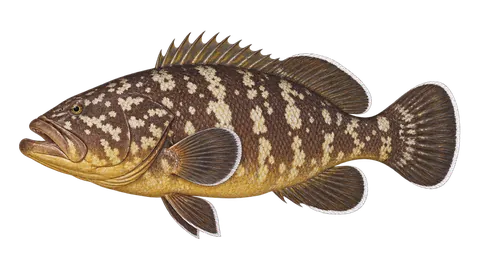
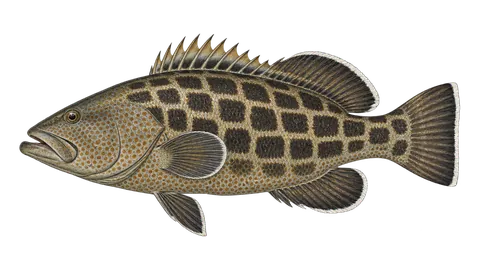
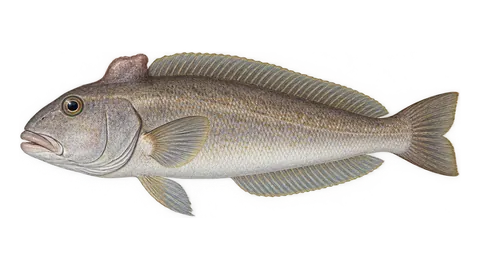
Robust grouper, dark brown to grayish brown, covered with white spots in rows that disappear in large adults. Black saddle mark on the tail base that extends below the lateral line, and a dark edge on the spiny dorsal fin. Juveniles have pale yellow caudal and pectoral fins. Differs from the true grouper and the badejo-quadrado by the black saddle on the tail base and the white spots.
how snowy grouper fishing looks
Loading the next 7 days…
Each card shows the day's index (0 to 100) and, below it, a strip with the index for each hour, from 0h to 23h. from poor to excellent.
Measure before you decide: below 45 cm, release it with a descending device.
what the law says
rules for the snowy grouper
Summary of the regulations we found, with the source for each. Rules change; before keeping or transporting fish, check with the state environmental agency. Conservation: Recovery plan (Portaria MMA 227/2018) with rules in PI SG-PR/MMA 40/2018, under review by Portaria 1.666/2026 (art. 11). Global assessment: VU (IUCN).
Catch and retention only from 45 cm
45 cm (TL)North CoastNortheast CoastSoutheast CoastSouth Coast
Catch, retention, transport, and sale are allowed only for specimens with a total length of 45 cm or more. Outside the limits of the ordinance, directed fishing is prohibited, and fish caught by chance must be released alive or discarded on the spot, with a record.
Fleet closed season Sep 1 to Oct 31 (100 to 600 m, Southeast and South)
fishing between 100 and 600 m depth prohibited for the listed fishing modes01/09 to 31/10Southeast CoastSouth Coast
From September 1 to October 31, fishing between 100 and 600 m depth is prohibited on the Southeast and South coast for the fishing modes listed in the ordinance (INI MPA/MMA 10/2011). On-board retention and landing of snowy grouper are tolerated only until September 5.
The species remains Vulnerable on the 2026 list. Its use depends on the recovery plan (Portaria MMA 227/2018) and the rules of PI 40/2018. Portaria GM/MMA 1.666/2026 ordered a review of the plans for species already on the list, and the earlier rules remain in force during the review. Confirm before keeping any fish.
catch and release Releasing the fish alive, quickly and with a wet hand. During a closed season it isn't always allowed: what the regulation says applies.
It almost always comes up with barotrauma (stomach everted, bulging eyes). To release it, use a descending device to take the fish back to the bottom; puncturing the swim bladder without the right technique kills it.
in the kitchen
White, firm, highly prized flesh. May only be kept from 45 cm.
calculator
how much it weighs without taking it out of the water
Length-weight relationship W = a·Lb (a = 0.01549, b = 3.04; FishBase (estimativa bayesiana, comprimento total)). It's an average: a fat or lean fish can vary by 10% to 20%.
estimated weight
—
sources and references
The season weights (months), the time of day and the sensitivities (cold, pressure, moon, wind, rain, tide, strong light, murky water and noise) are the app's editorial estimates, based on the literature below and on the field experience of anglers and guides. They are not official data nor a measurement made for this species, and they may vary by region and year. Closed seasons and legal rules appear in the rules section, with the norm and a link.