Southern red snapper closed season
15/12 to 30/04
Fishing for southern red snapper is banned from December 15 to April 30 every year. The authorized fleet may leave port from 00:00 on May 1.
Lutjanus purpureus
A deep-water red fish from the North and Northeast, the basis of a traditional commercial fishery. Listed as Endangered: in recreational fishing, release it.
Also called: pargo, pargo-vermelho, southern red snapper

The southern red snapper is a demersal lutjanid that lives on the outer shelf and upper slope, between 30 and 200 m, over gravel, rock and reefs. It forms aggregations on the banks of the Amazon shelf and the Northeast, and supports a traditional commercial fishery using pargueira (vertical longline) and traps, concentrated in Pará. It grows slowly and takes years to reproduce, which helps explain the decline of the fishery in Ceará and the shift of the fleet to the north. In 2026 it was reclassified as Endangered on the Brazilian national list. The fishery is strictly regulated, with a closed season, minimum size and catch limit, and the current rules do not provide for recreational fishing.
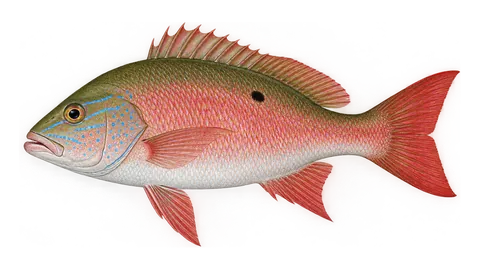
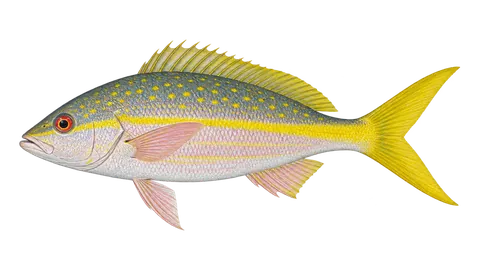
Tall body, long triangular snout, all red to pink, darker on the back and silvery pink on the belly. Adults have no black spot. Long pectoral fins reaching the anus; red eye. The cubera snapper (cioba) has a greenish back, a black spot and blue lines below the eye. The yellowtail snapper (guaiúba) has a yellow stripe down to its deeply forked tail. In the South and Southeast, pargo also refers to the red porgy (Pagrus pagrus), a different family with blue spots.
Loading the next 7 days…
Each card shows the day's index (0 to 100) and, below it, a strip with the index for each hour, from 0h to 23h. from poor to excellent.
Outer shelf and slope from Amapá to the Northeast. Today commercial fishing is concentrated between Amapá and the border of Maranhão with Piauí, from 50 m of depth, with Pará providing most of the production. In Ceará and Rio Grande do Norte it was heavily fished in past decades.
Habitat: Gravel, rock, sponge and reef bottoms of the outer shelf and upper slope, from 30 to 200 m.
coast
states
Amapá, Pará, Maranhão, Piauí, Ceará, Rio Grande do Norte, Paraíba, Pernambuco, Alagoas, Sergipe, Bahia
Biologically it can be caught all year, but fishing is banned from December 15 to April 30. The legal season for the authorized fleet runs from May 1 until the quota runs out or until mid-December.
Any time. Feeds day and night on the bottom. Commercial longline fishing works both shifts; current and drift matter more than the time of day.
Lives in stable water on the bottom; surface cold has little effect.
Little direct effect; rough seas make anchoring and drifting harder.
Spring tides bring strong current, which makes it hard to keep the bait on the bottom.
Little effect. Thunderstorm with lightning: head back.
Not applicable at sea. The equivalent is the color and clarity of the water: look for blue, clean water and current lines.
At 50 to 150 m, boat noise matters little.
Strong wind throws off the drift and makes it hard to keep the line vertical.
Moderate current helps; strong current requires very heavy sinkers.
From 30 to 200 m. The commercial zone starts at the 50 m isobath.
lures
natural baits
accessories
A snapper brought up from 50 to 150 m suffers barotrauma. If you hook one while fishing recreationally, release it with a descender, which takes the fish back to the bottom.
Vertical fishing with metal jigs over reefs, wrecks and the shelf edge, from 30 to 150 m deep.
guideHow to read down imaging, side imaging and live sonar to find structure, confirm fish and get back to the right spot.
guideReleasing only counts if the fish survives. Right gear, little time out of water, proper handling, the right hook, care with barotrauma and revival against the current.
Summary of the regulations we found, with the source for each. Rules change; before keeping or transporting fish, check with the state environmental agency.
Conservation: Listed as VU since 2014 (Portarias MMA 445/2014 and 148/2022). Use is allowed only under the terms of the Recovery Plan (Portaria GM/MMA 1.742/2026) and of Interministerial Portaria MPA/MMA 66/2026.
Fishing for southern red snapper is banned from December 15 to April 30 every year. The authorized fleet may leave port from 00:00 on May 1.
Capture, transport, storage, processing and trade of southern red snapper with fork length (from the tip of the snout to the fork of the tail) under 35 cm are prohibited.
Catch is permitted only to authorized vessels under categories 1.8, 1.9 and 1.10 (pargueira and traps), between Amapá and the MA/PI border, with an annual limit of 2,750 t and a fleet of up to 150 boats. Others must return the snapper to the sea. The rule does not provide for recreational fishing, and the species is EN, with use allowed only under the terms of the recovery plan. In practice: if you catch it, release it. Confirm with the MPA.
From February 16 to April 30, transport, processing, industrialization and trade of any quantity of southern red snapper are prohibited. Between the start of the closed season and February 15, only with a Stock Declaration.
Snapper closed season from Amapá to the MA/PI border, beyond the 50 m isobath. Transport and sale of any volume are prohibited from Feb 16 to Apr 30. Catching is allowed only for authorized vessels (modalities 1.8 to 1.10); the portaria does not provide for recreational fishing (see "prohibitions"). Portaria MPA 755/2026 closed the 2026 snapper fishing season on Sep 19, 2026.
Source: Portaria Interministerial MPA/MMA nº 66/2026 (DOU Jul 27, 2026), which repealed PI 42/2018
Snapper (Lutjanus purpureus, southern red snapper) moved to EN on the 2026 list. PI MPA/MMA 66/2026 allows catching only by authorized vessels in modalities 1.8, 1.9 and 1.10, with a minimum size of 35 cm (fork length) and a closed season from Dec 15 to Apr 30. The rule does not provide for recreational fishing; in practice, recreational anglers should not keep snapper.
Source: Portaria Interministerial MPA/MMA nº 66/2026; Portaria GM/MMA nº 1.742/2026 (snapper plan)
In recreational fishing, release it. Reel in slowly over the last few meters and release it with a descender; puncturing the swim bladder without the right technique kills the fish.
White meat, highly prized. Buy only legal snapper: 35 cm or more fork length and outside the trade ban period, February 16 to April 30.
Length-weight relationship W = a·Lb (a = 0.01479, b = 2.96; FishBase (estimativa bayesiana, comprimento total)). It's an average: a fat or lean fish can vary by 10% to 20%.
estimated weight
—
The season weights (months), the time of day and the sensitivities (cold, pressure, moon, wind, rain, tide, strong light, murky water and noise) are the app's editorial estimates, based on the literature below and on the field experience of anglers and guides. They are not official data nor a measurement made for this species, and they may vary by region and year. Closed seasons and legal rules appear in the rules section, with the norm and a link.
Your location is saved only on this device and feeds the forecast, the map and the "today" on the home page.