

- common size
- 35–65 cm
- maximum
- 100 cm
- common weight
- 0.8–4 kg
- record/max.
- 10.0 kg
- depth
- 30–200 m
- ideal water
- 26–29 °C

the right time
to be on the water
Choose the place and the species. The index, from 0 to 100, combines weather, sun, moon and tide with each fish's habits. Up to 28 days, with each day's confidence.
Loading the forecast…
—
Looking for alerts within 30 km…
Looking for what anglers have logged near here…
what you need to fish herelicense, certification and boat documents
fish likely at this spot
Tap a fish to see its forecast.
hour by hour
slide your finger or mouse over the chart to see each hoursee hour-by-hour table
why this index at —?
choose the day
the fishing month at a glance
what's the best window for the crew?
Choose how many fishing days. We compare each stretch by its average index, discount days with a warning or closed season, and show the 3 best.
trend for the coming weeks
Line: the middle value of 31 simulations of the American GEFS model. Band: where 8 out of 10 fall. Narrow, firm trend; wide, high uncertainty.
everything about the southern red snapper
how to recognize it
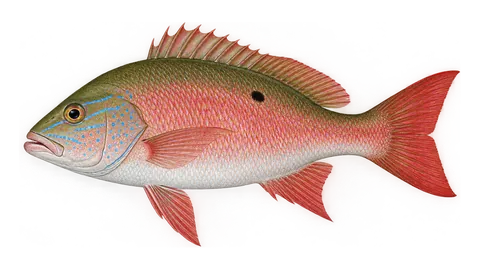
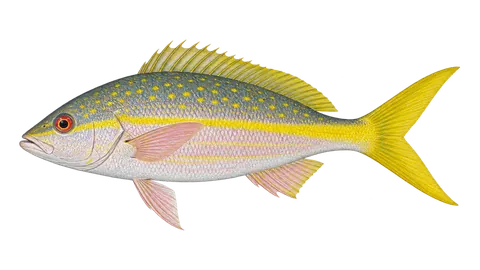
Tall body, long triangular snout, all red to pink, darker on the back and silvery pink on the belly. Adults have no black spot. Long pectoral fins reaching the anus; red eye. The cubera snapper (cioba) has a greenish back, a black spot and blue lines below the eye. The yellowtail snapper (guaiúba) has a yellow stripe down to its deeply forked tail. In the South and Southeast, pargo also refers to the red porgy (Pagrus pagrus), a different family with blue spots.
Also called: pargo, pargo-vermelho, southern red snapper
don't confuse with:
where found
open on the large mapWhere to look: Gravel, rock, sponge and reef bottoms of the outer shelf and upper slope, from 30 to 200 m.
Outer shelf and slope from Amapá to the Northeast. Today commercial fishing is concentrated between Amapá and the border of Maranhão with Piauí, from 50 m of depth, with Pará providing most of the production. In Ceará and Rio Grande do Norte it was heavily fished in past decades.
coast
states
Amapá, Pará, Maranhão, Piauí, Ceará, Rio Grande do Norte, Paraíba, Pernambuco, Alagoas, Sergipe, Bahia
when to fish
best season
Biologically it can be caught all year, but fishing is banned from December 15 to April 30. The legal season for the authorized fleet runs from May 1 until the quota runs out or until mid-December.
best time of day
Any time. Feeds day and night on the bottom. Commercial longline fishing works both shifts; current and drift matter more than the time of day.
what affects the southern red snapper
cold and cold fronts
Lives in stable water on the bottom; surface cold has little effect.
atmospheric pressure
Little direct effect; rough seas make anchoring and drifting harder.
moon
Spring tides bring strong current, which makes it hard to keep the bait on the bottom.
rain
Little effect. Thunderstorm with lightning: head back.
water level
Not applicable at sea. The equivalent is the color and clarity of the water: look for blue, clean water and current lines.
noise
At 50 to 150 m, boat noise matters little.
wind
Strong wind throws off the drift and makes it hard to keep the line vertical.
tide
Moderate current helps; strong current requires very heavy sinkers.
depth
From 30 to 200 m. The commercial zone starts at the 50 m isobath.
how to fish
lures
- 150 to 300 g slow pitch jigs
natural baits
- sardinha
- lula
- fish fillet
tip from an angler
A snapper brought up from 50 to 150 m suffers barotrauma. If you hook one while fishing recreationally, release it with a descender, which takes the fish back to the bottom.
- rod
- 20 to 40 lb, 6'0" to 7'0", for sinkers of 200 to 500 g
- spinning / baitcasting reel
- spinning reel 6000 to 10000 or baitcasting reel size 400 with good retrieve
- line
- braided line 30 to 50 lb, 300 m
- leader
- 60 to 80 lb monofilament leader
- hook
- circle hook 4/0 to 6/0, two or three per leader
accessories
- descender (descending device)
- sonar
catch and release
In recreational fishing, release it. Reel in slowly over the last few meters and release it with a descender; puncturing the swim bladder without the right technique kills the fish.
rules for the southern red snapper
Rules change; before keeping or transporting fish, check with the state environmental agency.
Southern red snapper closed season
15/12 to 30/04 details
Fishing for southern red snapper is banned from December 15 to April 30 every year. The authorized fleet may leave port from 00:00 on May 1.
Southern red snapper minimum size
35 cm (fork length) details
Capture, transport, storage, processing and trade of southern red snapper with fork length (from the tip of the snout to the fork of the tail) under 35 cm are prohibited.
Fishing only by the authorized fleet; recreational fishing not provided for
confirm with the agency details
Catch is permitted only to authorized vessels under categories 1.8, 1.9 and 1.10 (pargueira and traps), between Amapá and the MA/PI border, with an annual limit of 2,750 t and a fleet of up to 150 boats. Others must return the snapper to the sea. The rule does not provide for recreational fishing, and the species is EN, with use allowed only under the terms of the recovery plan. In practice: if you catch it, release it. Confirm with the MPA.
Trade and transport prohibited at the end of the closed season
16/02 to 30/04 details
From February 16 to April 30, transport, processing, industrialization and trade of any quantity of southern red snapper are prohibited. Between the start of the closed season and February 15, only with a Stock Declaration.
other rules that mention the southern red snapper (2)
Snapper closed season (North)
15/12 to 30/04APPAMA details
Snapper closed season from Amapá to the MA/PI border, beyond the 50 m isobath. Transport and sale of any volume are prohibited from Feb 16 to Apr 30. Catching is allowed only for authorized vessels (modalities 1.8 to 1.10); the portaria does not provide for recreational fishing (see "prohibitions"). Portaria MPA 755/2026 closed the 2026 snapper fishing season on Sep 19, 2026.
Source: Portaria Interministerial MPA/MMA nº 66/2026 (DOU Jul 27, 2026), which repealed PI 42/2018
Snapper (pargo): fishing reserved for the licensed fleet
APPAMAconfirm with the agency details
Snapper (Lutjanus purpureus, southern red snapper) moved to EN on the 2026 list. PI MPA/MMA 66/2026 allows catching only by authorized vessels in modalities 1.8, 1.9 and 1.10, with a minimum size of 35 cm (fork length) and a closed season from Dec 15 to Apr 30. The rule does not provide for recreational fishing; in practice, recreational anglers should not keep snapper.
Source: Portaria Interministerial MPA/MMA nº 66/2026; Portaria GM/MMA nº 1.742/2026 (snapper plan)
Conservation: Listed as VU since 2014 (Portarias MMA 445/2014 and 148/2022). Use is allowed only under the terms of the Recovery Plan (Portaria GM/MMA 1.742/2026) and of Interministerial Portaria MPA/MMA 66/2026.
how much it weighs without taking it out of the water
estimated weight
—
how we calculate
Length-weight relationship W = a·Lb (a = 0.01479, b = 2.96; FishBase (estimativa bayesiana, comprimento total)). It's an average: a fat or lean fish can vary by 10% to 20%.
more about the southern red snapper
The southern red snapper is a demersal lutjanid that lives on the outer shelf and upper slope, between 30 and 200 m, over gravel, rock and reefs. It forms aggregations on the banks of the Amazon shelf and the Northeast, and supports a traditional commercial fishery using pargueira (vertical longline) and traps, concentrated in Pará. It grows slowly and takes years to reproduce, which helps explain the decline of the fishery in Ceará and the shift of the fleet to the north. In 2026 it was reclassified as Endangered on the Brazilian national list. The fishery is strictly regulated, with a closed season, minimum size and catch limit, and the current rules do not provide for recreational fishing.
Family: Lutjanidae · predator
fun facts
- It was one of the first major resources of the Northeast's industrial fishery, starting in the 1960s, based in Fortaleza.
- The pargueira is a vertical longline with several hooks, hauled by hand or with a winch.
in the kitchen
White meat, highly prized. Buy only legal snapper: 35 cm or more fork length and outside the trade ban period, February 16 to April 30.
similar species
sources and references (8)
The season weights (months), the time of day and the sensitivities (cold, pressure, moon, wind, rain, tide, strong light, murky water and noise) are the app's editorial estimates, based on the literature below and on the field experience of anglers and guides. They are not official data nor a measurement made for this species, and they may vary by region and year. Closed seasons and legal rules appear in the rules section, with the norm and a link.
- scientific FishBase — Lutjanus purpureus (ficha da espécie)Names, distribution, biology, length-weight relationship and references. Page checked on October 13, 2026.
- official Portaria GM/MMA nº 1.667, de 27 de abril de 2026 — Lista Nacional Oficial de Espécies da Fauna Ameaçadas de Extinção (peixes e invertebrados aquáticos)The species is listed as EN (checked against the text published in the DOU, Brazil's official gazette, on April 28, 2026, section 1, p. 96).
- official Portaria MMA nº 148, de 7 de junho de 2022 — atualização da Lista Nacional de Espécies Ameaçadas de ExtinçãoPrevious national list, cited in this species' conservation history.
- official ICMBio/SALVE — Ficha de Lutjanus purpureus (avaliação nacional do risco de extinção)National assessment by ICMBio, published in 2023. DOI verified on Crossref.
- scientific IUCN Red List — busca por Lutjanus purpureusAccording to FishBase (version 2025-2 of the Red List), the species has not been assessed by the IUCN. Search for "Lutjanus purpureus" on the site.
- scientific Allen, G. R. (1985). FAO species catalogue. Vol. 6. Snappers of the world. FAO Fisheries Synopsis 125(6). Roma: FAO. 208 p.
- scientific Carpenter, K. E. (org.) (2002). The living marine resources of the Western Central Atlantic. Vol. 3: Bony fishes part 2 (Opistognathidae to Molidae). FAO Species Identification Guide for Fishery Purposes. Roma: FAO.Chapter Lutjanidae (Anderson Jr., W. D.).
- scientific Menezes, N. A.; Buckup, P. A.; Figueiredo, J. L.; Moura, R. L. (orgs.) (2003). Catálogo das espécies de peixes marinhos do Brasil. São Paulo: Museu de Zoologia da USP. 160 p.List of the marine species recorded in Brazil. Printed work; the URL is the bibliographic record in FishBase, which cites the catalogue for the species.
how we calculatewhere each number comes from
The weather comes from three independent global models, cross-checked hour by hour: when they agree, confidence goes up; when they diverge, the band between them shows on the chart. Beyond 16 days, we use the GEFS ensemble of 31 simulations: if 20 of the 31 predict rain, the chance of rain is 65%. Sun and moon are calculated astronomically, with no uncertainty.
The index adds up, weighted for each species: time of day (species curve anchored to real sunrise and sunset), moon (transits, rise and set, phase), pressure (3 h trend and 24 h swing), water temperature (in rivers, estimated from air temperature; at sea, estimated by an ocean model), wind, rain, clouds, tide and the month in the species' cycle.
sources for this lookup
how accurate the forecast is
Accuracy measured in the reference project (4 regions, 93 days, forecast vs. observed): maximum temperature is off by 0.6 °C on average the next day and 1.7 °C at 7 days; rain of 5 mm or more is detected 76% of the time the next day and 57% at 7 days. Detection isn't everything: the false alarm rate isn't published here yet, and 93 days in 4 regions is still a small sample. We now also measure every day, at the app's destinations: