mutton snapper
Lutjanus analis
A reef red fish of the Northeast and Southeast, wary and a fighter. A trophy in bottom fishing with natural bait and in light jigging.
Also called: cioba, mutton snapper

- common size
- 40–70 cm
- maximum
- 94 cm
- common weight
- 1.5–6 kg
- record/max.
- 15.6 kg
- depth
- 5–80 m
- ideal water
- 24–29 °C
who is the mutton snapper
The cubera snapper (cioba) is one of the most prized lutjanids on the tropical Brazilian coast. It lives on reefs, shoals, gravel bottoms and channel edges, from 5 to 80 m, and juveniles grow in mangroves, estuaries and seagrass beds. It eats fish, crabs, shrimp and octopus, hunting mainly at dusk and at night. It is wary: it drops the bait when it senses resistance, which calls for a fine leader and patience. It forms spawning aggregations at fixed spots, usually near the full moon, which makes it vulnerable to overfishing. In the fight it makes a strong run toward the rock. Its flesh is among the best from the sea.
fun facts
- Spawning aggregations gather many fish at the same spot, year after year.
- Juveniles use mangroves and seagrass beds as nurseries.
identification
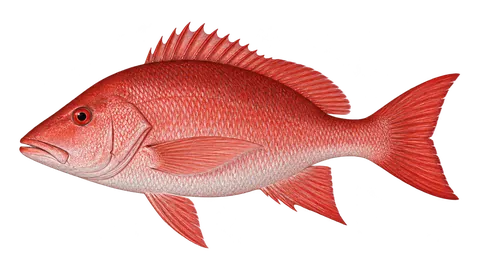
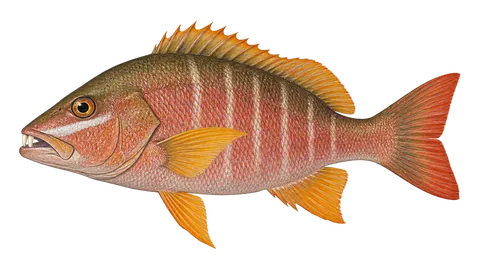
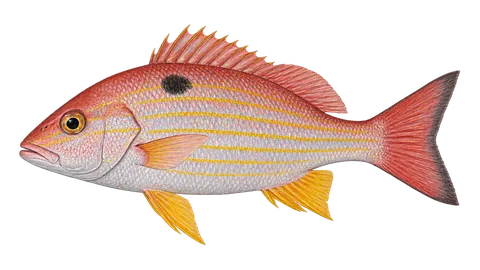
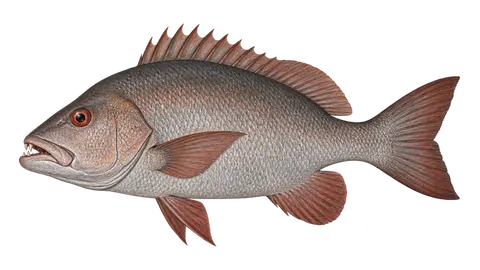
Olive-green back, pinkish to reddish flanks and a light belly. A small black spot above the lateral line, below the start of the soft part of the dorsal fin. Blue lines below the eye and on the operculum. Pointed anal fin and reddish tail. The southern red snapper is all red with no spot. The dog snapper (dentão) has a light patch below the eye and large canines. The lane snapper (ariacó) has yellow stripes on its flank.
Loading the next 7 days…
Each card shows the day's index (0 to 100) and, below it, a strip with the index for each hour, from 0h to 23h. from poor to excellent.
where found
From Maranhão to the Southeast, most common in the Northeast and Bahia. Known spots: reefs and shoals off Ceará, Rio Grande do Norte and Pernambuco, the surroundings of Abrolhos and the Royal Charlotte bank (BA), outside the Abrolhos Marine National Park, and wrecks off Vitória (ES) and Arraial do Cabo (RJ).
Habitat: Reefs, shoals, gravel bottoms and channel edges from 5 to 80 m. Juveniles in mangroves, estuaries and seagrass beds.
coast
states
Maranhão, Piauí, Ceará, Rio Grande do Norte, Paraíba, Pernambuco, Alagoas, Sergipe, Bahia, Espírito Santo, Rio de Janeiro, São Paulo
when to fish
best season
Can be fished year-round. Spawning aggregations occur at specific spots and moons, which vary by region; avoid targeting these concentrations.
best time of day
Night and twilight. Feeds best from dusk to dawn. During the day, only in deeper or murky water. The moon and a moving tide make a difference.
what affects the mutton snapper
sensitivity The little bars show how much each factor affects this species. Five full: it feels it a lot.
cold and cold fronts
A sharp drop in water temperature leaves the cubera snapper inactive for a day or two.
atmospheric pressure
Stable pressure helps; the change just before a cold front often gives a short peak.
moon
Strong effect: aggregations and feeding peaks tied to the full moon. Very bright nights make fish wary in shallow water.
rain
Light rain doesn't bother. Thunderstorm with lightning: head back.
water level
Not applicable at sea. The equivalent is the color and clarity of the water: look for blue, clean water and current lines.
noise
Very sensitive to noise in shallow water. Anchor away from the rock and let the bait drift to it.
wind
Strong wind makes it hard to anchor at the right spot and to feel the bite.
tide
A moving tide is essential; at slack tide fishing stops.
depth
Juveniles in the shallows; adults from 15 to 80 m, stuck to rock, reef or wreck.
how to fish
- rod
- 6'6" to 7'0", 15 to 30 lb
- spinning / baitcasting reel
- spinning reel 4000 to 6000 or low-profile baitcasting reel
- line
- braid 20 to 30 lb
- leader
- fluorocarbon 30 to 50 lb, 1.5 to 3 m
- hook
- circle hook 3/0 to 5/0
lures
- slow pitch jigs 60 to 150 g
- silicone shads on jig heads
natural baits
- fresh sardine
- lula
- live shrimp
- small live fish
accessories
- sliding sinker, the lightest the current allows
- descompressor
tip from an angler
Use a sliding sinker and let the cubera hold the bait for a few seconds before reeling in. A heavy leader and a heavy sinker scare the fish away.
deep-water saltwater boat fishing (pargo cubera, ariacó, guaiúba and dentão)
Fishing from an anchored or drifting boat over reefs, ledges and wrecks, with natural bait on the rig, from 20 to 100 m deep.
ready-made kitoffshore jigging
Vertical fishing with metal jigs over reefs, wrecks and the shelf edge, from 30 to 150 m deep.
guidecatch and release done right
Releasing only counts if the fish survives. Right gear, little time out of water, proper handling, the right hook, care with barotrauma and revival against the current.
rules for the mutton snapper
Summary of the regulations we found, with the source for each. Rules change; before keeping or transporting fish, check with the state environmental agency.
Conservation: Not on the national list (Portaria GM/MMA 1.667/2026). We found no specific federal rule for this species.
We found no species-specific rule beyond the region's general rules.
catch and release
catch and release Releasing the fish alive, quickly and with a wet hand. During a closed season it isn't always allowed: what the regulation says applies.
Below 30 m, watch for barotrauma: use a descender. Hold the fish by the mouth, support its belly and release it quickly.
in the kitchen
White, tender and flavorful, among the most prized. Baked whole, grilled or in moqueca.
how much it weighs without taking it out of the water
Length-weight relationship W = a·Lb (a = 0.01413, b = 2.96; FishBase (estimativa bayesiana, comprimento total)). It's an average: a fat or lean fish can vary by 10% to 20%.
estimated weight
—
sources and references
The season weights (months), the time of day and the sensitivities (cold, pressure, moon, wind, rain, tide, strong light, murky water and noise) are the app's editorial estimates, based on the literature below and on the field experience of anglers and guides. They are not official data nor a measurement made for this species, and they may vary by region and year. Closed seasons and legal rules appear in the rules section, with the norm and a link.
- scientific FishBase — Lutjanus analis (ficha da espécie)Names, distribution, biology, length-weight relationship and references. Page checked on October 13, 2026.
- official Portaria GM/MMA nº 1.667, de 27 de abril de 2026 — Lista Nacional Oficial de Espécies da Fauna Ameaçadas de Extinção (peixes e invertebrados aquáticos)Most recent national list. The species is not on it (search by scientific name in the text published in the DOU, checked on October 13, 2026).
- official ICMBio/SALVE — Ficha de Lutjanus analis (avaliação nacional do risco de extinção)ICMBio national assessment, published in 2025. DOI checked on Crossref.
- scientific IUCN Red List — Lutjanus analis (avaliação global: Quase Ameaçada, NT, 10/10/2015)Global assessment. Link given on the FishBase entry (Red List, version 2025-2).
- scientific Allen, G. R. (1985). FAO species catalogue. Vol. 6. Snappers of the world. FAO Fisheries Synopsis 125(6). Roma: FAO. 208 p.
- scientific Carpenter, K. E. (org.) (2002). The living marine resources of the Western Central Atlantic. Vol. 3: Bony fishes part 2 (Opistognathidae to Molidae). FAO Species Identification Guide for Fishery Purposes. Roma: FAO.Chapter Lutjanidae (Anderson Jr., W. D.).
- scientific Menezes, N. A.; Buckup, P. A.; Figueiredo, J. L.; Moura, R. L. (orgs.) (2003). Catálogo das espécies de peixes marinhos do Brasil. São Paulo: Museu de Zoologia da USP. 160 p.List of the marine species recorded in Brazil. Printed work; the URL is the bibliographic record in FishBase, which cites the catalogue for the species.