Skip to content
catalog Pimelodidae · predator

pati

Luciopimelodus pati

Freshwater

Slender, silvery catfish of the big rivers of the La Plata basin, heavily fished in the Argentine Paraná and the Uruguay River. Takes natural bait on the bottom of deep, murky channels.

Also called: pati, patí, bagre-pati

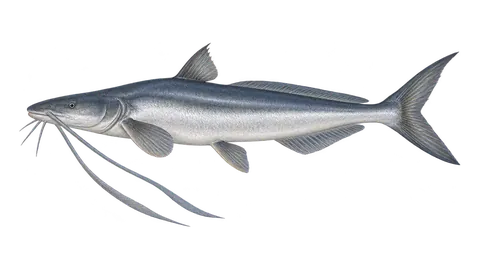
Scientific illustration of Pati
common size
40–70 cm
maximum
103 cm
common weight
1–4 kg
record/max.
10.0 kg
depth
3–20 m
ideal water
16–26 °C
overview

who is the pati

A leathery catfish of the family Pimelodidae, exceeding 1 m in length. It lives in the main channels of the Paraná, Paraguay and Uruguay rivers, in deep, murky water with moderate current. It is carnivorous and eats mostly fish. In Argentina and Uruguay it is one of the most sought-after catfish for bank and boat anglers, who fish on the bottom with pieces of fish as bait, mainly in the colder months. In Brazil it occurs in the Uruguay River (RS and SC). Like other large La Plata catfish, it is considered a migratory species and depends on free-flowing rivers without dams.

fun facts

  • In Argentina and Uruguay the name is written patí, with an accent.
  • The genus name combines Lucius, the elongated pike of the Northern Hemisphere, and Pimelodus, the genus of the mandis.
how to recognize it

identification

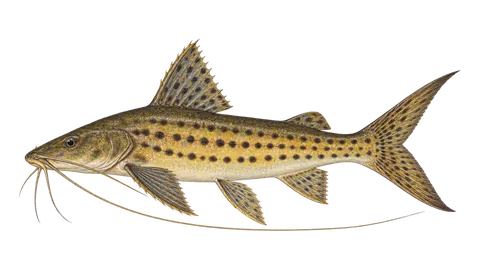
Elongated, slightly compressed body, silvery grey to bluish, white belly, no spots. Small, conical head, long thin barbels, a long adipose fin and a deeply forked tail with pointed lobes. The mandi has spots or stripes and is smaller; the barbado has a flattened head and broad, ribbon-like barbels.

how pati fishing looks

Loading the next 7 days…

Each card shows the day's index (0 to 100) and, below it, a strip with the index for each hour, from 0h to 23h. from poor to excellent.

distribution

where found

open on the large map

La Plata basin: Paraná, Paraguay and Uruguay rivers and the Río de la Plata (Argentina, Paraguay and Uruguay). In Brazil, the Uruguay River, including the upper stretch between RS and SC.

Habitat: Deep channels of large rivers, with murky water and moderate current; pools, tributary mouths and cut banks.

native to the basins

Uruguay

states

Rio Grande do Sul, Santa Catarina

calendar and clock

when to fish

best season

time of yearbest: May–Aug
JanFebSeaAprMayJunJulAugSepOctNovDec

In the Argentine Paraná and the Uruguay River, pati fishing is best from autumn to late winter (April to September). In Brazil, respect the spawning closure (piracema) of the Uruguay basin.

best time of day

0h6h12h18h sunrise ~6amsunset ~6pm

Night and twilight. Feeds more in late afternoon and at night; in very murky water it also bites by day.

weather, water and behavior

what affects the pati
sensitivity The little bars show how much each factor affects this species. Five full: it feels it a lot.

cold and cold fronts

Handles cold well; it is one of the fish that save winter fishing on the La Plata.

atmospheric pressure

A cold front arriving often activates it; the day after the front is weaker.

moon

Dark nights and new-moon nights usually produce more.

rain

Little direct effect; a sudden rise carrying lots of debris and branches hampers bottom fishing.

water level

A stable or falling river is best; a strong flood scatters the fish.

noise

Not very sensitive in deep, murky water.

wind

Little effect on the fish; wind against the current makes boat fishing difficult.

depth

Channel 5 to 15 m; the bait needs to sit still on the bottom.

technique, gear and bait

how to fish

rod
2.1 to 2.7 m, medium action, 15 to 30 lb
spinning / baitcasting reel
spinning reel 4000 to 5000 or medium baitcasting reel
line
monofilament 0.35 to 0.45 mm or braided line 30 lb
leader
monofilament 0.50 to 0.60 mm, 50 cm
hook
2/0 to 5/0

natural baits

  • piece or fillet of curimbatá (sábalo)
  • tuvira (morena)
  • thick earthworm
  • beef heart

accessories

  • olive or pyramid sinker 50 to 150 g
  • swivel with snap
  • alicate
  • wet cloth to hold it

tip from an angler

Sliding sinker, fresh fish bait and patience in the channel. The bite is subtle: wait for the line to run before setting the hook.

what the law says

rules for the pati

Summary of the regulations we found, with the source for each. Rules change; before keeping or transporting fish, check with the state environmental agency.
Conservation: A migratory species: dams without fish passage and intense fishing reduce stocks.

We found no species-specific rule beyond the region's general rules.

piracema closures in the basins where the species lives

Spawning closure (piracema) in the Uruguay River basin

01/10 to 31/01RSSC

Allowed: Recreational fishing from shore, or from a boat without motor. Only handline or rod, line and hook, one gear per angler, up to 5 kg. Prohibited in floodplain lakes, within 1,500 m of dams, within 500 m of confluences, and in stretches listed in the rule (e.g., Turvo River).

Source: IN IBAMA nº 193/2008

catch and release
catch and release Releasing the fish alive, quickly and with a wet hand. During a closed season it isn't always allowed: what the regulation says applies.

Watch the stingers on the dorsal and pectoral fins. Hold it with a wet cloth, unhook it with pliers and release it quickly, without leaving the fish out of water.

in the kitchen

White, tasty flesh, highly valued in the La Plata region. Grilled, stewed or fried in steaks.

calculator

how much it weighs without taking it out of the water

Length-weight relationship W = a·Lb (a = 0.00589, b = 3.1; FishBase (estimativa bayesiana para a família e o formato do corpo); peso máximo calculado por esta relação). It's an average: a fat or lean fish can vary by 10% to 20%.

estimated weight

—

sources and references

The season weights (months), the time of day and the sensitivities (cold, pressure, moon, wind, rain, tide, strong light, murky water and noise) are the app's editorial estimates, based on the literature below and on the field experience of anglers and guides. They are not official data nor a measurement made for this species, and they may vary by region and year. Closed seasons and legal rules appear in the rules section, with the norm and a link.

  1. scientific FishBase — Luciopimelodus pati (ficha da espécie)Names, distribution, biology, length-weight relationship, country list and references. Page checked on Oct 13, 2026.
  2. official Portaria GM/MMA nº 1.667, de 27 de abril de 2026 — Lista Nacional Oficial de Espécies da Fauna Ameaçadas de Extinção (peixes e invertebrados aquáticos)Most recent national list. The species is not on it (search by scientific name in the text published in the DOU, checked on October 13, 2026).
  3. official ICMBio/SALVE — Ficha de Luciopimelodus pati (avaliação nacional do risco de extinção)National assessment by ICMBio, published in 2023. DOI verified on Crossref.
  4. scientific IUCN Red List — Luciopimelodus pati (avaliação global: Pouco Preocupante, LC, 29/12/2020)Global assessment. Link given on the FishBase entry (Red List, version 2025-2).
  5. scientific Zaniboni Filho, E.; Meurer, S.; Shibatta, O. A.; Nuñer, A. P. O. (2004). Catálogo ilustrado de peixes do alto rio Uruguai. Florianópolis: Editora da UFSC; Tractebel Energia. 128 p.Printed work; the URL is the bibliographic record on FishBase, which cites this work for the species.
don't confuse

similar species