pluma porgy
Calamus pennatula
A deep-bodied, silvery sparid with blue reflections, from rock and sand bottoms of the Caribbean to Brazil. It eats crabs and shells and takes small natural bait well.
Also called: peixe-pena, pluma porgy, West Indian porgy

- common size
- 20–30 cm
- maximum
- 37 cm
- common weight
- 0.2–0.5 kg
- record/max.
- 0.8 kg
- depth
- 0–85 m
- ideal water
- 24–28 °C
who is the pluma porgy
The peixe-pena is a sparid of the family of the sargos and the red porgy, living in the western Atlantic from the Bahamas to Brazil, in the southern Gulf of Mexico and throughout the Caribbean, where it is the most common species of its genus. Adults are found over rock bottoms and reefs, but also on flat bottoms down to 85 m, usually from 5 to 30 m; juveniles stay in shallower water. With strong teeth, it eats crabs, hermit crabs, mollusks, worms and brittle stars. It is an important table fish in the Caribbean. In Brazil it has been recorded on deep reefs of the Northeast. In recreational fishing it is caught on natural bait on the bottom, on a small hook, and it fights well for its size.
fun facts
- It is the most common species of its genus in the Antilles.
- It eats even brittle stars, relatives of sea stars.
identification
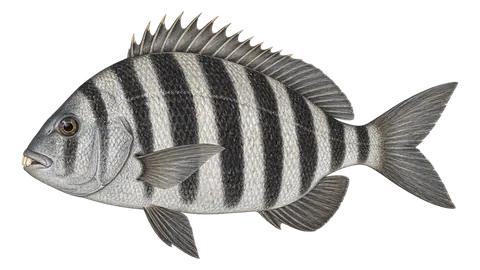
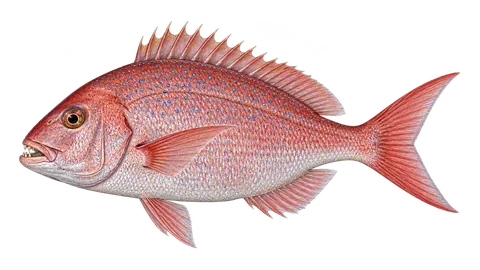
Deep-bodied and compressed, silvery with a lilac sheen; the edges of the scales are yellowish brown and the center of each scale has a vertical blue or blue-green mark. Head profile moderately sloped. Other Calamus species in Brazil are very similar and require attention to color details. The sargo-de-dente has wide black bars; the red porgy is pink.
Loading the next 7 days…
Each card shows the day's index (0 to 100) and, below it, a strip with the index for each hour, from 0h to 23h. from poor to excellent.
where found
From the Bahamas to Brazil, in the southern Gulf of Mexico and throughout the Caribbean. In Brazil there are records on deep reefs of the Northeast.
Habitat: Rock bottoms and reefs, as well as flat sandy bottoms; juveniles in shallower waters.
coast
when to fish
best season
Found year-round; in the Caribbean it is caught in any month.
best time of day
Daytime. Feeds by day, rooting the bottom for crabs and shells.
what affects the pluma porgy
sensitivity The little bars show how much each factor affects this species. Five full: it feels it a lot.
cold and cold fronts
A warm-water fish; activity drops in cold water.
atmospheric pressure
A churned sea after a cold front shuts down bottom fishing.
moon
Small effect.
rain
Little effect.
water level
Not applicable at sea.
noise
Moderately wary.
wind
Strong wind makes it hard to keep the bait still on the bottom.
tide
Weak to moderate current makes bottom fishing easier.
depth
Usually 5 to 30 m.
how to fish
- rod
- 6' to 7', 8 to 17 lb
- spinning / baitcasting reel
- spinning reel 2500 to 3000
- line
- braided line 10 to 20 lb
- leader
- fluorocarbon 20 to 30 lb, 50 cm
- hook
- hook 1 to 1/0, strong (the mouth is hard)
lures
- small jig head with artificial shrimp
natural baits
- shrimp
- piece of crab
- marisco
accessories
- small sinker
- alicate
tip from an angler
A small bait tied well to the hook: with its strong mouth and crushing teeth, it steals soft bait.
rules for the pluma porgy
Summary of the regulations we found, with the source for each. Rules change; before keeping or transporting fish, check with the state environmental agency.
Conservation: Not on the national list (Portaria GM/MMA 1.667/2026). We found no specific federal rule for this species.
We found no species-specific rule beyond the region's general rules.
catch and release
catch and release Releasing the fish alive, quickly and with a wet hand. During a closed season it isn't always allowed: what the regulation says applies.
Remove the hook with pliers and release quickly; it is a tough fish and returns well to the bottom.
in the kitchen
White, tasty flesh, good fried or baked. Ciguatera has been recorded in the Caribbean.
how much it weighs without taking it out of the water
Length-weight relationship W = a·Lb (a = 0.0195, b = 2.93; FishBase (estimativa bayesiana para o gênero e o formato do corpo, comprimento total)). It's an average: a fat or lean fish can vary by 10% to 20%.
estimated weight
—
sources and references
The season weights (months), the time of day and the sensitivities (cold, pressure, moon, wind, rain, tide, strong light, murky water and noise) are the app's editorial estimates, based on the literature below and on the field experience of anglers and guides. They are not official data nor a measurement made for this species, and they may vary by region and year. Closed seasons and legal rules appear in the rules section, with the norm and a link.
- scientific FishBase — Calamus pennatula (ficha da espécie)Names, distribution, biology, length-weight relationship, country list and references. Page checked October 13, 2026. The maximum weight was estimated from the length-weight relationship.
- official Portaria GM/MMA nº 1.667, de 27 de abril de 2026 — Lista Nacional Oficial de Espécies da Fauna Ameaçadas de Extinção (peixes e invertebrados aquáticos)Most recent national list. The species is not on it (search by scientific name in the text published in the DOU, checked on October 13, 2026).
- official ICMBio/SALVE — Ficha de Calamus pennatula (avaliação nacional do risco de extinção)ICMBio national assessment, published in 2025. DOI checked on Crossref.
- scientific IUCN Red List — Calamus pennatula (avaliação global: Pouco Preocupante, LC, 30/03/2011)Global assessment. Link given on the FishBase entry (Red List, version 2025-2).
- scientific Mesophotic.org — Calamus pennatula (registros em recifes mesofóticos)Lists studies on the species, including one on deep-reef fish of northeastern Brazil (Feitoza, Rosa and Rocha, 2005).
- scientific Carpenter, K. E. (org.) (2002). The living marine resources of the Western Central Atlantic. Vol. 3: Bony fishes part 2 (Opistognathidae to Molidae). FAO Species Identification Guide for Fishery Purposes. Roma: FAO.Chapter Sparidae (Carpenter, K. E.).