Skip to content
catalog Sciaenidae · predator

southern king weakfish

Macrodon atricauda

SeaEstuary

The dog-toothed pescada-foguete of the Southeast and South. It comes in schools close to the beach and at estuary mouths; fine meat that is in high demand.

Also called: pescada-foguete, pescadinha-real, pescadinha, foguete

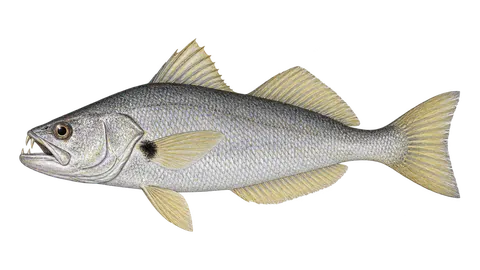
Scientific illustration of Southern king weakfish
common size
20–35 cm
maximum
46 cm
common weight
0.1–0.4 kg
record/max.
0.9 kg
depth
1–60 m
ideal water
18–25 °C
overview

who is the southern king weakfish

The pescada-foguete is a small, elongated weakfish with a large mouth and strong canine teeth, heavily exploited by artisanal and industrial fishing from Espírito Santo to the Río de la Plata. Until 2010 it was treated as Macrodon ancylodon, a name now kept for the northern and northeastern form (pescada-gó); the southeastern and southern form was revalidated as Macrodon atricauda. It lives on sand and mud bottoms near the coast, from shallow water to a few dozen meters, and eats shrimp and small fish. It approaches the surf zone and the mouths of bays and estuaries, where it is caught from the beach and from boats with shrimp and sardine. It is intensively exploited across its range.

fun facts

  • It was recognized as a species distinct from the northern pescada-gó only in 2010.
  • The name atricauda, "black tail", describes the dark tip of the caudal fin.
how to recognize it

identification

Elongated, silver body with a grayish-brown back, large oblique mouth with strong canines in both jaws, and a pointed, spear-shaped tail with a dark tip (atricauda means "black tail"). Differs from the pescada-olhuda and the vermilion seatrout by its very visible teeth and pointed tail. The northern pescada-gó (M. ancylodon) is almost identical and is told apart by scale and ray counts.

how southern king weakfish fishing looks

Loading the next 7 days…

Each card shows the day's index (0 to 100) and, below it, a strip with the index for each hour, from 0h to 23h. from poor to excellent.

distribution

where found

open on the large map

From Espírito Santo to Rio Grande do Sul, reaching Uruguay and northern Argentina.

Habitat: Sand and mud bottoms of the inner shelf, near the surf zone and the mouths of bays and estuaries.

coast

Southeast CoastSouth Coastcoastalshelf

states

Espírito Santo, Rio de Janeiro, São Paulo, Paraná, Santa Catarina, Rio Grande do Sul

calendar and clock

when to fish

best season

time of yearbest: Oct–Feb
JanFebSeaAprMayJunJulAugSepOctNovDec

In spring and summer, schools come closer to the coast in the Southeast and South.

best time of day

0h6h12h18h sunrise ~6amsunset ~6pm

Night and twilight. Comes close to the beach and channels in late afternoon and at night; during the day it stays deeper.

weather, water and behavior

what affects the southern king weakfish
sensitivity The little bars show how much each factor affects this species. Five full: it feels it a lot.

cold and cold fronts

A sharp drop in temperature pushes schools away from the beach.

atmospheric pressure

A cold front shuts down activity for a day or two.

moon

New and waxing moon nights usually produce more on the beach.

rain

Light rain doesn't hurt; very muddy water does.

water level

Salt water entering the bays brings the pescada-foguete inside.

noise

Not very sensitive on the beach; from a boat, avoid running the motor over the school.

wind

Moderate choppy sea helps on the beach; strong surf makes fishing impossible.

tide

Fish the flood tide and the first hours of the ebb.

depth

From 1 to 20 m in most beach and boat catches.

technique, gear and bait

how to fish

rod
beach: 3.6 to 4.2 m, 80 to 150 g; boat: 6'0" to 7'0", 10 to 20 lb
spinning / baitcasting reel
spinning reel 4000 to 6000 (beach) or 2500 to 4000 (boat)
line
monofilament 0.30 to 0.35 mm or braided line 15 to 20 lb with shock leader
leader
monofilament 0.40 to 0.50 mm
hook
maruseigo or wide gap 1 to 1/0 (the mouth has teeth)

lures

  • small shads on 10 to 20 g jig heads (boat)

natural baits

  • shrimp
  • sardine strips
  • squid strips
  • corrupto

accessories

  • pyramid sinker or treble hook (beach)
  • forceps

tip from an angler

Use a two-hook rig on the beach and strip baits: the pescada-foguete strikes bait that moves with the current.

what the law says

rules for the southern king weakfish

Summary of the regulations we found, with the source for each. Rules change; before keeping or transporting fish, check with the state environmental agency.
Conservation: Not on the national list (Portaria GM/MMA 1.667/2026). Minimum size of 25 cm from ES to RS (IN MMA 53/2005, as Macrodon ancylodon).

Minimum size 25 cm (ES to RS)

25 cm (TL)ESRJSPPRSCRSSoutheast CoastSouth Coastconfirm with the agency

On the coast from ES to RS it is banned to fish for, keep on board or land pescada-foguete under 25 cm total length. The 20% tolerance of the catch (by weight) provided in the rule is for enforcement at landings; recreational anglers must release the small ones. The rule does not apply to trawling. The rule uses the name Macrodon ancylodon, which at the time included the southeastern and southern pescada, now M. atricauda.

Source: IN MMA nº 53/2005, Annex II (pescadinha / king weakfish, Macrodon ancylodon)
catch and release
catch and release Releasing the fish alive, quickly and with a wet hand. During a closed season it isn't always allowed: what the regulation says applies.

Pescadas die easily out of the water: if you release a small one, do it quickly, without squeezing the belly, and use pliers to remove the hook.

in the kitchen

White, fine and tender meat; a classic fried as fillets or whole, breaded.

calculator

how much it weighs without taking it out of the water

Length-weight relationship W = a·Lb (a = 0.00631, b = 3.09; FishBase (estimativa bayesiana, comprimento total)). It's an average: a fat or lean fish can vary by 10% to 20%.

estimated weight

—

sources and references

The season weights (months), the time of day and the sensitivities (cold, pressure, moon, wind, rain, tide, strong light, murky water and noise) are the app's editorial estimates, based on the literature below and on the field experience of anglers and guides. They are not official data nor a measurement made for this species, and they may vary by region and year. Closed seasons and legal rules appear in the rules section, with the norm and a link.

  1. scientific FishBase — Macrodon atricauda (ficha da espécie)Names, distribution, biology, length-weight relationship and references. Page checked on October 13, 2026.
  2. official Portaria GM/MMA nº 1.667, de 27 de abril de 2026 — Lista Nacional Oficial de Espécies da Fauna Ameaçadas de Extinção (peixes e invertebrados aquáticos)Most recent national list. The species is not on it (search by scientific name in the text published in the DOU, checked on October 13, 2026).
  3. official ICMBio/SALVE — Ficha de Macrodon atricauda (avaliação nacional do risco de extinção)ICMBio national assessment, published in 2025. DOI checked on Crossref.
  4. scientific IUCN Red List — Macrodon atricauda (avaliação global: Pouco Preocupante, LC, 30/07/2019)Global assessment. Link given on the FishBase entry (Red List, version 2025-2).
  5. official Instrução Normativa MMA nº 53, de 22 de novembro de 2005 — tamanho mínimo de captura de espécies marinhas e estuarinas do litoral Sudeste e SulText reproduced from the DOU of Nov 24, 2005, checked on Oct 13, 2026. Annex II; § 2 of art. 2 (exemption in competitions) was revoked by IN MMA nº 3/2006.
  6. scientific Carvalho-Filho, A.; Santos, S.; Sampaio, I. (2010). Macrodon atricauda (Günther, 1880) (Perciformes: Sciaenidae), a valid species from the southwestern Atlantic, with comments on its conservation. Zootaxa 2519: 48–58.Revalidation of the species. Printed work; the URL is the bibliographic record in FishBase, which cites this work for the species.
don't confuse

similar species