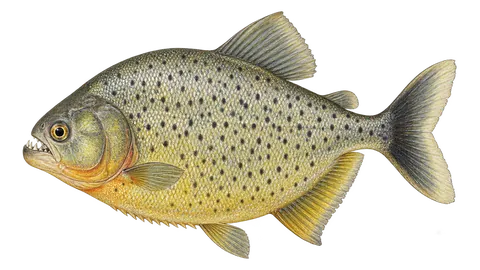
A small silvery piranha (pirambeba) from the Pantanal that tears off pieces of fins and bait. It reached the upper Paraná after Itaipu and reduced the native piranha in many stretches.
Also called: pirambeba, piranha, catirina, piranha-branca, prateada
Piranha up to about 30 cm, native to the Paraguay basin and the middle and lower Paraná. It eats fish, almost always in pieces, along with fins and scales, and feeds mostly by day; at night it shelters. The Itaipu reservoir covered the Sete Quedas falls in 1982, which had separated the upper Paraná from the rest of the basin, and the pirambeba moved upriver. There it bred heavily, defends its spawning and territory aggressively and, in several stretches, reduced the native piranha (Serrasalmus maculatus, the yellow piranha). In the Pantanal it is the pirambeba; in other regions the same name is used for the yellow piranha, which causes confusion. In MS it counts toward the amateur angler's bag of 5 piranhas, and in Goiás it is treated as non-native in the Paranaíba.
fun facts
Marginatus means 'with a margin', for the dark edge of the tail.
In the upper Paraná, studies showed that it breeds intensely in flowing water, where the native piranha barely bred, which helps explain the invasion.
how to recognize it
identification
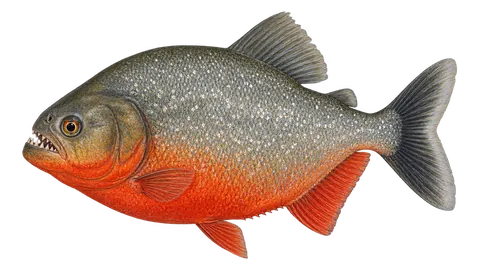
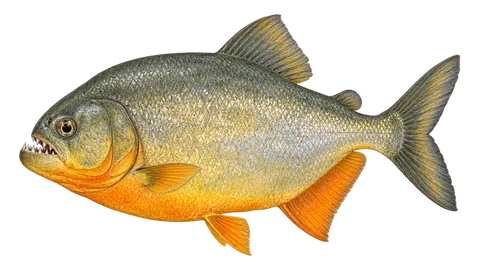
Tall, compressed, disc-shaped body, silvery with golden reflections and small dark spots on the upper flank. Pointed snout, protruding lower jaw with triangular teeth. The tail has a broad dark rear edge, which gives the name marginatus. The red-bellied piranha is larger and sturdier with a red belly; the yellow piranha is more yellowish and has larger spots. Telling the two Serrasalmus apart in the field is hard.
how pirambeba-do-pantanal fishing looks
Loading the next 7 days…
Each card shows the day's index (0 to 100) and, below it, a strip with the index for each hour, from 0h to 23h. from poor to excellent.
Native to the Paraguay basin (Pantanal) and the middle and lower Paraná, in Argentina, Paraguay and Uruguay. It invaded the upper Paraná after the Itaipu reservoir formed.
Habitat: Baías, corixos, rivers and vegetated lagoons in the Pantanal; reservoirs, várzeas and lagoons of the upper Paraná.
native to the basins
Paraguay (Pantanal)
introduced in
Paraná
states
Mato Grosso do Sul, Mato Grosso, São Paulo, Paraná, Goiás, Minas Gerais
calendar and clock
when to fish
best season
time of yearbest: Jun–Nov
JanFebSeaAprMayJunJulAugSepOctNovDec
All year; in the Pantanal dry season, as the baías shrink, piranhas concentrate and bite more.
best time of day
Daytime. Feeds by day; the largest extend hunting until dusk. At night they shelter.
weather, water and behavior
what affects the pirambeba-do-pantanal
sensitivity The little bars show how much each factor affects this species. Five full: it feels it a lot.
5'6" to 6', medium action, 10 to 20 lb, or bamboo cane
spinning / baitcasting reel
spinning reel 2000 to 3000
line
monofilament 0.30 to 0.35 mm
leader
fine steel wire leader of 15 to 20 cm (crimped to the hook)
hook
No. 1/0 to 2/0, long-shank
natural baits
piece of fish
beef heart or beef
minhoca
accessories
long-nose pliers
cloth to grip
tip from an angler
Always crimped: the teeth cut the line. Set the hook quickly, because it tears the bait apart.
what the law says
rules for the pirambeba-do-pantanal
Summary of the regulations we found, with the source for each. Rules change; before keeping or transporting fish, check with the state environmental agency. Conservation: Not on the national list of threatened species (Portaria GM/MMA nº 1.667/2026).
MS: counts toward the 5-piranha bag
up to 5 piranhas in addition to the native fishMSParaguay (Pantanal)Paraná
In MS, the amateur angler may carry 1 native fish plus 5 more piranhas. The decree expressly includes Serrasalmus marginatus, along with the red-bellied piranha (Pygocentrus nattereri).
catch and transport without size or quantity limitGOParaná
In the Paranaíba basin, in Goiás, the pirambeba (Serrasalmus marginatus) is on the list of non-native species with free catch and transport, with its origin attributed to Itaipu.
piracema closures in the basins where the species lives
Spawning closure (piracema) in the Pantanal of Mato Grosso do Sul
05/11 to 28/02MS
Allowed: Subsistence fishing by riverside residents and authorized scientific fishing. Decree 15.166/2019 (art. 11, §5) allows catch and release only in February and only in the channels of the Paraguay and Paraná rivers. For the rest of the period, not even catch and release is allowed. Check the Imasul portaria for each season.
Spawning closure (piracema) in Mato Grosso (all basins)
01/10 to 31/01MT
Allowed: All fishing modalities are prohibited in rivers, including catch and release (Law 9.096/2009, art. 19-A). Exceptions: subsistence fishing from shore (3 kg or 1 fish, no transport or sale) and scientific fishing. Law 13.159/2025 now allows licensed sport fishing in UHE/PCH hydropower reservoirs, natural lakes and border rivers, subject to a scientific study and a license from the environmental agency. We have not confirmed whether these licenses are already being issued.
catch and release Releasing the fish alive, quickly and with a wet hand. During a closed season it isn't always allowed: what the regulation says applies.
Hold it with a cloth behind the head, away from the mouth, and use long-nose pliers to remove the hook.
in the kitchen
Piranha broth, a Pantanal tradition; the flesh is tasty but has many bones.
calculator
how much it weighs without taking it out of the water
Length-weight relationship W = a·Lb (a = 0.01318, b = 3.17; FishBase). It's an average: a fat or lean fish can vary by 10% to 20%.
estimated weight
—
sources and references
The season weights (months), the time of day and the sensitivities (cold, pressure, moon, wind, rain, tide, strong light, murky water and noise) are the app's editorial estimates, based on the literature below and on the field experience of anglers and guides. They are not official data nor a measurement made for this species, and they may vary by region and year. Closed seasons and legal rules appear in the rules section, with the norm and a link.