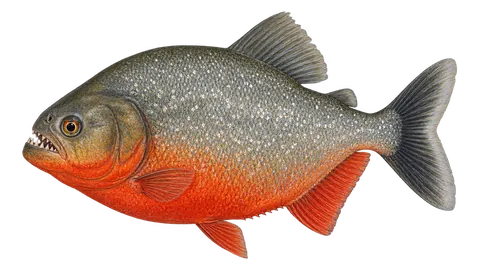
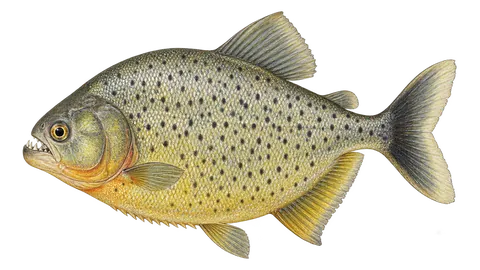
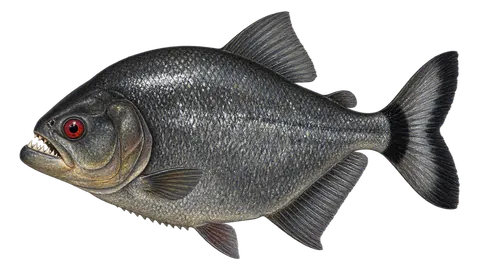
Considered the largest piranha, Pygocentrus piraya is native to the São Francisco basin and common in oxbow lagoons and reservoirs. In the Barragem da Pedra reservoir, on the Contas River (BA), its diet was dominated by fins, fish and shrimp. It attacks meat, fish and artificial lures in groups and cuts line easily. Outside its home basin it was moved to Northeast reservoirs, with records in the Jaguaribe River (CE) since the 1960s, and Goiás rules list it as allochthonous in the Paranaíba. In sport fishing it can exceed 3 kg.
fun facts
It is considered the largest piranha species.
Fins of other fish often show up in its stomach: it nips more than it kills.
how to recognize it
identification
Tall, sturdy body, greenish-grey back and silvery flank with golden reflections; belly, throat and lower fins yellow-orange. Short, blunt snout, projecting lower jaw and sharp triangular teeth. The São Francisco pirambeba (Serrasalmus brandtii) is smaller, flatter and has a more pointed snout.
how san francisco piranha fishing looks
Loading the next 7 days…
Each card shows the day's index (0 to 100) and, below it, a strip with the index for each hour, from 0h to 23h. from poor to excellent.
Native to the São Francisco basin, including the large reservoirs. Also recorded in the Contas River (BA), the Jaguaribe (CE) and, as an allochthonous species, in the Paranaíba in Goiás.
Habitat: Eddies, oxbow lagoons, reservoir shores and submerged timber; schools in mid-water.
Long-shank hook and wire leader. Never put your hand near the mouth.
what the law says
rules for the san francisco piranha
Summary of the regulations we found, with the source for each. Rules change; before keeping or transporting fish, check with the state environmental agency. Conservation: Not on the national list (Portaria GM/MMA 1.667/2026).
GO (Paranaíba): allochthonous, free capture
no size or bag limitGOParaná
In the Paranaíba basin in Goiás, piranha caju (Pygocentrus piraya) is in Annex II of the state rule, which lists allochthonous species with free capture and transport.
piracema closures in the basins where the species lives
Spawning closure (piracema) in Minas Gerais (state rule)
01/11 to 28/02MG
Allowed: Only exotic or hybrid species, 3 kg + 1 fish per day, with handline, rod, simple pole, or spinning or baitcasting reel. Nets prohibited. Keep the minimum distances from dams and reservoirs.
Allowed: Sport and guided fishing only in reservoirs, catch and release with barbless hooks (no keeping, transporting or eating). Subsistence: up to 5 kg per day, for household consumption only.
Spawning closure (piracema) in the São Francisco River basin (rivers and reservoirs)
01/11 to 28/02MGBAPEALSEGODF
Allowed: Recreational fishing from a boat or from shore with handline, rod, spinning or baitcasting reel, up to 5 kg + 1 fish. Prohibited within 1,000 m of dams, waterfalls and rapids, and within 500 m of confluences. Floodplain lakes have a longer closed season (see next item).
catch and release Releasing the fish alive, quickly and with a wet hand. During a closed season it isn't always allowed: what the regulation says applies.
Use long-nose pliers and a lip grip. Release quickly, keeping your hand away from the mouth.
in the kitchen
White, tasty flesh with bones; broth and fried fish are traditional.
calculator
how much it weighs without taking it out of the water
Length-weight relationship W = a·Lb (a = 0.02239, b = 3.14; FishBase). It's an average: a fat or lean fish can vary by 10% to 20%.
estimated weight
—
sources and references
The season weights (months), the time of day and the sensitivities (cold, pressure, moon, wind, rain, tide, strong light, murky water and noise) are the app's editorial estimates, based on the literature below and on the field experience of anglers and guides. They are not official data nor a measurement made for this species, and they may vary by region and year. Closed seasons and legal rules appear in the rules section, with the norm and a link.