

- common size
- 12–22 cm
- maximum
- 32 cm
- common weight
- 0.1–0.2 kg
- record/max.
- 0.4 kg
- depth
- 0.3–5 m
- ideal water
- 24–30 °C

the right time
to be on the water
Choose the place and the species. The index, from 0 to 100, combines weather, sun, moon and tide with each fish's habits. Up to 28 days, with each day's confidence.
Loading the forecast…
—
Looking for alerts within 30 km…
Looking for what anglers have logged near here…
what you need to fish herelicense, certification and boat documents
fish likely at this spot
Tap a fish to see its forecast.
hour by hour
slide your finger or mouse over the chart to see each hoursee hour-by-hour table
why this index at —?
choose the day
the fishing month at a glance
what's the best window for the crew?
Choose how many fishing days. We compare each stretch by its average index, discount days with a warning or closed season, and show the 3 best.
trend for the coming weeks
Line: the middle value of 31 simulations of the American GEFS model. Band: where 8 out of 10 fall. Narrow, firm trend; wide, high uncertainty.
everything about the pirambeba-do-pantanal
how to recognize it
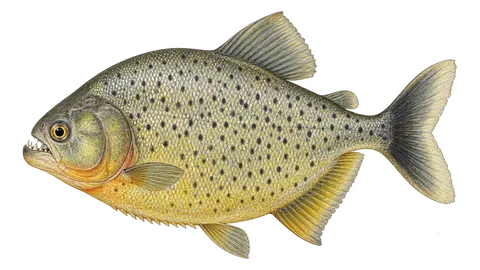
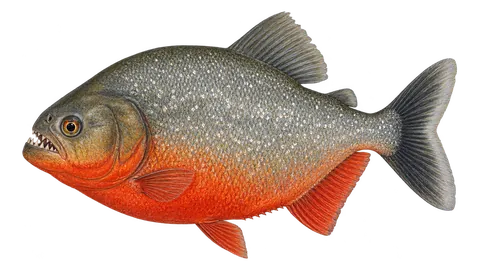
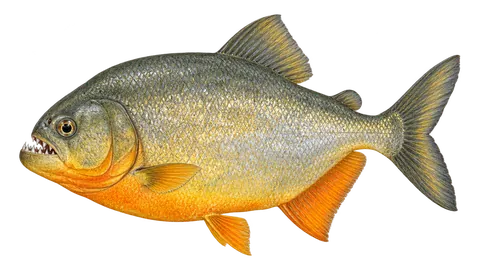
Tall, compressed, disc-shaped body, silvery with golden reflections and small dark spots on the upper flank. Pointed snout, protruding lower jaw with triangular teeth. The tail has a broad dark rear edge, which gives the name marginatus. The red-bellied piranha is larger and sturdier with a red belly; the yellow piranha is more yellowish and has larger spots. Telling the two Serrasalmus apart in the field is hard.
Also called: pirambeba, piranha, catirina, piranha-branca, prateada
don't confuse with:
where found
open on the large mapWhere to look: Baías, corixos, rivers and vegetated lagoons in the Pantanal; reservoirs, várzeas and lagoons of the upper Paraná.
Native to the Paraguay basin (Pantanal) and the middle and lower Paraná, in Argentina, Paraguay and Uruguay. It invaded the upper Paraná after the Itaipu reservoir formed.
native to the basins
introduced in
states
Mato Grosso do Sul, Mato Grosso, São Paulo, Paraná, Goiás, Minas Gerais
when to fish
best season
All year; in the Pantanal dry season, as the baías shrink, piranhas concentrate and bite more.
best time of day
Daytime. Feeds by day; the largest extend hunting until dusk. At night they shelter.
what affects the pirambeba-do-pantanal
cold and cold fronts
Cold drops activity.
atmospheric pressure
Little effect.
moon
Little known effect.
rain
Little effect.
water level
Drought concentrates the school.
noise
Not very sensitive; bait scent attracts it.
wind
Little effect.
depth
Mid-water and bottom, 0.5 to 4 m.
how to fish
natural baits
- piece of fish
- beef heart or beef
- minhoca
tip from an angler
Always crimped: the teeth cut the line. Set the hook quickly, because it tears the bait apart.
- rod
- 5'6" to 6', medium action, 10 to 20 lb, or bamboo cane
- spinning / baitcasting reel
- spinning reel 2000 to 3000
- line
- monofilament 0.30 to 0.35 mm
- leader
- fine steel wire leader of 15 to 20 cm (crimped to the hook)
- hook
- No. 1/0 to 2/0, long-shank
accessories
- long-nose pliers
- cloth to grip
catch and release
Hold it with a cloth behind the head, away from the mouth, and use long-nose pliers to remove the hook.
rules for the pirambeba-do-pantanal
Rules change; before keeping or transporting fish, check with the state environmental agency.
MS: counts toward the 5-piranha bag
up to 5 piranhas in addition to the native fishMS details
In MS, the amateur angler may carry 1 native fish plus 5 more piranhas. The decree expressly includes Serrasalmus marginatus, along with the red-bellied piranha (Pygocentrus nattereri).
Source: Decreto estadual MS nº 15.166/2019, art. 4º, II (as amended by Decreto nº 15.375/2020)
GO: pirambeba non-native in the Paranaíba
catch and transport without size or quantity limitGO details
In the Paranaíba basin, in Goiás, the pirambeba (Serrasalmus marginatus) is on the list of non-native species with free catch and transport, with its origin attributed to Itaipu.
Source: IN Semad-GO nº 17/2026, art. 5º and Annex II (Paranaíba basin)
piracema and closed seasons
Each bar is the period when fishing is prohibited or restricted. The green line is today. Tap the name to see what is still allowed.
Spawning closure (piracema) in the Pantanal of Mato Grosso do Sul
Allowed: Subsistence by riverside and artisanal fishers: on land or in a rowboat, with a pole, handline and hook, up to 3 kg or 1 fish per day, with no sale or transport.
Spawning closure (piracema) in Mato Grosso (all basins)
Allowed: All fishing modalities are prohibited in rivers, including catch and release (Law 9.096/2009, art. 19-A). Exceptions: subsistence fishing from shore (3 kg or 1 fish, no transport or sale) and scientific fishing. Law 13.159/2025 now allows licensed sport fishing in UHE/PCH hydropower reservoirs, natural lakes and border rivers, subject to a scientific study and a license from the environmental agency. We have not confirmed whether these licenses are already being issued.
Conservation: Not on the national list of threatened species (Portaria GM/MMA nº 1.667/2026).
how much it weighs without taking it out of the water
estimated weight
—
how we calculate
Length-weight relationship W = a·Lb (a = 0.01318, b = 3.17; FishBase). It's an average: a fat or lean fish can vary by 10% to 20%.
more about the pirambeba-do-pantanal
Piranha up to about 30 cm, native to the Paraguay basin and the middle and lower Paraná. It eats fish, almost always in pieces, along with fins and scales, and feeds mostly by day; at night it shelters. The Itaipu reservoir covered the Sete Quedas falls in 1982, which had separated the upper Paraná from the rest of the basin, and the pirambeba moved upriver. There it bred heavily, defends its spawning and territory aggressively and, in several stretches, reduced the native piranha (Serrasalmus maculatus, the yellow piranha). In the Pantanal it is the pirambeba; in other regions the same name is used for the yellow piranha, which causes confusion. In MS it counts toward the amateur angler's bag of 5 piranhas, and in Goiás it is treated as non-native in the Paranaíba.
Family: Serrasalmidae · predator
fun facts
- Marginatus means 'with a margin', for the dark edge of the tail.
- In the upper Paraná, studies showed that it breeds intensely in flowing water, where the native piranha barely bred, which helps explain the invasion.
in the kitchen
Piranha broth, a Pantanal tradition; the flesh is tasty but has many bones.
similar species
sources and references (7)
The season weights (months), the time of day and the sensitivities (cold, pressure, moon, wind, rain, tide, strong light, murky water and noise) are the app's editorial estimates, based on the literature below and on the field experience of anglers and guides. They are not official data nor a measurement made for this species, and they may vary by region and year. Closed seasons and legal rules appear in the rules section, with the norm and a link.
- scientific FishBase — Serrasalmus marginatus (ficha da espécie)Distribution, maximum size and weight, daytime feeding behavior, length-weight relationship and country list. Page checked on Oct 13, 2026.
- scientific IUCN Red List — Serrasalmus marginatus (avaliação global: Pouco Preocupante, LC, 22/12/2020)Global assessment. Link given on the FishBase entry (Red List, version 2025-2).
- official Portaria GM/MMA nº 1.667, de 27 de abril de 2026 — Lista Nacional Oficial de Espécies da Fauna Ameaçadas de Extinção (peixes e invertebrados aquáticos)The species is not on the list (checked against the text published in the DOU of 28/04/2026, section 1, p. 96).
- scientific Agostinho, C. (2003). Reproductive aspects of piranhas Serrasalmus spilopleura and Serrasalmus marginatus into the Upper Paraná River, Brazil. Brazilian Journal of Biology 63(1): 1-6.Invasion of the upper Paraná after Itaipu and decline of the native piranha (cited as S. spilopleura). DOI checked on Crossref.
- scientific Peretti, D.; Andrian, I. (2008). Feeding and morphological analysis of the digestive tract of four species of fish from the upper Paraná River floodplain, Brazil. Brazilian Journal of Biology 68(3): 671-679.Fish-eating diet, with prey found in pieces in the stomach. DOI checked on Crossref.
- official Decreto estadual MS nº 15.375/2020 — altera o Decreto nº 15.166/2019 (pesca em MS)Art. 4º, II: 5 piranha specimens (Pygocentrus nattereri and/or Serrasalmus marginatus). Page checked on Oct 13, 2026.
- official IN Semad-GO nº 17/2026 — normas de pesca em GoiásAnnex II, Paranaíba basin: pirambeba (Serrasalmus marginatus) non-native, origin Itaipu. Page checked on Oct 13, 2026.
how we calculatewhere each number comes from
The weather comes from three independent global models, cross-checked hour by hour: when they agree, confidence goes up; when they diverge, the band between them shows on the chart. Beyond 16 days, we use the GEFS ensemble of 31 simulations: if 20 of the 31 predict rain, the chance of rain is 65%. Sun and moon are calculated astronomically, with no uncertainty.
The index adds up, weighted for each species: time of day (species curve anchored to real sunrise and sunset), moon (transits, rise and set, phase), pressure (3 h trend and 24 h swing), water temperature (in rivers, estimated from air temperature; at sea, estimated by an ocean model), wind, rain, clouds, tide and the month in the species' cycle.
sources for this lookup
how accurate the forecast is
Accuracy measured in the reference project (4 regions, 93 days, forecast vs. observed): maximum temperature is off by 0.6 °C on average the next day and 1.7 °C at 7 days; rain of 5 mm or more is detected 76% of the time the next day and 57% at 7 days. Detection isn't everything: the false alarm rate isn't published here yet, and 93 days in 4 regions is still a small sample. We now also measure every day, at the app's destinations: