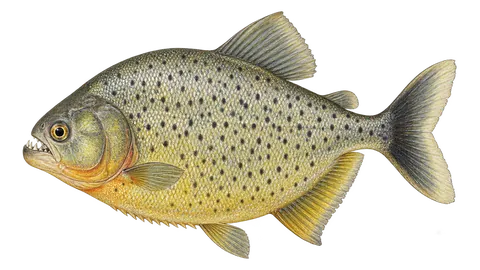
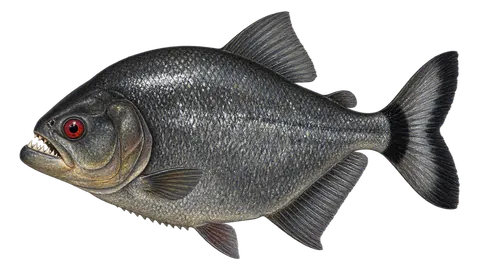
Small piranha of the Brazilian and Peruvian Amazon, up to about 19 cm. It is hard to separate from close relatives, and the name has been applied to more than one species.
Small piranha of the Amazon basin, in Brazil and Peru. FishBase lists it as a sport fish and gives 19 cm standard length as the maximum size; IUCN rates it Least Concern (2020). Its distribution is uncertain: FishBase says the occurrence in the Essequibo is not certain and cites a record in Argentina, and aquarium sources note the name may have been applied to more than one species. Its habits are not described; the genus Serrasalmus eats fish and fin pieces, and some members also eat seeds and fruit. For the angler, it is one more small piranha that steals bait and cuts thin line.
fun facts
The epithet serrulatus means 'serrated'.
FishBase cites the species in Argentina, a record that aquarium sources consider of doubtful validity.
how to recognize it
identification
Small piranha with a tall, flattened, silvery body, triangular cutting teeth in a single row and a serrated keel on the belly. It looks very much like other small Amazonian Serrasalmus (S. eigenmanni, S. hollandi, S. humeralis and S. nalseni), and safe identification depends on a specialist. In the field, treat it as a piranha and check the scientific name the local rule cites.
how piranha fishing looks
Loading the next 7 days…
Each card shows the day's index (0 to 100) and, below it, a strip with the index for each hour, from 0h to 23h. from poor to excellent.
Amazon basin, in western Brazil and Peru. The occurrence in the Essequibo is uncertain, and FishBase's Argentine record is of doubtful validity.
Habitat: Rivers, pools and igarapés of the Amazon, in shade and near marginal or submerged vegetation, like other small Serrasalmus (estimate based on the genus).
native to the basins
Amazon
states
Amazonas, Acre, Rondônia
calendar and clock
when to fish
best season
time of yearbest: Jul–Oct
JanFebSeaAprMayJunJulAugSepOctNovDec
Estimate: falling water and dry season concentrate fish in pools and channels.
best time of day
Daytime. No timing studies for the species. Small piranhas feed by day (estimate).
weather, water and behavior
what affects the piranha
sensitivity The little bars show how much each factor affects this species. Five full: it feels it a lot.
Long-shank hook and steel leader: the teeth cut nylon on contact. Set the hook fast.
what the law says
rules for the piranha
Summary of the regulations we found, with the source for each. Rules change; before keeping or transporting fish, check with the state environmental agency. Conservation: Not on the Brazilian national list (Ministerial Ordinance GM/MMA No. 1.667/2026).
We found no species-specific rule beyond the region's general rules.
piracema closures in the basins where the species lives
Spawning closure (piracema) in Mato Grosso (all basins)
01/10 to 31/01MT
Allowed: All fishing modalities are prohibited in rivers, including catch and release (Law 9.096/2009, art. 19-A). Exceptions: subsistence fishing from shore (3 kg or 1 fish, no transport or sale) and scientific fishing. Law 13.159/2025 now allows licensed sport fishing in UHE/PCH hydropower reservoirs, natural lakes and border rivers, subject to a scientific study and a license from the environmental agency. We have not confirmed whether these licenses are already being issued.
Allowed: Recreational anglers with handline or rod, line and hook are outside the Annex II prohibitions, with a bag limit of 5 kg + 1 fish, unless a stricter state rule applies.
catch and release Releasing the fish alive, quickly and with a wet hand. During a closed season it isn't always allowed: what the regulation says applies.
Long-nose pliers, and no hands near the mouth. Hold it with a damp cloth and release it quickly.
in the kitchen
Small and full of bones; we found no market notes specific to the species.
calculator
how much it weighs without taking it out of the water
Length-weight relationship W = a·Lb (a = 0.0138, b = 3.16; FishBase (relação peso-comprimento bayesiana, estimativa pelo gênero e formato do corpo)). It's an average: a fat or lean fish can vary by 10% to 20%.
estimated weight
—
sources and references
The season weights (months), the time of day and the sensitivities (cold, pressure, moon, wind, rain, tide, strong light, murky water and noise) are the app's editorial estimates, based on the literature below and on the field experience of anglers and guides. They are not official data nor a measurement made for this species, and they may vary by region and year. Closed seasons and legal rules appear in the rules section, with the norm and a link.
scientificFishBase: Serrasalmus serrulatus (ficha da espécie)Size, length-weight, depth, habitat, distribution, biology and IUCN status. Page checked on October 13, 2026. The maximum weight and the typical sizes and weights on the page are editorial estimates made with the length-weight relationship, because FishBase does not publish a maximum weight for the species.
technicalSeriously Fish: Serrasalmus serrulatusResemblance to other Serrasalmus, identification difficulty, standard length of 190 mm and doubt about the validity of the Argentine record. Page checked on October 13, 2026.