

- common size
- 35–50 cm
- maximum
- 53 cm
- common weight
- 0.5–1.5 kg
- record/max.
- 2.9 kg
- depth
- 1–10 m
- ideal water
- 24–28 °C

the right time
to be on the water
Choose the place and the species. The index, from 0 to 100, combines weather, sun, moon and tide with each fish's habits. Up to 28 days, with each day's confidence.
Loading the forecast…
—
Looking for alerts within 30 km…
Looking for what anglers have logged near here…
what you need to fish herelicense, certification and boat documents
fish likely at this spot
Tap a fish to see its forecast.
hour by hour
slide your finger or mouse over the chart to see each hoursee hour-by-hour table
why this index at —?
choose the day
the fishing month at a glance
what's the best window for the crew?
Choose how many fishing days. We compare each stretch by its average index, discount days with a warning or closed season, and show the 3 best.
trend for the coming weeks
Line: the middle value of 31 simulations of the American GEFS model. Band: where 8 out of 10 fall. Narrow, firm trend; wide, high uncertainty.
everything about the rebeca
how to recognize it
Elongated, robust body with a row of pointed bony plates along the middle of the flank, a broad, flattened head, three pairs of barbels and strong spines on the pectoral and dorsal fins. Females are larger and stockier than males. Among the doradids of the Amazon it is one of the largest; identify the species by its plates, spines and barbels together and, when in doubt, treat the fish as an armored catfish, taking care with the spines.
Also called: rebeca, bacu
don't confuse with:
where found
open on the large mapWhere to look: Slow or still water in tributaries, igarapés, swamps and lakes, among roots and submerged vegetation. It probably also uses main channels and flooded areas.
Rivers, igarapés and slow-water lakes of the Amazon and Tocantins basins, such as Lake Hyanuary, near Manaus (AM), where it was described. Outside Brazil, Bolivia, Colombia, Ecuador, Peru and the Essequibo basin.
native to the basins
states
Amazonas
when to fish
best season
It makes seasonal migrations linked to spawning, on a poorly known schedule. In the dry season, with the river low, fish concentrate in pools and channels, and bottom fishing is best then.
best time of day
Daytime. Mainly diurnal, according to FishBase, in small groups that move among roots and vegetation.
what affects the rebeca
cold and cold fronts
Cold spells (friagem) reduce activity for a few days.
atmospheric pressure
Little effect.
moon
Small effect.
rain
Heavy rain muddies the water and scatters the fish, but the species already lives in dark water.
water level
A falling river and dry season concentrate fish in pools and channels; at high water it spreads through the flooded area.
noise
Moderate: avoid knocking the hull.
wind
Little effect on the bottom.
depth
Bottom of pools and banks with roots, 2 to 8 m.
how to fish
natural baits
- forest fruit
- caramujo
- minhoca
- fish pieces
tip from an angler
Ripe fruit or a snail on the bottom, next to roots, and set the hook firmly. Once the fish is hooked, avoid contact with its body: plates and spines cut.
- rod
- 6'6" to 7', medium-heavy action, 20 to 40 lb
- spinning / baitcasting reel
- 5000 to 6000 spinning reel or low-profile baitcaster 300
- line
- braid 30 to 50 lb
- leader
- heavy monofilament 0.60 to 0.80 mm, 60 cm: the bony plates wear through the line
- hook
- 3/0 to 6/0, forged, hooks in the corner of the mouth
accessories
- thick gloves
- long-nose pliers
- boga-grip
catch and release
Use thick gloves and hold the fish firmly by the body, away from the pectoral and dorsal spines and the side plates, which cut. Remove the hook with long pliers and release slowly, in water with little current.
rules for the rebeca
Rules change; before keeping or transporting fish, check with the state environmental agency.
We found no species-specific rule beyond the region's general rules.
piracema and closed seasons
Each bar is the period when fishing is prohibited or restricted. The green line is today. Tap the name to see what is still allowed.
Closed season in Goiás (state rule)
Allowed: Sport and guided fishing only in reservoirs, catch and release with barbless hooks (no keeping, transporting or eating). Subsistence: up to 5 kg per day, for household consumption only.
Spawning closure (piracema) in Mato Grosso (all basins)
Allowed: All fishing modalities are prohibited in rivers, including catch and release (Law 9.096/2009, art. 19-A). Exceptions: subsistence fishing from shore (3 kg or 1 fish, no transport or sale) and scientific fishing. Law 13.159/2025 now allows licensed sport fishing in UHE/PCH hydropower reservoirs, natural lakes and border rivers, subject to a scientific study and a license from the environmental agency. We have not confirmed whether these licenses are already being issued.
Spawning closure (piracema) in the Araguaia River basin
Allowed: Recreational fishing only in reservoirs, with handline, rod, or spinning or baitcasting reel. Fish may only be eaten on site, not transported. Competitions prohibited. Subsistence: 3 kg + 1 fish. State rules (GO and TO) may be stricter.
Spawning closure (piracema) in the Tocantins and Gurupi river basins
Allowed: Recreational fishing only in reservoirs, with on-site consumption. Subsistence: 5 kg + 1 fish. State rules may be stricter.
Spawning closure (piracema) in Tocantins (state rule)
Allowed: Recreational catch and release with barbless hooks and a recreational fishing card; subsistence fishing by riverside and artisanal fishers from the bank or a rowboat, with a cane pole, handline and hook, with no transport or sale.
Closed season in the Amazon basin in Amazonas
Allowed: Under Portaria 48/2007 (art. 2, II), the recreational angler who fishes with handline or rod, line and hook is outside the Annex II prohibitions, unless a stricter state rule applies. Recreational angler bag limit: 5 kg + 1 fish. Competitions prohibited.
Source: Portaria IBAMA nº 48/2007
Closed season in the Amazon basin in Acre
Allowed: Recreational anglers with handline or rod, line and hook are outside the Annex II prohibitions, with a bag limit of 5 kg + 1 fish, unless a stricter state rule applies. On the Acre River, no fishing of any species during the period.
Source: Portaria IBAMA nº 48/2007; IN IBAMA nº 205/2008 (Acre River)
Closed season in the Acre river
Allowed: IN Ibama 205/2008 prohibits fishing in the Acre river and its tributaries during the closed season, with no exception for recreational anglers: treat it as prohibited.
Source: IN IBAMA nº 205/2008
Closed season in the Amazon basin in Pará
Allowed: Recreational anglers with handline or rod, line and hook are outside the Annex II prohibitions, with a bag limit of 5 kg + 1 fish, unless a stricter state rule applies.
Source: Portaria IBAMA nº 48/2007
Closed season in the rivers of Marajó Island (PA)
Allowed: The same recreational-angler exceptions as in Portaria 48/2007 apply (handline or rod, 5 kg + 1 fish), unless a stricter state rule applies.
Source: Portaria IBAMA nº 48/2007
Amazon basin closed season in Rondônia
Allowed: In the Madeira, Mamoré, Jamari, Abunã, Machado and Roosevelt river basins and in the main channel of the Guaporé, licensed recreational anglers may fish only for non-protected species, using a single simple gear per person (handline, rod with or without a reel, or a simple pole with a single hook). The limit is up to 5 kg or 1 fish per week; if the fish is over 5 kg, you keep only that one. You may not sell, trade or give away the catch. Catch and release is allowed only with non-protected species. Fishing is always banned within 200 m of dams, rapids, waterfalls, fish ladders and river mouths.
Closed season in the Amazon basin in Amapá
Allowed: Recreational anglers with handline or rod, line and hook are outside the Annex II prohibitions, with a bag limit of 5 kg + 1 fish, unless a stricter state rule applies.
Source: Portaria IBAMA nº 48/2007
Closed season in Roraima
Border rivers MT/RO and MT/PA
Allowed: See the exceptions in Portaria 48/2007 and the state rules for each bank.
Source: Portaria IBAMA nº 48/2007
Conservation: Not on the Brazilian national list (Ministerial Ordinance GM/MMA No. 1.667/2026).
how much it weighs without taking it out of the water
estimated weight
—
how we calculate
Length-weight relationship W = a·Lb (a = 0.0123, b = 3.0; FishBase (relação peso-comprimento bayesiana, estimativa da própria espécie)). It's an average: a fat or lean fish can vary by 10% to 20%.
more about the rebeca
Doradid, a catfish with spines and bony plates, reaching 53 cm standard length and 2.9 kg. It lives in the Amazon, Tocantins and Essequibo basins (Brazil, Bolivia, Colombia, Ecuador and Peru, per FishBase's country list) and was described from Lake Hyanuary, near Manaus. It seeks slow or still water, in tributaries, igarapés and swamps, sheltering among roots and submerged vegetation. It lives in small groups, sometimes forming shoals, and is mainly diurnal. It is omnivorous: it eats snails and fruit that fall into the water, such as those of Licania longipetala and jauari (Astrocaryum jauari). It makes seasonal migrations linked to spawning. It turns up in commercial fishing and, now and then, on the bottom hook of anglers fishing in the Amazon.
Family: Doradidae · omnivore
fun facts
- English-speaking aquarists call it the 'mother of snails' catfish because it eats large numbers of snails.
- The side plates and pectoral spines can catch in the net and cut the skin.
- It likes fruit that falls into the water, such as jauari fruit.
in the kitchen
It shows up in commercial fishing. The thick skin and bony plates call for careful cleaning; the meat is catfish-type, good in caldeirada.
similar species
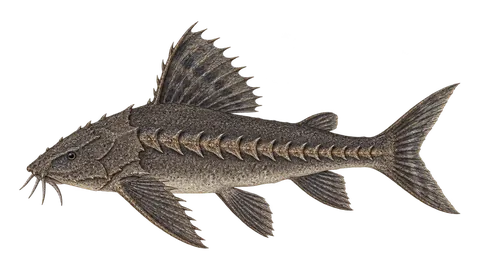
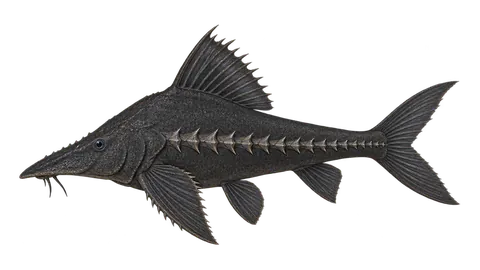


sources and references (4)
The season weights (months), the time of day and the sensitivities (cold, pressure, moon, wind, rain, tide, strong light, murky water and noise) are the app's editorial estimates, based on the literature below and on the field experience of anglers and guides. They are not official data nor a measurement made for this species, and they may vary by region and year. Closed seasons and legal rules appear in the rules section, with the norm and a link.
- scientific FishBase: Megalodoras uranoscopus (ficha da espécie)Size, length-weight relationship, depth, habitat, distribution, biology and IUCN status. Page checked on October 13, 2026. The common size (FishBase gives 49 cm standard length) and the common weight and depth range are editorial estimates for sport fish; the maximum length of 53 cm and the weight of 2.9 kg are as published. The color pattern follows that of doradids in general, because we found no published description of this species' coloration.
- scientific FishBase: nomes populares de Megalodoras uranoscopusNames by country and language.
- official Portaria GM/MMA nº 1.667, de 27 de abril de 2026: Lista Nacional Oficial de Espécies da Fauna Ameaçadas de Extinção (peixes e invertebrados aquáticos)The species is not on the list. Checked in the DOU of April 28, 2026.
- technical Seriously Fish: Megalodoras uranoscopusSlow-water habitat, omnivorous diet (snails and fruit), group behavior, migrations linked to spawning and differences between the sexes. Page checked on October 13, 2026.
how we calculatewhere each number comes from
The weather comes from three independent global models, cross-checked hour by hour: when they agree, confidence goes up; when they diverge, the band between them shows on the chart. Beyond 16 days, we use the GEFS ensemble of 31 simulations: if 20 of the 31 predict rain, the chance of rain is 65%. Sun and moon are calculated astronomically, with no uncertainty.
The index adds up, weighted for each species: time of day (species curve anchored to real sunrise and sunset), moon (transits, rise and set, phase), pressure (3 h trend and 24 h swing), water temperature (in rivers, estimated from air temperature; at sea, estimated by an ocean model), wind, rain, clouds, tide and the month in the species' cycle.
sources for this lookup
how accurate the forecast is
Accuracy measured in the reference project (4 regions, 93 days, forecast vs. observed): maximum temperature is off by 0.6 °C on average the next day and 1.7 °C at 7 days; rain of 5 mm or more is detected 76% of the time the next day and 57% at 7 days. Detection isn't everything: the false alarm rate isn't published here yet, and 93 days in 4 regions is still a small sample. We now also measure every day, at the app's destinations: