

sardinha-papuda
Triportheus angulatus
The freshwater sardine of the Amazon: schools near the surface, a projecting chest and strong demand at the markets. Caught on a cane pole with fruit or insects.
- common size
- 14–20 cm
- maximum
- 24 cm
- common weight
- 0.1–0.1 kg
- record/max.
- 0.2 kg
- depth
- 0–3 m
- ideal water
- 26–31 °C
how to recognize it
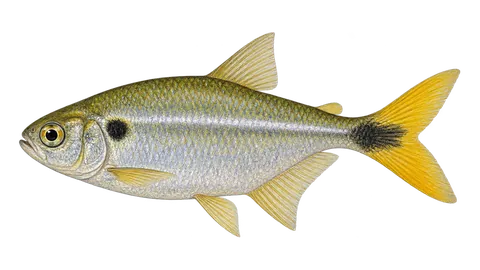
Compressed, silvery body, with the chest projecting into a keel, like a pouch. Long pectoral fins. Upturned mouth. Forked tail with dark central rays. Not related to marine sardines.
Also called: sardinha, sardinha-papuda, sardinha-chata, sardinha-de-água-doce
don't confuse with:
where found
open on the large mapWhere to look: Surface and mid-water of rivers, paranás (river channels) and várzea lakes, over sand and near flooded forest.
Rivers and várzea lakes across the whole Amazon basin. Mato Grosso do Sul's fishing decree lists the species among the state's non-native species.
native to the basins
states
Amazonas, Pará, Amapá, Acre, Rondônia, Roraima
when to fish
next 7 days
Loading the next 7 days…
best season
Falling water and dry season (July to November). From Nov 15 to Mar 15 there is a closed season in Amazonas, Acre and Amapá.
best time of day
Daytime. Active by day, especially in the morning and late afternoon.
what affects the sardinha-papuda
cold and cold fronts
Cold spells send the school to the bottom.
atmospheric pressure
Little known effect.
moon
Little effect.
rain
Heavy rain scatters the surface school.
water level
Falling water concentrates the school.
noise
Splashing and motor noise make the school sink.
wind
Strong wind and chop hamper surface fishing.
depth
Surface, up to 1 m.
how to fish
lures
- dry fly or small nymph
natural baits
- small fruits from the bank
- inseto
- bread dough
tip from an angler
Very shallow bait, almost at the surface, with a small float; floating bran chum keeps the school in place.
- rod
- cane pole 3 to 4 m or fly 3 to 5
- spinning / baitcasting reel
- optional
- line
- monofilament 0.18 to 0.22 mm
- leader
- optional
- hook
- small, #12 to 8
accessories
- small float
- floating bran chum
catch and release
Fragile: loses scales easily. Release it without gripping it hard, with a dry hand.
rules for the sardinha-papuda
Rules change; before keeping or transporting fish, check with the state environmental agency.
Amazon closed season (AM, AC, AP)
catch, transport and sale prohibited (commercial fishing)15/11 to 15/03AMACAP details
In AM, AC and AP the sardine (Triportheus spp.) is listed in Annex II of the ordinance, with fishing banned from November 15 to March 15. Under art. 2 of the ordinance, recreational anglers fishing with a hand line or rod, line and hook are exempt from this ban, unless a stricter state rule applies; during the period the recreational bag limit is 5 kg + 1 fish.
MS: added to the bag limit, no limit (non-native)
can be added to the bag limit, subject to the closed seasonMS details
In MS the freshwater sardine (Triportheus angulatus) is on the list of exotic and allochthonous species that may be added to the angler's bag limit, subject to the closed season.
piracema and closed seasons
Each bar is the period when fishing is prohibited or restricted. The green line is today. Tap the name to see what is still allowed.
Spawning closure (piracema) in Mato Grosso (all basins)
Allowed: All fishing modalities are prohibited in rivers, including catch and release (Law 9.096/2009, art. 19-A). Exceptions: subsistence fishing from shore (3 kg or 1 fish, no transport or sale) and scientific fishing. Law 13.159/2025 now allows licensed sport fishing in UHE/PCH hydropower reservoirs, natural lakes and border rivers, subject to a scientific study and a license from the environmental agency. We have not confirmed whether these licenses are already being issued.
Closed season in the Amazon basin in Amazonas
Allowed: Under Portaria 48/2007 (art. 2, II), the recreational angler who fishes with handline or rod, line and hook is outside the Annex II prohibitions, unless a stricter state rule applies. Recreational angler bag limit: 5 kg + 1 fish. Competitions prohibited.
Source: Portaria IBAMA nº 48/2007
Closed season in the Amazon basin in Acre
Allowed: Recreational anglers with handline or rod, line and hook are outside the Annex II prohibitions, with a bag limit of 5 kg + 1 fish, unless a stricter state rule applies. On the Acre River, no fishing of any species during the period.
Source: Portaria IBAMA nº 48/2007; IN IBAMA nº 205/2008 (Acre River)
Closed season in the Acre river
Allowed: IN Ibama 205/2008 prohibits fishing in the Acre river and its tributaries during the closed season, with no exception for recreational anglers: treat it as prohibited.
Source: IN IBAMA nº 205/2008
Closed season in the Amazon basin in Pará
Allowed: Recreational anglers with handline or rod, line and hook are outside the Annex II prohibitions, with a bag limit of 5 kg + 1 fish, unless a stricter state rule applies.
Source: Portaria IBAMA nº 48/2007
Closed season in the rivers of Marajó Island (PA)
Allowed: The same recreational-angler exceptions as in Portaria 48/2007 apply (handline or rod, 5 kg + 1 fish), unless a stricter state rule applies.
Source: Portaria IBAMA nº 48/2007
Amazon basin closed season in Rondônia
Allowed: In the Madeira, Mamoré, Jamari, Abunã, Machado and Roosevelt river basins and in the main channel of the Guaporé, licensed recreational anglers may fish only for non-protected species, using a single simple gear per person (handline, rod with or without a reel, or a simple pole with a single hook). The limit is up to 5 kg or 1 fish per week; if the fish is over 5 kg, you keep only that one. You may not sell, trade or give away the catch. Catch and release is allowed only with non-protected species. Fishing is always banned within 200 m of dams, rapids, waterfalls, fish ladders and river mouths.
Closed season in the Amazon basin in Amapá
Allowed: Recreational anglers with handline or rod, line and hook are outside the Annex II prohibitions, with a bag limit of 5 kg + 1 fish, unless a stricter state rule applies.
Source: Portaria IBAMA nº 48/2007
Closed season in Roraima
Border rivers MT/RO and MT/PA
Allowed: See the exceptions in Portaria 48/2007 and the state rules for each bank.
Source: Portaria IBAMA nº 48/2007
Conservation: Not on the national list (Portaria GM/MMA 1.667/2026).
how much it weighs without taking it out of the water
estimated weight
—
how we calculate
Length-weight relationship W = a·Lb (a = 0.01413, b = 2.91; FishBase). It's an average: a fat or lean fish can vary by 10% to 20%.
more about the sardinha-papuda
Schooling fish living near the surface over sandy bottoms, in rivers and várzea (floodplain) lakes of the Amazon. Active by day, it eats almost anything: fruit and seeds falling from the forest, insects, plankton and small crustaceans. Its projecting chest, where the long pectoral fins attach, gives it the name papuda. It is one of the most landed species at Amazon ports and has its own closed season in several states. On a cane pole it is caught with fruit, insects or dough; it is also used as bait for peacock bass where the rules allow.
Family: Triportheidae · omnivore
fun facts
- The projecting chest supports the muscles of the pectoral fins, which help with short jumps at the surface.
- It eats many fruits and helps spread seeds of the flooded forest.
in the kitchen
Fried whole and crispy; also in caldeirada.
similar species
sources and references (6)
The season weights (months), the time of day and the sensitivities (cold, pressure, moon, wind, rain, tide, strong light, murky water and noise) are the app's editorial estimates, based on the literature below and on the field experience of anglers and guides. They are not official data nor a measurement made for this species, and they may vary by region and year. Closed seasons and legal rules appear in the rules section, with the norm and a link.
- scientific FishBase — Triportheus angulatus (ficha da espécie)Names, distribution, biology, length-weight relationship and references. Page checked on October 13, 2026.
- official Portaria GM/MMA nº 1.667, de 27 de abril de 2026 — Lista Nacional Oficial de Espécies da Fauna Ameaçadas de Extinção (peixes e invertebrados aquáticos)Most recent national list. The species is not on it (search by scientific name in the text published in the DOU, checked on October 13, 2026).
- official ICMBio/SALVE — Ficha de Triportheus angulatus (avaliação nacional do risco de extinção)ICMBio national assessment, published in 2025. DOI checked on Crossref.
- scientific IUCN Red List — Triportheus angulatus (avaliação global: Pouco Preocupante, LC, 30/11/2020)Global assessment. Link given on the FishBase entry (Red List, version 2025-2).
- scientific Ferreira, E. J. G.; Zuanon, J. A. S.; Santos, G. M. (1998). Peixes comerciais do médio Amazonas: região de Santarém, Pará. Brasília: Ibama. 211 p.Printed work; the URL is the bibliographic record on FishBase, which cites this work for the species.
- scientific Mérona, B. de; Rankin-de-Mérona, J. (2004). Food resource partitioning in a fish community of the central Amazon floodplain. Neotropical Ichthyology 2(2): 75–84.Diet of várzea species of central Amazonia, including the sardine. DOI checked in Crossref.