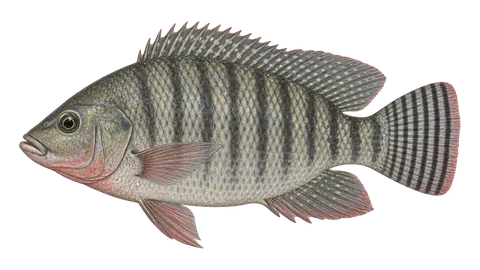
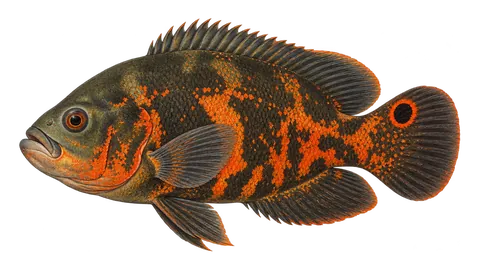
The first tilapia to reach Brazil, in 1950, brought in to clear aquatic plants from reservoirs. Tall body with a yellow or red belly, and a habit of eating leaves and stems. Fish with light tackle and never release into a river or reservoir.
Also called: tilápia-rendali, tilápia-do-congo, tilápia
African cichlid from the Congo basin and the southern part of the continent, it was the first tilapia introduced to Brazil: it arrived in 1950 through a São Paulo power company, and in 1952 through the São Paulo state Department of Agriculture, to stock reservoirs and control aquatic plants that clogged turbines. Farming lost ground to the Nile tilapia because it grows slowly and breeds early. It escaped, established itself and now has records in the natural environment in RS, SC, PR, SP, MG, RJ, MS, DF, PE and AP. It prefers calm, vegetated water; juveniles eat plankton, and adults eat leaves, stems and algae, plant debris, insects and crustaceans. It breeds fast and harms native fish when released outside farms. FishBase says it makes excellent food.
fun facts
It was the first tilapia to reach Brazil, in 1950, and was used to control aquatic plants in reservoirs.
The population can double in about 4.5 years, according to a Brazilian survey.
Both parents guard eggs and fry in a nest dug in the bottom, unlike tilapias that incubate in the mouth.
how to recognize it
identification
Tall, compressed body, narrow head with a steeply sloping profile and a small mouth. Olive-green to brown color, with dark transverse blotches and a white, yellow or bright red belly. The dorsal fin has 15 to 17 spines. Males are larger, with elongated, pointed tips on the dorsal and anal fins; females have rounded fins. In Africa it looks very much like Coptodon zillii, but the rendali has a steeper head and less marked vertical bars.
how redbreast tilapia fishing looks
Loading the next 7 days…
Each card shows the day's index (0 to 100) and, below it, a strip with the index for each hour, from 0h to 23h. from poor to excellent.
Exotic, native to Africa. Records in the natural environment in RS, SC, PR, SP, MG, RJ, MS, DF, PE and AP (the source gives no basin) and listed as exotic in the Araguaia-Tocantins, Paranaíba and São Francisco basins in Goiás. Outside Brazil, it is established in Mexico, Cuba, the Dominican Republic, Puerto Rico, El Salvador, Colombia and Peru.
Habitat: Calm, well-vegetated water, in river eddies, swamps, reservoirs, lagoons and canals; tolerates brackish water. Pairs dig a nest in a muddy or sandy bottom and guard the eggs and fry.
São Paulo, Goiás, Rio Grande do Sul, Santa Catarina, Paraná, Minas Gerais, Rio de Janeiro, Mato Grosso do Sul, Distrito Federal, Pernambuco, Amapá
calendar and clock
when to fish
best season
time of yearbest: Oct–Mar
JanFebSeaAprMayJunJulAugSepOctNovDec
Spring and summer, when the water warms and pairs guard their nests; in winter, especially in the South and Southeast, activity drops sharply. FishBase gives 24 to 28 °C as the comfort range, with tolerance of 8 to 41 °C.
best time of day
Daytime. Mainly by day and in shoals; it feeds best in the warm hours of winter and early or late in the afternoon in summer.
weather, water and behavior
what affects the redbreast tilapia
sensitivity The little bars show how much each factor affects this species. Five full: it feels it a lot.
cold and cold fronts
Sensitive: below about 18 °C it eats little, although it survives very low temperatures without dying.
atmospheric pressure
Little effect.
moon
No significant effect.
rain
Cold rain shuts down activity.
water level
Little effect; look for banks with vegetation and eddies.
noise
Tolerant, used to pay lakes and reservoirs.
wind
A little chop helps; strong wind makes it hard to see the float.
depth
Shallow and near plants in heat; 3 to 8 m in cold.
Fish next to aquatic plants with a feeding float and a small hook. The bite is that of a cautious herbivore: wait for the float to run and set the hook lightly.
what the law says
rules for the redbreast tilapia
Summary of the regulations we found, with the source for each. Rules change; before keeping or transporting fish, check with the state environmental agency. Conservation: The Least Concern status applies to the native range, in Africa. In Brazil it is an exotic species and is not on the national list (Portaria GM/MMA nº 1.667/2026); management aims to prevent new releases.
Releasing into a river, lake or reservoir without a license is an offense
introducing or releasing into the natural environment is banned without a technical opinion and a licenseconfirm with the agency
Introducing an animal specimen, native or exotic, into the country or outside its natural range, without a favorable official technical opinion and a license from the environmental authority, is an offense (Decreto 6.514/2008, art. 25) and a crime (Lei 9.605/1998, art. 31). Releasing redbreast tilapia from a tank, fish farm or aquarium into a river, lake or reservoir falls under this, according to environmental agencies. Anglers catching the fish in the environment where it already lives should follow the local rule on releasing or killing it.
Mato Grosso do Sul: tilapias can be added to the bag limit
fish may be added to the limit of 1 fish + 5 piranhas, observing the closed seasonMSParaguay (Pantanal)Paraná
State Decree 15.166/2019, art. 7º, allows recreational anglers to add to their limit exotic, allochthonous and hybrid fish, including tilapias (Oreochromis spp. and Tilapia spp.), provided the closed season is observed. The list uses the old genus Tilapia, which included the redbreast tilapia (Coptodon rendalli).
Mato Grosso: introducing an exotic species without a license brings a fine
fine of R$6,000 to R$100,000, plus R$100 per kilo or fractionMT
Art. 46 of MT's fishing law penalizes anyone who introduces native, exotic or non-native species without authorization or a license from the competent agency, or in breach of the license. It applies to releasing captive-raised fish into a river or lake.
Mato Grosso: catch and transport of exotic fish have their own resolution
under Cepesca Resolution nº 02/2024MTParaguay (Pantanal)AmazonTocantins-Araguaiaconfirm with the agency
The official Sema-MT table (updated June 6, 2025) cites Cepesca Resolution nº 02, of March 7, 2024, which regulates the catch and transport of exotic fish in the rivers of the Paraguay, Amazon and Araguaia-Tocantins basins. We did not check the text of the resolution: confirm the conditions with Sema-MT before transporting. Transporte Zero under art. 19-B covers only the 12 native species on the list, none of which are tilapias.
Mexico: up to 5 freshwater fish per day, no live fish as bait
5 freshwater fish per angler per day; 1 rod; no sale
In Mexico's federal-jurisdiction inland waters, the limit for freshwater species is 5 fish per angler per day, with only one rod in operation. Using fish as live bait in inland waters is banned, and fish caught in sport fishing may not be sold. Each reservoir's committee may lower the limit and set sizes. The rule does not mention tilapia or give an exception for exotic species; fish above the limit may be caught if released alive (item 4.9.5).
Goiás: redbreast tilapia released in the Araguaia-Tocantins, Paranaíba and São Francisco basins
catch, kill and transport with no size or quantity limit; no saleGOTocantins-AraguaiaParanáSão Francisco
IN Semad-GO nº 17/2026, art. 5º, allows the collection, killing and transport of the exotic, allochthonous and hybrid species in Annex II, with no size or quantity limit. The redbreast tilapia (Coptodon rendalli) is in Annex II for the Araguaia-Tocantins, Paranaíba and São Francisco basins. The fish may not be sold or processed, and a fishing license remains mandatory. Outside Annex II the zero transport limit of art. 2º applies, with on-site consumption of up to 5 kg per angler.
catch and release Releasing the fish alive, quickly and with a wet hand. During a closed season it isn't always allowed: what the regulation says applies.
Exotic: do not return it to environments where it does not yet exist, and never release live fish from a tank or fish farm into a river, lake or reservoir. Where local rules allow, prefer killing it for food.
in the kitchen
FishBase describes it as excellent eating. White fillet, fried, baked or grilled, like other tilapias.
calculator
how much it weighs without taking it out of the water
Length-weight relationship W = a·Lb (a = 0.01585, b = 3.0; FishBase (relação peso-comprimento bayesiana, estimativa da própria espécie)). It's an average: a fat or lean fish can vary by 10% to 20%.
estimated weight
—
sources and references
The season weights (months), the time of day and the sensitivities (cold, pressure, moon, wind, rain, tide, strong light, murky water and noise) are the app's editorial estimates, based on the literature below and on the field experience of anglers and guides. They are not official data nor a measurement made for this species, and they may vary by region and year. Closed seasons and legal rules appear in the rules section, with the norm and a link.
scientificFishBase: Coptodon rendalli (ficha da espécie)Size, length-weight relationship, depth, habitat, distribution, biology and IUCN status. Page checked on October 13, 2026. The common size and weight are editorial estimates for sport fish; the maximum length of 45 cm and the weight of 2.5 kg are as published. The depth range of the card (3 to 8 m) is FishBase's.
scientificFishBase: introduções de Coptodon rendalliList of introductions by country, with the entry into Brazil (1953, from Zaire) and the shipment from Brazil to Peru (1966). Page checked on October 13, 2026. The 1950 date used in the text comes from Moreira and Silva (2023).