FreshwaterEstuarynon-native in BrazilIUCN global: VU · vulnerable
Exotic African tilapia, tolerant of brackish water, low oxygen and temperature changes. It has scattered records in Brazil. It is Vulnerable in Africa, but here it is invasive: fish with light tackle and never release into a river or reservoir.
Cichlid from southeastern Africa (lower Zambezi, Shire and coastal plains as far as Algoa Bay), taken to aquaculture in many countries. It escaped, established itself in several of them and often displaces native fish. It is very hardy: it grows and breeds in fresh, brackish and salt water, tolerates low oxygen and can use surface air. Omnivorous, it eats algae, plankton, insects, shrimp and aquatic plants; adults tend toward herbivory and large ones may take small fish. The female incubates the eggs in her mouth. In Brazil, FishBase records an introduction between 1960 and 1969, and a 2023 survey cites an entry in 1981 for crossbreeding with other tilapias; records in the natural environment are few, such as in the Tietê River at Buritama (SP) and in Paraíba.
fun facts
It grows and breeds in fresh, brackish and salt water and tolerates even hypersaline conditions.
Only territorial males make sounds during courtship, and the female incubates the eggs alone, living off her body reserves.
Crossed with Oreochromis urolepis hornorum, it gave rise to the farmed 'red tilapia' (or 'Florida red').
It is on the IUCN list as Vulnerable (A4ae) because of the native African populations; in Brazil it is an exotic species.
how to recognize it
identification
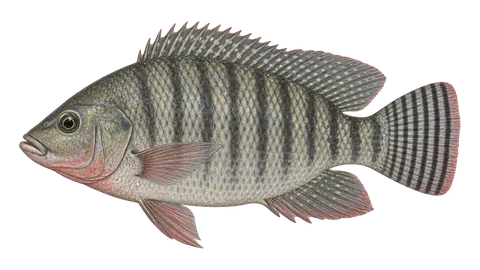
Adult males have an elongated snout, like a duck's bill, due to enlarged jaws, and the upper head profile is concave. Breeding males are black, with a white underside of the head and red edges on the dorsal and tail fins; females and males outside breeding are silvery, with 2 to 5 dark spots in the middle of the flank. The dorsal fin has 15 to 18 spines. The head scales are relatively large: two between the eyes and nine up to the dorsal fin.
how mozambique tilapia fishing looks
Loading the next 7 days…
Each card shows the day's index (0 to 100) and, below it, a strip with the index for each hour, from 0h to 23h. from poor to excellent.
Native to southeastern Africa. In Brazil it is exotic, with few records in the natural environment: Tietê River (Buritama, SP), Paraíba and the Araguaia-Tocantins basin in Goiás, where the state rule lists it as exotic. Outside Brazil, established in Central America, the Antilles, Mexico, Colombia, Venezuela, Peru, Bolivia and the Guianas.
Habitat: Reservoirs, rivers, streams, canals, swamps and tidal creeks, usually over muddy bottoms and with vegetation; very common in closed estuaries and coastal lagoons. Tolerates low oxygen and survives in temporary pools.
Feeding float with pellet bait and a small hook 20 to 40 cm below, next to vegetated banks. Set the hook lightly when the float runs away.
what the law says
rules for the mozambique tilapia
Summary of the regulations we found, with the source for each. Rules change; before keeping or transporting fish, check with the state environmental agency. Conservation: The Vulnerable status applies to the native populations in Africa. In Brazil it is an exotic species and is not on the national list (Portaria GM/MMA nº 1.667/2026); management aims to prevent new releases.
Releasing into a river, lake or reservoir without a license is an offense
introducing or releasing into the natural environment is banned without a technical opinion and a licenseconfirm with the agency
Introducing an animal specimen, native or exotic, into the country or outside its natural range, without a favorable official technical opinion and a license from the environmental authority, is an offense (Decreto 6.514/2008, art. 25) and a crime (Lei 9.605/1998, art. 31). Releasing Mozambique tilapia from a tank, fish farm or aquarium into a river, lake or reservoir falls under this, according to environmental agencies. Anglers catching the fish in the environment where it already lives should follow the local rule on releasing or killing it.
Mato Grosso do Sul: tilapias can be added to the bag limit
fish may be added to the limit of 1 fish + 5 piranhas, observing the closed seasonMSParaguay (Pantanal)Paraná
State Decree 15.166/2019, art. 7º, allows recreational anglers to add to their limit fish of exotic, allochthonous and hybrid species, including tilapias (Oreochromis spp. and Tilapia spp.), provided the closed season is observed.
Mato Grosso: introducing an exotic species without a license brings a fine
fine of R$6,000 to R$100,000, plus R$100 per kilo or fractionMT
Art. 46 of MT's fishing law penalizes anyone who introduces native, exotic or non-native species without authorization or a license from the competent agency, or in breach of the license. It applies to releasing captive-raised fish into a river or lake.
Mato Grosso: catch and transport of exotic fish have their own resolution
under Cepesca Resolution nº 02/2024MTParaguay (Pantanal)AmazonTocantins-Araguaiaconfirm with the agency
The official Sema-MT table (updated June 6, 2025) cites Cepesca Resolution nº 02, of March 7, 2024, which regulates the catch and transport of exotic fish in the rivers of the Paraguay, Amazon and Araguaia-Tocantins basins. We did not check the text of the resolution: confirm the conditions with Sema-MT before transporting. Transporte Zero under art. 19-B covers only the 12 native species on the list, none of which are tilapias.
Mexico: up to 5 freshwater fish per day, no live fish as bait
5 freshwater fish per angler per day; 1 rod; no sale
In Mexico's federal-jurisdiction inland waters, the limit for freshwater species is 5 fish per angler per day, with only one rod in operation. Using fish as live bait in inland waters is banned, and fish caught in sport fishing may not be sold. Each reservoir's committee may lower the limit and set sizes. The rule does not mention tilapia or give an exception for exotic species; fish above the limit may be caught if released alive (item 4.9.5).
Goiás: Mozambique tilapia released in the Araguaia-Tocantins basin
catch, kill and transport with no size or quantity limit; no saleGOTocantins-Araguaia
IN Semad-GO nº 17/2026, art. 5º, allows the collection, killing and transport of the exotic, allochthonous and hybrid species in Annex II, with no size or quantity limit. The Mozambique tilapia (Oreochromis mossambicus) is in Annex II for the Araguaia-Tocantins basin; in the Paranaíba and São Francisco basins it is not on the list. The fish may not be sold or processed, and a fishing license remains mandatory. Outside Annex II the zero transport limit of art. 2º applies, with on-site consumption of up to 5 kg per angler.
catch and release Releasing the fish alive, quickly and with a wet hand. During a closed season it isn't always allowed: what the regulation says applies.
Exotic: do not return it to environments where it does not yet exist, and never release live fish from a tank or fish farm into a river, lake or reservoir. Where local rules allow, prefer killing it for food.
in the kitchen
A common table fish worldwide (FishBase records commercial fishing and aquaculture). Fried, baked or grilled, like other tilapias; fish from muddy water improve with quick bleeding and cleaning.
calculator
how much it weighs without taking it out of the water
Length-weight relationship W = a·Lb (a = 0.01698, b = 3.0; FishBase (relação peso-comprimento bayesiana, estimativa da própria espécie)). It's an average: a fat or lean fish can vary by 10% to 20%.
estimated weight
—
sources and references
The season weights (months), the time of day and the sensitivities (cold, pressure, moon, wind, rain, tide, strong light, murky water and noise) are the app's editorial estimates, based on the literature below and on the field experience of anglers and guides. They are not official data nor a measurement made for this species, and they may vary by region and year. Closed seasons and legal rules appear in the rules section, with the norm and a link.
scientificFishBase: Oreochromis mossambicus (ficha da espécie)Size, length-weight relationship, depth, habitat, distribution, biology and IUCN status. Page checked on October 13, 2026. The common size and weight are editorial estimates for sport fish (FishBase gives a common length of 35 cm, from a farming source); the maximum length of 39 cm is standard length and the weight of 1.1 kg is as published.
scientificFishBase: introduções de Oreochromis mossambicusList of introductions by country, with the record in Brazil (1960 to 1969) and the shipment from Brazil to Bolivia (1983). Page checked on October 13, 2026.