Skip to content
catalog Salmonidae · predator

brown trout

Salmo trutta

Freshwater

European salmonid introduced to Patagonia in the 20th century. In the rivers of Tierra del Fuego, the form that spends part of its life at sea returns huge, making the Río Grande one of the world's most famous fly-fishing destinations.

Also called: truta-marrom, truta-fário, brown trout, truta-marinha (forma que vai ao mar)

Scientific illustration of Brown trout
common size
35–70 cm
maximum
140 cm
common weight
0.5–5 kg
record/max.
50.0 kg
depth
0.3–20 m
ideal water
8–16 °C
overview

who is the brown trout

Native to Europe and western Asia, it was released into lakes and rivers of Argentine Patagonia and southern Chile through the 20th century and established itself in almost every cold habitat. It is the most wary and the most predatory of the trouts: large fish eat other fish and hunt mostly at dawn and dusk. Some populations run to sea, feed there and return to rivers to spawn; in Tierra del Fuego and Chilean Patagonia these sea-run trout climb the rivers in summer and autumn and are the great fly-fishing trophy. There are also lake forms that grow very large in Andean lakes. Like any introduced species, it competes with native fish such as the perch and galaxiids. Fishing follows strict seasons and regulations in both countries.

fun facts

  • Sea-run trout and river trout are the same species; the difference is whether or not they spend a phase of their life at sea.
  • The rivers of Tierra del Fuego produce some of the largest sea-run trout in the world, and on the most sought-after rivers almost all fishing is catch and release.
how to recognize it

identification

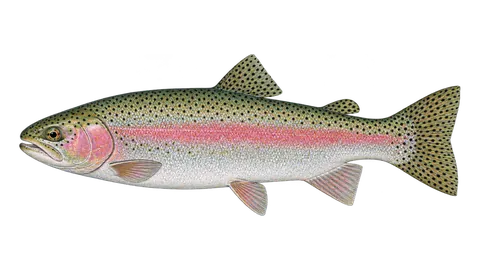
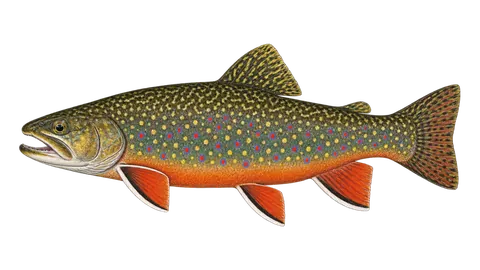
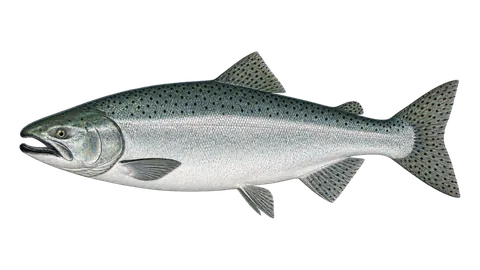
Spindle-shaped body, golden to olive-brown, with black and red spots scattered along the flanks, often with a pale halo. Adipose fin with an orange edge and a nearly straight tail, with few or no spots. The rainbow has a pink stripe and a fully spotted tail; the fontinalis has worm-like markings on its back and white-edged fins. The sea-run form is silvery, with X-shaped black spots.

how brown trout fishing looks

Loading the next 7 days…

Each card shows the day's index (0 to 100) and, below it, a strip with the index for each hour, from 0h to 23h. from poor to excellent.

distribution

where found

open on the large map

Not established in Brazil. Exotic, native to Europe and western Asia. Andean-Patagonian lakes and rivers of Argentina (Neuquén, Río Negro, Chubut, Santa Cruz and Tierra del Fuego) and southern Chile. The sea-run form climbs rivers in Tierra del Fuego, especially the Río Grande, and rivers in Chilean Patagonia.

Habitat: Cold, clear rivers with deep pools, undercut banks, logs and rapids; Andean lakes and river mouths on lakes. The sea-run form spends part of the year in coastal sea and estuaries.

calendar and clock

when to fish

best season

time of yearbest: Jan–Apr
JanFebSeaAprMayJunJulAugSepOctNovDec

In Patagonia the season usually runs from November to April or May, depending on the province or region. Sea-run trout enter the Tierra del Fuego rivers from January, and February to April are usually the best months. Outside the season, salmonid fishing is prohibited in most habitats.

best time of day

0h6h12h18h sunrise ~6amsunset ~6pm

Dawn and dusk. Large fish hunt at dawn, late afternoon and on dark days. In strong sun and clear water they hide in pools and under banks.

weather, water and behavior

what affects the brown trout
sensitivity The little bars show how much each factor affects this species. Five full: it feels it a lot.

cold and cold fronts

Tolerates very cold water. What shuts down fishing is warm water above 20 °C.

atmospheric pressure

Overcast days with falling pressure ahead of a front usually produce more.

moon

On a full moon large fish feed more at night and are lazy by day.

rain

Light rain helps; meltwater or storm flooding muddies the river for days.

water level

A river rising after rain encourages sea-run trout to enter; very low, clear water keeps the fish wary.

noise

Extremely wary: approach crouching, with no shadow over the pool, and cast from a distance.

wind

Strong Patagonian and Tierra del Fuego winds call for heavy lines and low casts; at times they ruffle the water and help.

depth

In rivers, pools and undercut banks at 1 to 3 m; in lakes it drops to 10 to 20 m in summer.

technique, gear and bait

how to fish

rod
fly #6 to #8, 9' to 10'; for sea-run trout, switch or spey #7 to #8; spinning 6'6" to 7'6", 6 to 14 lb
spinning / baitcasting reel
fly reel with a good drag; spinning reel 2500 to 3000
line
fly: floating or sink-tip; spinning: monofilament 0.22 to 0.30 mm
leader
tippet 8 to 16 lb (heavier for sea-run trout)
hook
flies #2 to 12; single barbless hooks where required

lures

  • streamers (woolly bugger, zonker)
  • nymphs with rubber legs for sea-run trout
  • dry flies during insect hatches
  • minnow 7 to 11 cm
  • spoon 7 to 15 g
  • spinner #3 to 4

natural baits

  • natural bait is usually banned for salmonid fishing in Patagonia; use artificials only

accessories

  • waders and felt or rubber boots
  • large passaguá
  • polarized glasses
  • water thermometer
  • corta-vento

tip from an angler

Cast at an angle downstream and let the fly sweep across the pool (swing). Sea-run trout strike at the end of the swing: keep the line tight and do not set the hook before you feel the weight.

what the law says

rules for the brown trout

Summary of the regulations we found, with the source for each. Rules change; before keeping or transporting fish, check with the state environmental agency.
Conservation: Exotic in South America and considered invasive: it preys on and competes with native fish in Patagonian lakes and rivers.

Chile: license and limit of 3 fish or 15 kg per day

3 fish or 15 kg per day (whichever comes first)confirm with the agency

In recreational salmonid fishing in Chile's inland waters, including brown trout, the general rule published by Sernapesca is a maximum of 3 fish or 15 kg per angler per day, with a valid recreational fishing license and one rod per person. The season is set by region (in Magallanes, 2025-2026: Oct 16 to Apr 14), and some rivers and lakes are catch-and-release only. In some regions live or organic bait is banned for salmonids.

Source: Sernapesca — Ley de Pesca Recreativa nº 20.256 and regional season resolutions (official notices from 2023 and 2025)

Argentina (Patagonia): season-based regulations

permit required; bag limits and release rules vary by habitatconfirm with the agency

Brown trout and other salmonid fishing in Argentine Patagonia follows the Reglamento General de Pesca Deportiva Continental Patagónico, renewed each season by the Patagonian provinces and the Administración de Parques Nacionales (for 2025/2026, Resolución APN 417/2025). A fishing permit is required, and opening dates, bag limits and mandatory release sections vary by lake and river. Check the season regulations before keeping any fish.

Source: Resolución APN nº 417/2025 (Boletín Oficial, Dec 9, 2025) and General Regulation of Patagonian Inland Sport Fishing

catch and release
catch and release Releasing the fish alive, quickly and with a wet hand. During a closed season it isn't always allowed: what the regulation says applies.

Wet hands, fish kept in the water, and a rubber landing net. Large sea-run trout: do not lift it by the tail or keep it out of the water for more than a few seconds. Revive it facing the current until it swims off on its own.

in the kitchen

Pink to orange flesh, very good smoked or grilled. Where keeping fish is allowed, respect the bag limit and season.

calculator

how much it weighs without taking it out of the water

Length-weight relationship W = a·Lb (a = 0.00871, b = 3.03; FishBase). It's an average: a fat or lean fish can vary by 10% to 20%.

estimated weight

—

sources and references

The season weights (months), the time of day and the sensitivities (cold, pressure, moon, wind, rain, tide, strong light, murky water and noise) are the app's editorial estimates, based on the literature below and on the field experience of anglers and guides. They are not official data nor a measurement made for this species, and they may vary by region and year. Closed seasons and legal rules appear in the rules section, with the norm and a link.

  1. scientific FishBase — Salmo trutta (ficha da espécie)Names, distribution, biology, length-weight relationship, country list and references. Page checked on Oct 13, 2026.
  2. scientific IUCN Red List — Salmo trutta (avaliação global: Pouco Preocupante, LC, 09/06/2022)Global assessment. Link given on the FishBase entry (Red List, version 2025-2).
  3. scientific Pascual, M. A.; Ciancio, J. E. (2007). Introduced anadromous salmonids in Patagonia: risks, uses, and a conservation paradox. In: Ecology of Fish Introductions (Methods and Technologies in Fish Biology and Fisheries). Dordrecht: Springer, p. 333-353.DOI checked in Crossref.
  4. scientific Soto, D. et al. (2006). Southern Chile, trout and salmon country: invasion patterns and threats for native species. Revista Chilena de Historia Natural 79(1).DOI checked in Crossref.
  5. technical CABI Compendium — Salmo trutta (sea trout). Siriwardena, S. (2019).Data sheet for the sea-run form. DOI checked in Crossref.
  6. official Sernapesca (Chile) — Comenzó la temporada de pesca recreativa en la región de Magallanes (16/10/2025)Official notice with the 2025-2026 season in Magallanes, mandatory license, a limit of 3 fish or 15 kg per day, and habitats with mandatory release.
  7. official Sernapesca (Chile) — Sernapesca anuncia apertura de temporada de pesca recreativa de salmónidos en la Región del Biobío (10/11/2023)Confirms the daily limit of 3 fish or 15 kg, the license requirement and the ban on live or organic bait for salmonids in that region.
  8. official Argentina — Resolución APN nº 417/2025 (Administración de Parques Nacionales): aprova o Reglamento General de Pesca Deportiva Continental Patagónico, temporada 2025/2026Published in the Boletín Oficial on Dec 9, 2025. The text approves the regulation and annex for the southern national parks; dates, bag limits and release sections are in the annexes.
don't confuse

similar species