

- common size
- 20–40 cm
- maximum
- 86 cm
- common weight
- 0.2–1.5 kg
- record/max.
- 8.0 kg
- depth
- 0.3–6 m
- ideal water
- 8–14 °C

the right time
to be on the water
Choose the place and the species. The index, from 0 to 100, combines weather, sun, moon and tide with each fish's habits. Up to 28 days, with each day's confidence.
Loading the forecast…
—
Looking for alerts within 30 km…
Looking for what anglers have logged near here…
what you need to fish herelicense, certification and boat documents
fish likely at this spot
Tap a fish to see its forecast.
hour by hour
slide your finger or mouse over the chart to see each hoursee hour-by-hour table
why this index at —?
choose the day
the fishing month at a glance
what's the best window for the crew?
Choose how many fishing days. We compare each stretch by its average index, discount days with a warning or closed season, and show the 3 best.
trend for the coming weeks
Line: the middle value of 31 simulations of the American GEFS model. Band: where 8 out of 10 fall. Narrow, firm trend; wide, high uncertainty.
everything about the brook trout
how to recognize it
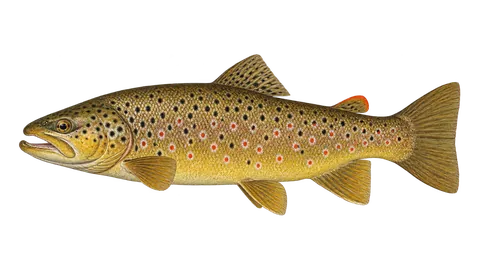
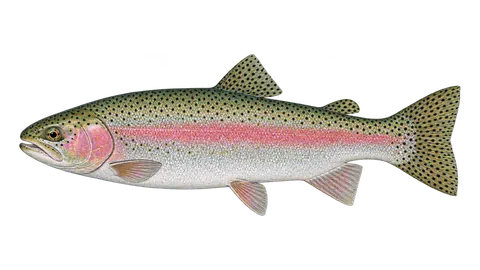
Olive-green back with pale worm-like markings (vermiculations) that climb toward the dorsal fin. Flanks with pale spots and small red spots with blue halos. Pectoral, pelvic and anal fins with a white edge followed by a black band. Nearly straight tail. The brown trout has no vermiculations or white edges; the rainbow has a pink stripe and black spots on the tail.
Also called: truta-fontinalis, fontinalis, truta-de-arroio, brook trout
don't confuse with:
where found
open on the large mapWhere to look: Mountain and steppe streams, high lagoons, river headwaters and stream mouths on lakes; cold, clear, well-oxygenated water.
Not established in Brazil. Exotic, native to eastern North America. Streams, lagoons and headwaters of Argentine Patagonia (from Neuquén to Tierra del Fuego) and southern Chile.
when to fish
best season
Summer and early Patagonian autumn (December to April) are the best months, within each province's or region's legal season. In high lagoons the start of the season, with colder water, is usually very good.
best time of day
Daytime, with peaks at dawn and dusk. Active by day, peaking at dawn, late afternoon and during insect hatches.
what affects the brook trout
cold and cold fronts
Likes very cold water; suffers in water above 18 to 20 °C.
atmospheric pressure
A sudden change in weather reduces insect hatches and activity.
moon
Little effect.
rain
Light rain activates them; runoff muddies the stream.
water level
Low, clear stream, fish concentrated in the pools.
noise
Wary in a small stream: approach from downstream, without casting a shadow.
wind
It hampers dry flies; on a lagoon, the shore with the wind at its back gathers insects and fish.
depth
Shallow in the stream; in a lagoon, 1 to 5 m near vegetation and inlets.
how to fish
lures
- nymphs (pheasant tail, hare's ear)
- dry flies (elk hair caddis)
- small streamer (woolly bugger)
- spinner #0 to 2
- small spoon 2 to 5 g
natural baits
- natural bait is usually banned for salmonid fishing in Patagonia; use artificials only
tip from an angler
In a stream, cast upstream and let the nymph drift along the bottom. In a lagoon, retrieve a dark streamer in short tugs near the vegetation.
- rod
- fly #3 to #6, 7'6" to 9'; or ultralight 5' to 6'6", 2 to 6 lb
- spinning / baitcasting reel
- simple fly reel or 1000 spinning reel
- line
- floating WF fly line; monofilament 0.16 to 0.20 mm
- leader
- leader 9' 4X to 5X; fluorocarbon 4 to 6 lb
- hook
- flies #10 to 16, barbless
accessories
- rubber passaguá
- wader
- polarized glasses
- water thermometer
catch and release
Small, delicate fish: wet hands, no squeezing, unhook it in the water. Above 18 °C water, avoid fishing.
rules for the brook trout
Rules change; before keeping or transporting fish, check with the state environmental agency.
Chile: license and limit of 3 fish or 15 kg per day
3 fish or 15 kg per day (whichever comes first)confirm with the agency details
In recreational salmonid fishing in Chile's inland waters, including the fontinalis, the general rule published by Sernapesca is a maximum of 3 fish or 15 kg per angler per day, with a valid recreational fishing license and one rod per person. The season is set by region (in Magallanes, 2025-2026: Oct 16 to Apr 14), and some rivers and lakes are catch-and-release only. In some regions live or organic bait is banned for salmonids.
Argentina (Patagonia): season-based regulations
permit required; bag limits and release rules vary by habitatconfirm with the agency details
Fishing for fontinalis and other salmonids in Argentine Patagonia follows the Reglamento General de Pesca Deportiva Continental Patagónico, renewed each season by the Patagonian provinces and the Administración de Parques Nacionales (for 2025/2026, Resolución APN 417/2025). A fishing permit is required, and opening dates, bag limits and mandatory release sections vary by lake and river. Check the season regulations before keeping any fish.
Conservation: Exotic in South America; it can compete with native fish of streams and lagoons.
how much it weighs without taking it out of the water
estimated weight
—
how we calculate
Length-weight relationship W = a·Lb (a = 0.00912, b = 3.03; FishBase). It's an average: a fat or lean fish can vary by 10% to 20%.
more about the brook trout
Native to eastern North America, it was introduced to Argentina and Chile and now lives in mountain streams, high lagoons and the headwaters of Patagonian rivers. It is not a true trout but a char, a relative of the Northern Hemisphere chars. It needs very cold, clean, well-oxygenated water. It eats insects, crustaceans and small fish; the largest live in lakes and lagoons rich in food and in some lowland Patagonian rivers. It spawns in autumn over gravel in running water, and at that time males develop an intense red belly. Being introduced, it competes with the native stream fauna. It is a classic light fly and ultralight spinning fish.
Family: Salmonidae · predator
fun facts
- Despite its common name, it is a char, a relative of the Arctic char, and not a trout of the genus Salmo.
- At autumn spawning, males develop an intense red-orange belly.
in the kitchen
Pink, delicate flesh; grilled in butter or smoked, where keeping fish is allowed.
similar species
sources and references (6)
The season weights (months), the time of day and the sensitivities (cold, pressure, moon, wind, rain, tide, strong light, murky water and noise) are the app's editorial estimates, based on the literature below and on the field experience of anglers and guides. They are not official data nor a measurement made for this species, and they may vary by region and year. Closed seasons and legal rules appear in the rules section, with the norm and a link.
- scientific FishBase — Salvelinus fontinalis (ficha da espécie)Names, distribution, biology, length-weight relationship, country list and references. Page checked on Oct 13, 2026.
- scientific IUCN Red List — Salvelinus fontinalis (avaliação global: Pouco Preocupante, LC, 01/08/2021)Global assessment. Link given on the FishBase entry (Red List, version 2025-2).
- technical CABI Compendium — Salvelinus fontinalis (brook trout). Copp, G. H.; Godard, M. (2010).Data sheet for an invasive species. DOI checked in Crossref.
- scientific Soto, D. et al. (2006). Southern Chile, trout and salmon country: invasion patterns and threats for native species. Revista Chilena de Historia Natural 79(1).DOI checked in Crossref.
- official Sernapesca (Chile) — Comenzó la temporada de pesca recreativa en la región de Magallanes (16/10/2025)Official notice with the 2025-2026 season in Magallanes, mandatory license, a limit of 3 fish or 15 kg per day, and habitats with mandatory release.
- official Argentina — Resolución APN nº 417/2025 (Administración de Parques Nacionales): aprova o Reglamento General de Pesca Deportiva Continental Patagónico, temporada 2025/2026Published in the Boletín Oficial on Dec 9, 2025. The text approves the regulation and annex for the southern national parks; dates, bag limits and release sections are in the annexes.
how we calculatewhere each number comes from
The weather comes from three independent global models, cross-checked hour by hour: when they agree, confidence goes up; when they diverge, the band between them shows on the chart. Beyond 16 days, we use the GEFS ensemble of 31 simulations: if 20 of the 31 predict rain, the chance of rain is 65%. Sun and moon are calculated astronomically, with no uncertainty.
The index adds up, weighted for each species: time of day (species curve anchored to real sunrise and sunset), moon (transits, rise and set, phase), pressure (3 h trend and 24 h swing), water temperature (in rivers, estimated from air temperature; at sea, estimated by an ocean model), wind, rain, clouds, tide and the month in the species' cycle.
sources for this lookup
how accurate the forecast is
Accuracy measured in the reference project (4 regions, 93 days, forecast vs. observed): maximum temperature is off by 0.6 °C on average the next day and 1.7 °C at 7 days; rain of 5 mm or more is detected 76% of the time the next day and 57% at 7 days. Detection isn't everything: the false alarm rate isn't published here yet, and 93 days in 4 regions is still a small sample. We now also measure every day, at the app's destinations: