Skip to content
fishing forecast

lesser amberjack

Seriola fasciata · Carangidae · predator

Sea

Small bottom-dwelling amberjack, from 55 to about 350 m, moving near banks and the slope. Fights hard for its size and is fished vertically, with jigs and natural bait.

Also called: arabaiana-roliça, arabaiana-branca, lesser amberjack, false amberjack

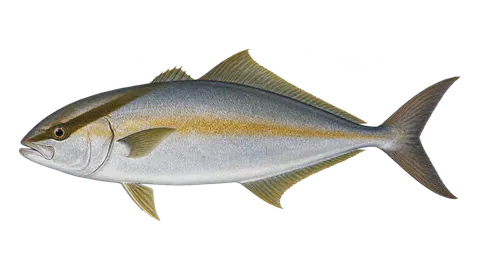
Scientific illustration of Lesser amberjack
common size
40–55 cm
maximum
68 cm
common weight
0.8–2.1 kg
record/max.
4.6 kg
depth
55–348 m
ideal water
14–22 °C
location

Sample location: choose yours to see the forecast for where you fish.

period

Reading the weather across 3 global models and 31 simulations…

the species

everything about the lesser amberjack

overview

who is the lesser amberjack

The lesser amberjack (arabaiana-roliça) is the smallest amberjack in the Atlantic: FishBase gives up to 67.5 cm fork length and 4.6 kg, with the common size around 50 cm. Adults live near the bottom on the outer shelf and the slope, from 55 to 348 m, and juveniles stay in open sea near the surface. They eat squid and fish, and the eggs float. In the western Atlantic it ranges from Massachusetts (USA) to Brazil; its distribution in the eastern Atlantic is uncertain, because for a long time it was confused with Seriola carpenteri. It is fished for subsistence and in sport fishing, usually as a catch by anglers fishing the bottom with jigs or natural bait on banks and shelf breaks. Like other amberjacks, it has a reputation for fighting well beyond its size.

fun facts

  • Its distribution in the eastern Atlantic is uncertain: for a long time the species was confused with Seriola carpenteri.
  • Juveniles live near the surface in open sea and only move down to the bottom as they grow.
  • It is the smallest amberjack in the Atlantic: it rarely exceeds 70 cm.
how to recognize it

identification

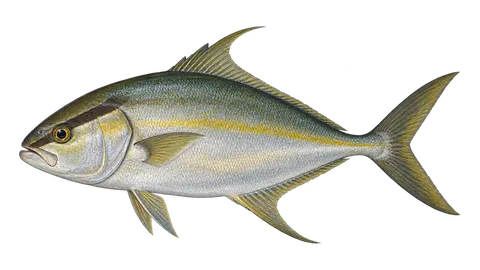
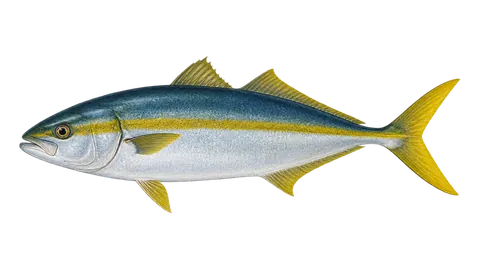
Elongated, not very deep body, slightly flattened, bluish or olive above and silver below, with a yellowish band along the middle of the flank. As in other amberjacks, it usually has a dark band crossing the eye. The soft dorsal has 28 to 33 rays and the anal fin 17 to 20. It is much smaller than the olho-de-boi (Seriola dumerili) and the pitangola (S. rivoliana), which exceed 1 m; telling small amberjacks apart requires checking counts and proportions in an identification guide.

distribution

where found

open on the large map

In the western Atlantic, from Massachusetts (USA) to Brazil; FishBase gives the southern limit at about 30°S. In Brazil it lives on bottoms of 55 to 348 m, on the outer shelf and the slope, and rarely reaches shore fishing.

Habitat: Rocky bottoms, banks and shelf breaks on the outer shelf and upper slope, near the bottom, from 55 to 348 m; juveniles stay near the surface in open sea.

coast

North CoastNortheast CoastSoutheast CoastSouth Coastshelfoceanic
calendar and clock

when to fish

best season

time of year
JanFebSeaAprMayJunJulAugSepOctNovDec

No set season: it lives in deep water, where temperature changes little. What matters is calm seas for vertical fishing and moderate current.

best time of day

0h6h12h18h sunrise ~6amsunset ~6pm

Daytime, with peaks at dawn and dusk. Hunts by day and at dusk; in deep water light matters less than the current and where the bait school is.

weather, water and behavior

what affects the lesser amberjack
sensitivity The little bars show how much each factor affects this species. Five full: it feels it a lot.

cold and cold fronts

It lives in cold bottom water; cold fronts affect it little, but the rough seas they bring get in the way.

atmospheric pressure

Small effect on the bottom; the pressure drop before a front usually gives a short peak.

moon

Small effect.

rain

Not very relevant at that depth.

water level

Not applicable at sea.

noise

Less sensitive than rocky-shore fish, but the boat needs to stay still over the bank.

wind

Strong wind and waves get in the way of vertical fishing with a tight line.

tide

Moderate current helps keep the jig and bait near the bank; strong current calls for a heavy sinker.

depth

From 55 to 348 m, according to FishBase; juveniles stay near the surface.

technique, gear and bait

how to fish

rod
6'0" to 6'6", 30 to 50 lb, fast action
spinning / baitcasting reel
baitcasting reel 300 to 400 or spinning reel 8000 to 10000 with strong drag
line
braid 40 to 65 lb
leader
fluorocarbon 60 to 80 lb, 1.5 to 2 m
hook
circle hook 5/0 to 8/0 or the jig's assist hooks

lures

  • vertical jig, 100 to 300 g
  • slow jig
  • jig with a double assist hook

natural baits

  • whole sardine or fillets
  • lula
  • bonito strips

accessories

  • descender to release
  • luvas
  • long-nose pliers
  • harness or fighting belt

tip from an angler

With the jig, work from the bottom up to about 20 m above it, with fast retrieves and pauses; if the current demands it, go up in jig weight.

what the law says

rules for the lesser amberjack

Summary of the regulations we found, with the source for each. Rules change; before keeping or transporting fish, check with the state environmental agency.
Conservation: Not on the Brazilian national list (Portaria GM/MMA nº 1.667/2026). We found no specific federal minimum size or closed season for the species in Brazil.

Mexico: up to 5 per species and 10 saltwater fish per day

5 specimens of the species per angler per day, within the limit of 10 saltwater fish

In sport and recreational fishing in Mexican federal waters, each angler may keep up to 10 marine fish per day, no more than 5 of the same species. The lesser amberjack has no quota of its own in the rule. Fish over the bag limit must go back alive, and a kept fish may not be sold. Anglers fishing from a boat need a Conapesca permit.

Source: Amendment to NOM-017-PESC-1994 (recreational sport fishing in federal waters of Mexico), DOF Nov 25, 2013, items 4.9.1, 4.9.5 and 4.11 (Sagarpa/Conapesca)

catch and release
catch and release Releasing the fish alive, quickly and with a wet hand. During a closed season it isn't always allowed: what the regulation says applies.

If it comes from more than 50 m, it arrives with an inflated swim bladder: release it with a descender, without waiting for it to swim off on its own. Wet hands and a quick photo.

in the kitchen

Firm, tasty flesh, good grilled, baked or as steaks. FishBase records reports of ciguatera, as with other amberjacks: avoid eating large specimens caught on Caribbean reefs and check with local fishers.

calculator

how much it weighs without taking it out of the water

Length-weight relationship W = a·Lb (a = 0.01585, b = 2.94; FishBase (relação peso-comprimento bayesiana, estimativa da própria espécie)). It's an average: a fat or lean fish can vary by 10% to 20%.

estimated weight

—

sources and references

The season weights (months), the time of day and the sensitivities (cold, pressure, moon, wind, rain, tide, strong light, murky water and noise) are the app's editorial estimates, based on the literature below and on field experience from anglers and guides. They are not official data or measurements made for this species and may vary by region and year. Closed seasons and legal rules appear in the rules section, with the rule and link. Common sizes and weights are ranges around the common length reported by FishBase, with the weight calculated from the length-weight relationship.

  1. scientific FishBase: Seriola fasciata (ficha da espécie)Size, length-weight, depth, habitat, distribution, biology, and IUCN status. Page checked on Oct 13, 2026.
  2. scientific FishBase: nomes populares de Seriola fasciataNames by country and language. Arabaiana-branca and arabaiana-roliça are the Brazilian Portuguese names on the list; the app uses arabaiana-roliça. We found no other Brazilian source that settles the name.
  3. official Portaria GM/MMA nº 1.667, de 27 de abril de 2026: Lista Nacional Oficial de Espécies da Fauna Ameaçadas de Extinção (peixes e invertebrados aquáticos)The species is not on the list. Checked in the DOU of April 28, 2026.
  4. official Instrução Normativa MMA nº 53, de 22 de novembro de 2005: tamanho mínimo de captura de espécies marinhas e estuarinas do litoral Sudeste e SulAnnex II, from ES to RS. Checked Oct 13, 2026: the species is not in Annex II (there is no federal minimum size for it).
  5. official Nicarágua: Resolução Executiva PA nº 003-2012 (INPESCA), tamanhos mínimos de captura para peixes e moluscos, La Gaceta nº 66Signed in Managua on Jan 31, 2012. Item One sets the minimum sizes for the Caribbean coast. Digitized copy from FAOLEX, checked Oct 13, 2026; we found no later text amending it.
  6. official DOF: Modificação da NOM-017-PESC-1994, para regular a pesca deportivo-recreativa em águas de jurisdição federal do México (DOF de 25/11/2013)Daily quotas at sea (item 4.9.1), return of the excess (4.9.5), ban on selling the fish (4.11) and ban on fishing in closed zones and seasons (4.10 a). Text checked Oct 13, 2026.
don't confuse

similar species