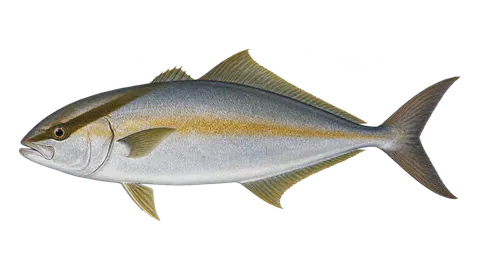
yellowtail amberjack
Seriola lalandi
A jack from the cooler waters of southern and southeastern Brazil. Fast and strong, it hits jigs and surface lures on ledges and islands.
Also called: olhete, yellowtail amberjack

- common size
- 60–120 cm
- maximum
- 250 cm
- common weight
- 5–25 kg
- record/max.
- 97.0 kg
- depth
- 5–100 m
- ideal water
- 17–22 °C
who is the yellowtail amberjack
The yellowtail amberjack (olhete) is the cold-water cousin of the greater amberjack. It prefers water temperatures of 16 to 22 °C, which is why it is most common from Rio de Janeiro to Rio Grande do Sul, especially in winter and spring. It moves in schools around islands, ledges, deep rocky coasts and shoals, and rises to the surface to hunt mullet, sardines, scad and squid. It fights with long runs and a lot of power, always trying to get back to structure. It is a classic target for jigging and popping along the coasts of São Paulo, Paraná and Santa Catarina. Its flesh is among the best of the rocky-shore fish.
fun facts
- In Oceania it is called yellowtail kingfish and is one of the most famous jigging fish in the world.
- A related species, the Japanese buri, is the hamachi of sushi; yellowtail amberjack flesh is similar.
identification
Slimmer and more elongated than the greater amberjack. Blue-green back, white belly and a bronze-yellow band from the snout to the tail. Bright yellow tail and fins with a yellowish tone. The dark band on the nape is weak or absent. The greater amberjack (medregal) is taller, has a dark tail, a clear dark band through the eye and fewer than 20 gill rakers on the first arch.
Loading the next 7 days…
Each card shows the day's index (0 to 100) and, below it, a strip with the index for each hour, from 0h to 23h. from poor to excellent.
where found
From Espírito Santo to Rio Grande do Sul, most common from São Paulo southward. Landmarks: islands and ledges off Ilhabela and Ubatuba (SP), Cabo Frio and Arraial do Cabo (RJ), shoals off the Paraná coast and the islands of Santa Catarina, such as Florianópolis and Bombinhas. Ilha do Arvoredo (SC), Laje de Santos (SP) and Ilhas dos Currais (PR) are conservation areas where fishing is prohibited.
Habitat: Deep rocky coasts, islands, ledges, shoals and wrecks, from 5 to 100 m, in cold, clear water.
coast
states
Espírito Santo, Rio de Janeiro, São Paulo, Paraná, Santa Catarina, Rio Grande do Sul
when to fish
best season
In the Southeast and South the best season runs from May to October, with water between 17 and 21 °C. In summer, with warm surface water, the fish goes deeper and is harder to catch.
best time of day
Daytime, with peaks at dawn and dusk. Rises to the surface at dawn and at dusk, when popping works best. During the day, jigging near the bottom works better. Current over the ledge is decisive.
what affects the yellowtail amberjack
sensitivity The little bars show how much each factor affects this species. Five full: it feels it a lot.
cold and cold fronts
It likes cold water, but a sharp drop below 15 °C also shuts down activity.
atmospheric pressure
Cold fronts bring the cold water the yellowtail amberjack seeks; fishing is often good once the sea settles after them.
moon
Spring tides bring strong current over the ledges, which gets the school going.
rain
Little effect. Thunderstorm with lightning: head back.
water level
Not applicable at sea. The equivalent is the color and clarity of the water: look for blue, clean water and current lines.
noise
On shallow ledges the school dives with noise. Approach with the motor low and drift.
wind
A strong south wind makes the sea dangerous near the rocky coasts.
tide
A moderate current over the ledge is the ideal condition.
depth
From 5 to 100 m; rises to the surface over shallow ledges at dawn.
how to fish
- rod
- jigging PE 3 to 5; popping 7'6" to 8'0", PE 4 to 6
- spinning / baitcasting reel
- spinning reel 8000 to 14000 or jigging baitcasting reel size 300 to 400
- line
- braided line PE 3 to 5 (40 to 65 lb)
- leader
- fluorocarbon 60 to 100 lb, 3 to 5 m
- hook
- assist hooks 4/0 to 7/0; circle 6/0 to 8/0 on live bait
lures
- 100 to 250 g jigs
- slow pitch jigs 80 to 200 g
- stickbaits and poppers 15 to 20 cm
natural baits
- live white mullet (tainhota), scad or sardines
- live squid
accessories
- fighting belt
- luvas
- split-ring pliers
tip from an angler
On shallow ledges, start with popping at dawn; when the fish stops rising, switch to a jig in the same current.
rules for the yellowtail amberjack
Summary of the regulations we found, with the source for each. Rules change; before keeping or transporting fish, check with the state environmental agency.
We found no species-specific rule beyond the region's general rules.
catch and release
catch and release Releasing the fish alive, quickly and with a wet hand. During a closed season it isn't always allowed: what the regulation says applies.
A long fight tires the fish: release it quickly, with the fish in the water. In deep fishing, use a descender against barotrauma.
in the kitchen
White, firm flesh with just the right amount of fat. Excellent as sashimi, grilled or baked.
how much it weighs without taking it out of the water
Length-weight relationship W = a·Lb (a = 0.00913708, b = 2.93; FishBase (estimativa bayesiana, comprimento total); coeficiente a ajustado ao porte máximo registrado). It's an average: a fat or lean fish can vary by 10% to 20%.
estimated weight
—
sources and references
The season weights (months), the time of day and the sensitivities (cold, pressure, moon, wind, rain, tide, strong light, murky water and noise) are the app's editorial estimates, based on the literature below and on the field experience of anglers and guides. They are not official data nor a measurement made for this species, and they may vary by region and year. Closed seasons and legal rules appear in the rules section, with the norm and a link.
- scientific FishBase — Seriola lalandi (ficha da espécie)Names, distribution, biology, length-weight relationship and references. Page checked on October 13, 2026.
- official Portaria GM/MMA nº 1.667, de 27 de abril de 2026 — Lista Nacional Oficial de Espécies da Fauna Ameaçadas de Extinção (peixes e invertebrados aquáticos)Most recent national list. The species is not on it (search by scientific name in the text published in the DOU, checked on October 13, 2026).
- official ICMBio/SALVE — Ficha de Seriola lalandi (avaliação nacional do risco de extinção)National assessment by ICMBio, published in 2023. DOI verified on Crossref.
- scientific IUCN Red List — Seriola lalandi (avaliação global: Pouco Preocupante, LC, 09/03/2015)Global assessment. Link given on the FishBase entry (Red List, version 2025-2).
- scientific Menezes, N. A.; Buckup, P. A.; Figueiredo, J. L.; Moura, R. L. (orgs.) (2003). Catálogo das espécies de peixes marinhos do Brasil. São Paulo: Museu de Zoologia da USP. 160 p.List of the marine species recorded in Brazil. Printed work; the URL is the bibliographic record in FishBase, which cites the catalogue for the species.