Skip to content
fishing forecast

flathead catfish

Pylodictis olivaris · Ictaluridae · predator

Freshwater

One of the largest catfish in North America: broad, flat head, projecting lower jaw, rounded tail and mottled body. An ambush hunter in deep pools with logs, it exceeds 1 m and 50 kg.

Also called: bagre-piltonte, bagre-de-cabeça-chata, flathead catfish

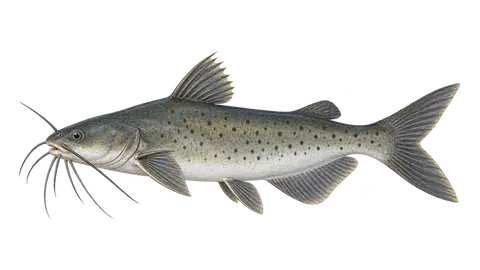
Scientific illustration of Flathead catfish
common size
45–90 cm
maximum
155 cm
common weight
1–7.5 kg
record/max.
55.8 kg
depth
1–12 m
ideal water
22–29 °C
location

Sample location: choose yours to see the forecast for where you fish.

period

Reading the weather across 3 global models and 31 simulations…

the species

everything about the flathead catfish

overview

who is the flathead catfish

A catfish of the family Ictaluridae, native to North America, from the Mississippi, Ohio and Missouri basins and the Gulf drainages down to Mexico. In Mexico it occurs in the north, in the Rio Bravo basin, and Mexico's inland-waters rule lists it, as pintontle, among the commercial-fishing species of the Venustiano Carranza (Don Martín, in Coahuila) and José López Portillo (Cerro Prieto, in Nuevo León) reservoirs. Adults live in deep pools of rivers from small to large, among logs and debris, and also in lakes and reservoirs. It is an ambush predator, mostly nocturnal: juveniles eat insect larvae and crustaceans, and adults eat fish, crayfish and mollusks. FishBase gives up to 155 cm, 55.8 kg and 25 years. The IGFA world record, 123 lb (about 55.8 kg), came from Elk City Reservoir, Kansas, in 1998. Outside its native range, in the USA, it is a problem as an introduced predator.

fun facts

  • The IGFA world record, 123 lb, was caught at Elk City Reservoir, Kansas, in 1998; a 2016 study estimated the fish was at least 22 years old.
  • The male guards the nest built under logs or other cover.
  • In U.S. rivers where it was introduced, it became a control priority because of its appetite for native fish.
how to recognize it

identification

Broad, very flattened head, with the lower jaw projecting beyond the upper and small eyes. Rounded tail, unlike the forked tail of the channel and blue catfish, and an adipose fin with a free rear tip. The body is grayish brown, mottled with dark, and the belly is yellowish white; the chin barbels are pale.

distribution

where found

open on the large map

Not found in Brazil. Native to the USA, from the Great Lakes and Mississippi basins to the Gulf drainages and northern Mexico, in the Río Bravo (Rio Grande) basin. The Mexican inland waters standard lists the species in the Don Martín (Coahuila) and Cerro Prieto (Nuevo León) reservoirs.

Habitat: Deep holes in medium and large rivers, with logs, submerged timber, and debris; lakes and reservoirs. Young fish stay in rapids over rock and sand bottoms.

calendar and clock

when to fish

best season

time of yearbest: May–Sep
JanFebSeaAprMayJunJulAugSepOctNovDec

Bites best from spring to early fall, with water above about 20 °C. In Texas, spawning is in late June and July, in nests under logs guarded by the male.

best time of day

0h6h12h18h sunrise ~6amsunset ~6pm

Nighttime. Mainly nocturnal: by day it stays still in burrows and holes; at night it goes out to hunt.

weather, water and behavior

what affects the flathead catfish
sensitivity The little bars show how much each factor affects this species. Five full: it feels it a lot.

cold and cold fronts

Water below about 10 to 12 °C leaves the fish almost motionless; the warmer the water, the better the fishing.

atmospheric pressure

Stable weather helps.

moon

Small effect.

rain

A moderate rise and slightly murky water move the fish toward the banks; a flash flood with strong current makes bottom fishing hard.

water level

A river at a stable or falling level concentrates fish in deep holes with logs.

noise

Moderate by day, when the fish is still in burrows; at night it is less wary.

wind

Little effect on bottom fishing.

depth

Holes 2 to 10 m deep, next to logs and debris; at night it may hunt in shallower areas.

technique, gear and bait

how to fish

rod
7' to 8', heavy action, 20 to 50 lb
spinning / baitcasting reel
low-profile baitcasting reel 300 to 400 or spinning reel 8000 to 10000, with a strong drag
line
monofilament 0.40 to 0.55 mm (30 to 50 lb) or braided line 50 to 80 lb
leader
monofilament or fluorocarbon 50 to 80 lb, 50 to 80 cm
hook
circle hook 6/0 to 10/0

lures

  • rarely used with lures

natural baits

  • pieces of fresh fish
  • lagostim

accessories

  • heavy bottom sinker
  • rod holder
  • luva
  • large passaguá

tip from an angler

Fish at dusk and at night, on the bottom, next to logs and holes. Live fish is the classic bait in the USA, but it is banned in recreational fishing in Mexico's inland waters.

what the law says

rules for the flathead catfish

Summary of the regulations we found, with the source for each. Rules change; before keeping or transporting fish, check with the state environmental agency.
Conservation: Assessed on Mar 1, 2012 as Least Concern.

Mexico: up to 5 freshwater fish per day, one rod, and no live fish as bait

5 fish per angler per day; one rod in use; no live fish as bait

In Mexico's federal inland waters, recreational fishing for freshwater species is limited to 5 fish per angler per day (this also applies to the pintontle). Each reservoir's committee may lower the bag limit and set sizes. Only one rod per angler may be in use, and using live fish as bait is prohibited. Fish kept may not be sold, and any fish over the limit must be returned alive to the water. No permit is required to fish from the bank; a permit is required from a boat.

Source: Amendment to NOM-017-PESC-1994, DOF Nov 25, 2013, items 4.3, 4.6 b, 4.7 c, 4.9.2, 4.9.5 and 4.11 (Sagarpa/Conapesca)

Mexico: Ictaluridae catfish with a minimum size of 340 mm

340 mm (total length)confirm with the agency

Item 4.3.4 of the inland fishing standard sets a total length of 340 mm for "all species of the family Ictaluridae", but the list that accompanies it names only Ictalurus (blue, channel, and others) and does not name the pintontle. Since Pylodictis olivaris is an Ictaluridae, the prudent reading is to apply the minimum. The reservoirs in Annex 1 have their own sizes. The Chihuahua closed seasons (April 2 to June 25) mention only Ictalurus punctatus and I. furcatus.

Source: NOM-060-SAG/PESC-2014, item 4.3.4, DOF May 27, 2014 (Sagarpa/Conapesca)

Don Martín reservoir (Coahuila): pintontle with a minimum size of 45 cm

45 cm (total length)confirm with the agency

At the Venustiano Carranza (Don Martín) reservoir in Coahuila, Annex 1 of the standard sets 45 cm total length as the minimum catch size for the pintontle (Pylodictis olivaris). The entry appears alongside the rules for commercial fishing and household consumption and does not set a separate limit for recreational anglers for this species; as a precaution, respect the size.

Source: NOM-060-SAG/PESC-2014, Annex 1, items VI.V d) and VI.VII (Coahuila), DOF May 27, 2014

catch and release
catch and release Releasing the fish alive, quickly and with a wet hand. During a closed season it isn't always allowed: what the regulation says applies.

A heavy, slippery fish: use wet gloves and a large landing net, support its weight under the belly, and don't hold it only by the jaw. With a circle hook, the fish is usually hooked at the corner of the mouth.

in the kitchen

It is a commercial species, and the flesh is edible. Prepare steaks or fillets fried, grilled, or baked.

calculator

how much it weighs without taking it out of the water

Length-weight relationship W = a·Lb (a = 0.00589, b = 3.11; FishBase (relação peso-comprimento bayesiana, estimativa da própria espécie)). It's an average: a fat or lean fish can vary by 10% to 20%.

estimated weight

—

sources and references

The season factors (months), the time of day, and the sensitivities (cold, pressure, moon, wind, rain, tide, strong light, murky water, and noise) are editorial estimates by the app, based on the literature cited below and on field experience of anglers and guides. They are not official data or measurements made for this species and may vary by region and year. Closed seasons and legal rules appear in the rules section, with the standard and link. Depth, gear, and baits are editorial recommendations, based on the species' nocturnal and ambush habits and on catfish fishing in general; there is no specific source on recreational fishing for this species in Mexico.

  1. scientific FishBase: Pylodictis olivaris (ficha da espécie)Size, length-weight, depth, habitat, distribution, biology, and IUCN status. Page checked on Oct 13, 2026.
  2. scientific FishBase: nomes populares de Pylodictis olivarisNames by country and language.
  3. scientific IUCN Red List: Pylodictis olivaris (avaliação global: Pouco Preocupante, LC, 01/03/2012)Global assessment. Link given on the FishBase entry (Red List, version 2025-2).
  4. scientific Fishes of Texas: Pylodictis olivaris (flathead catfish)Identification (flat head, rounded tail, free adipose fin), size, habitat, diet, spawning, nocturnal activity, native range, and introduced populations. The catch record cited on the page (44.5 kg, 1986) predates the 1998 IGFA record. Page checked on Oct 13, 2026.
  5. scientific Neely, B.; Lynott, S. (2016). Examination of the world record flathead catfish captured from Elk City Reservoir, Kansas. Transactions of the Kansas Academy of Science 119(3-4)Confirms the 123 lb fish (1998) as Pylodictis olivaris and estimates a minimum age of 22 years. The exact catch date varies between sources (May 14 or 19, 1998), so the profile gives only the year. Page checked on Oct 13, 2026.
  6. official DOF: Modificação da NOM-017-PESC-1994, que regula a pesca esportivo-recreativa em águas de jurisdição federal do México (publicada em 25/11/2013)Items 4.3, 4.4, 4.6 b, 4.7 c, 4.9.2, 4.9.5, and 4.11: permit, one rod per angler in inland waters, ban on live fish as bait, limit of 5 freshwater fish per day, release of the fish over the limit, and ban on sale. Text checked on Oct 13, 2026.
  7. official DOF: NOM-060-SAG/PESC-2014, pesca responsável em corpos de água continentais de jurisdição federal do México (publicada em 27/05/2014)Item 4.3.4 (minimum size of 340 mm for the family Ictaluridae, whose named list mentions only Ictalurus), and Annex 1 of the Don Martín (pintontle at 45 cm) and Cerro Prieto (pintontle among commercial species, without its own size) reservoirs. Text checked on Oct 13, 2026.
don't confuse

similar species