Skip to content
fishing forecast

schoolmaster

Lutjanus apodus · Lutjanidae · predator

SeaEstuary

A Caribbean reef snapper with pale bars and yellow fins. It lives in groups near corals and mangroves and takes natural bait and small jigs. It does not occur in Brazil.

Also called: cají, cajisote, schoolmaster, schoolmaster snapper

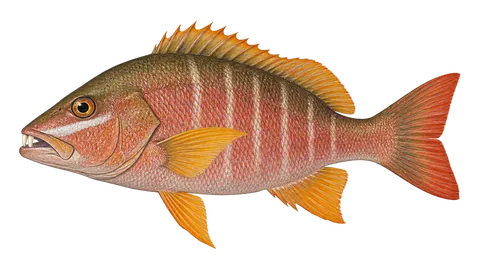
Scientific illustration of Schoolmaster
common size
25–45 cm
maximum
79 cm
common weight
0.4–2 kg
record/max.
10.8 kg
depth
2–63 m
ideal water
25–29 °C
location

Sample location: choose yours to see the forecast for where you fish.

period

Reading the weather across 3 global models and 31 simulations…

the species

everything about the schoolmaster

overview

who is the schoolmaster

The cají, called schoolmaster in English, is a snapper of the tropical western Atlantic, common in the Bahamas, the Antilles and the Caribbean coasts of Central and South America, down to Trinidad. Adults live on shallow, clear-water coral reefs, often in still groups during the day in the shade of corals and gorgonians; juveniles stay on sandy bottoms with seagrass, in lagoons and mangroves, and sometimes enter brackish water. It eats fish, shrimp, crabs, worms, snails and octopus. It can live over 40 years. Brazilian records were confusion with the baúna (Lutjanus alexandrei), a Brazilian species described in 2007. It is good table fish and takes natural bait and small baits near reefs.

fun facts

  • Can live over 40 years.
  • Juveniles sometimes enter the brackish water of lagoons and mangroves.
how to recognize it

identification

Body gray-olive to brownish on the back, with about eight narrow pale vertical bars, which may disappear in large adults; yellow fins. Long snout and a pair of large upper canines, visible with the mouth closed. A blue line, continuous or broken, under the eye, which disappears with growth. The Brazilian baúna (Lutjanus alexandrei) has a reddish body, six vertical white lines and blue spots between the snout and the preopercle.

distribution

where found

open on the large map

Does not occur in Brazil's coastal waters: early records were misidentifications (Moura and Lindeman, 2007). Tropical western Atlantic, from the Bahamas and the Antilles to the Caribbean coasts of Central and South America, down to Trinidad.

Habitat: Shallow clear-water coral reefs, near corals and gorgonians; juveniles in seagrass, lagoons and mangroves.

calendar and clock

when to fish

best season

time of year
JanFebSeaAprMayJunJulAugSepOctNovDec

Found year-round in the Caribbean.

best time of day

0h6h12h18h sunrise ~6amsunset ~6pm

Night and twilight. By day it stays still in groups in the shade of corals; it feeds more at dusk and at night.

weather, water and behavior

what affects the schoolmaster
sensitivity The little bars show how much each factor affects this species. Five full: it feels it a lot.

cold and cold fronts

A tropical reef fish; strong cold fronts reduce its activity.

atmospheric pressure

Little direct effect.

moon

Moonlit nights make night hunting more active.

rain

Murky water gets in the way.

water level

Not applicable at sea. In the mangrove, the ebbing tide carries juveniles into the channels.

noise

Still groups scatter at the noise of a motor or an anchor.

wind

Strong wind makes it hard to fish stationary over the reef.

tide

Current at the reef edge brings bait and activates the school.

depth

Shallow reefs, from 2 to 20 m for most catches.

technique, gear and bait

how to fish

rod
6' to 7', 8 to 17 lb
spinning / baitcasting reel
spinning reel 2500 to 3000
line
braided line 10 to 20 lb
leader
fluorocarbon 15 to 25 lb, 1 m
hook
circle 1/0 to 2/0

lures

  • small jig head with artificial shrimp
  • fly streamer

natural baits

  • shrimp
  • fish or squid strip
  • small crab

accessories

  • light sinker
  • alicate

tip from an angler

A small natural bait at the coral edge, late in the afternoon, works better than during the day, when the group stays still and wary.

what the law says

rules for the schoolmaster

Summary of the regulations we found, with the source for each. Rules change; before keeping or transporting fish, check with the state environmental agency.
Conservation: Species outside the Brazilian fauna. In Puerto Rico it counts toward the federal quota for groupers, snappers and parrotfish.

Puerto Rico (federal waters): up to 5 per person per day

5 per person per day; 15 per boat with 3 or more people

In federal waters around Puerto Rico, beyond 9 miles from the coast, the recreational angler may keep a maximum of 5 fish per day from groupers, snappers and parrotfish combined (up to 15 per boat when there are 3 or more people aboard). The limit does not apply to anyone with a commercial license from Puerto Rico or the U.S. Virgin Islands.

Source: 50 CFR 622.444(a)(1) (NOAA Fisheries, US)

catch and release
catch and release Releasing the fish alive, quickly and with a wet hand. During a closed season it isn't always allowed: what the regulation says applies.

Hold it by the mouth and belly, remove the hook with pliers and release it near the reef.

in the kitchen

Good white flesh, fried or grilled. Ciguatera has been recorded in reef fish.

calculator

how much it weighs without taking it out of the water

Length-weight relationship W = a·Lb (a = 0.01514, b = 2.97; FishBase (estimativa bayesiana, comprimento total)). It's an average: a fat or lean fish can vary by 10% to 20%.

estimated weight

—

sources and references

The season weights (months), the time of day and the sensitivities (cold, pressure, moon, wind, rain, tide, strong light, murky water and noise) are the app's editorial estimates, based on the literature below and on the field experience of anglers and guides. They are not official data nor a measurement made for this species, and they may vary by region and year. Closed seasons and legal rules appear in the rules section, with the norm and a link.

  1. scientific FishBase — Lutjanus apodus (ficha da espécie)Names, distribution, biology, length-weight relationship, country list and references. Page checked October 13, 2026. FishBase's country list still includes Brazil; we follow Moura and Lindeman (2007), who did not confirm the species in Brazilian waters.
  2. scientific Moura, R. L.; Lindeman, K. C. (2007). A new species of snapper (Perciformes: Lutjanidae) from Brazil, with comments on the distribution of Lutjanus griseus and L. apodus. Zootaxa 1422: 31-43.DOI verified in Crossref. Describes the baúna (Lutjanus alexandrei), previously confused with these species.
  3. scientific Moura, R. L.; Lindeman, K. C. A new inshore snapper species (Lutjanidae) from Brazil and the distributional status of gray snapper and schoolmaster, Lutjanus griseus and L. apodus. Proceedings of the Gulf and Caribbean Fisheries Institute 60.The abstract states that L. griseus and L. apodus do not occur in Brazil's inland waters.
  4. scientific IUCN Red List — Lutjanus apodus (avaliação global: Pouco Preocupante, LC, 10/10/2015)Global assessment. Link given on the FishBase entry (Red List, version 2025-2).
  5. official Code of Federal Regulations, 50 CFR Part 622, Subpart S — Regulations specific to the Puerto Rico Management Area (NOAA Fisheries, EUA)Consolidated text in the eCFR, checked October 13, 2026: §622.438 (prohibited species), §622.439 (area and time closures) and §622.444 (quotas). It applies in federal waters, beyond 9 miles from the coast.
  6. scientific Allen, G. R. (1985). FAO species catalogue. Vol. 6. Snappers of the world: an annotated and illustrated catalogue of lutjanid species known to date. FAO Fisheries Synopsis 125(6). Roma: FAO.
  7. scientific Carpenter, K. E. (org.) (2002). The living marine resources of the Western Central Atlantic. Vol. 3: Bony fishes part 2 (Opistognathidae to Molidae). FAO Species Identification Guide for Fishery Purposes. Roma: FAO.Chapter Lutjanidae (Anderson Jr., W. D.).
don't confuse

similar species