

gray snapper
Lutjanus griseus
The mangrove snapper of the Caribbean and the Gulf of Mexico. Smart and wary, it lives among mangrove roots, rocks and reefs and feeds mostly at night. It does not occur in Brazil.
- common size
- 25–50 cm
- maximum
- 89 cm
- common weight
- 0.5–3 kg
- record/max.
- 20.0 kg
- depth
- 0–180 m
- ideal water
- 24–30 °C
how to recognize it
Greenish to bronze-gray body, sometimes with a reddish tone, with no clear bars in adults. Long snout and slightly concave head profile; two large upper canines. Juveniles have a dark band from the snout to the eye and a blue line below the eye. The dog snapper (dentão) has a triangular pale patch below the eye; the schoolmaster (cají) has pale bars on its body and yellow fins.
Also called: vermelho-do-mangue, caranha-do-mangue, mangrove snapper, gray snapper
don't confuse with:
where found
open on the large mapWhere to look: Mangroves, estuaries and the lower stretches of rivers (juveniles); reefs, rocky shores, rock bottoms and wrecks (adults).
Does not occur in Brazil: early records were misidentifications (Moura and Lindeman, 2007). Western Atlantic, from Massachusetts and Bermuda to the Bahamas, the Gulf of Mexico and the whole Caribbean, down to Venezuela and Trinidad and Tobago.
when to fish
next 7 days
Loading the next 7 days…
best season
In the Gulf of Mexico and the Caribbean, fishing improves in the Northern Hemisphere summer, when adults gather to spawn near the full moon.
best time of day
Night and twilight. Feeds mostly at night and at dusk; during the day it stays in groups near roots and rocks and is very wary.
what affects the gray snapper
cold and cold fronts
Cold fronts shut down activity in shallow mangroves.
atmospheric pressure
Stable pressure helps; just after a front, fishing drops.
moon
Spawning happens near the full moon in the Northern Hemisphere summer.
rain
Heavy rain muddies mangrove channels.
water level
In the mangrove, the ebbing tide pulls fish out of the roots and carries them into the channels.
noise
Very wary: approach quietly and avoid knocking on the hull.
wind
Strong wind makes accurate casting into the roots difficult.
tide
A moving tide is essential; at slack tide fishing stops.
depth
Juveniles in the shallows of mangroves; adults from 5 to 50 m on reefs and rocks.
how to fish
lures
- jig head 1/4 to 1/2 oz with artificial shrimp
- small midwater lure
- fly streamer
natural baits
- live shrimp
- live sardine or small fish
- caranguejo
tip from an angler
A fine fluorocarbon leader and live bait with no sinker, let drift with the tide into the roots, will fool the most wary fish.
- rod
- 6'6" to 7', 10 to 20 lb
- spinning / baitcasting reel
- spinning reel 2500 to 4000
- line
- braided line 15 to 30 lb
- leader
- fluorocarbon 20 to 30 lb, 1 m
- hook
- circle 1/0 to 3/0
accessories
- light sinker
- alicate
catch and release
Hold it by the mouth and belly, remove the hook with pliers and release it near the root or rock.
rules for the gray snapper
Rules change; before keeping or transporting fish, check with the state environmental agency.
We found no species-specific rule beyond the region's general rules.
Conservation: Species outside the Brazilian fauna. We found no specific rule in the Caribbean countries consulted; each country's general rules apply.
how much it weighs without taking it out of the water
estimated weight
—
how we calculate
Length-weight relationship W = a·Lb (a = 0.01514, b = 2.96; FishBase (estimativa bayesiana, comprimento total)). It's an average: a fat or lean fish can vary by 10% to 20%.
more about the gray snapper
The vermelho-do-mangue (gray snapper), called pargo prieto or caballerote in Spanish-speaking countries and mangrove snapper in English, lives in the western Atlantic, from the US east coast and Bermuda to the Bahamas, the Gulf of Mexico and the whole Caribbean. Juveniles grow in mangroves, estuaries and the lower stretches of rivers; adults move to reefs, rocky shores and rock bottoms, usually down to about 50 m, sometimes in large groups. It feeds at night on fish, shrimp, crabs and squid. It lives up to 30 years. Early records in Brazil were confusion with other species, mostly the baúna (Lutjanus alexandrei). In the mangroves and reefs of the Caribbean and Mexico it is a classic target for live-bait and artificial-lure fishing.
Family: Lutjanidae · predator
fun facts
- In Florida, juveniles even enter freshwater.
- Can live up to 30 years.
in the kitchen
White, very good flesh, fried, baked or grilled. Ciguatera has been reported in Caribbean reef areas.
similar species
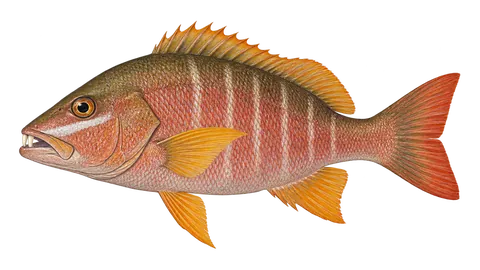
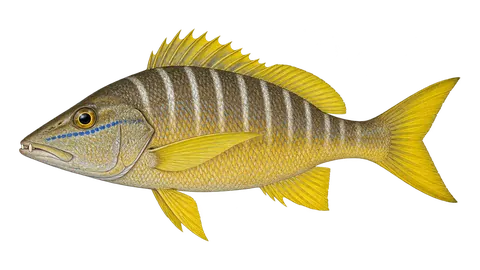
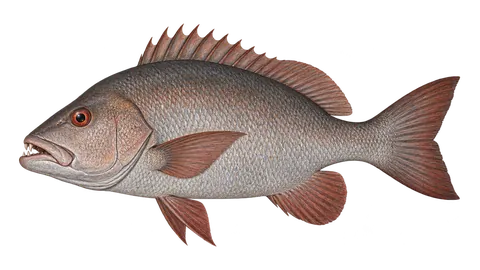
sources and references (6)
The season weights (months), the time of day and the sensitivities (cold, pressure, moon, wind, rain, tide, strong light, murky water and noise) are the app's editorial estimates, based on the literature below and on the field experience of anglers and guides. They are not official data nor a measurement made for this species, and they may vary by region and year. Closed seasons and legal rules appear in the rules section, with the norm and a link.
- scientific FishBase — Lutjanus griseus (ficha da espécie)Names, distribution, biology, length-weight relationship, country list and references. Page checked October 13, 2026. In the country list, Brazil appears as a misidentification.
- scientific Moura, R. L.; Lindeman, K. C. (2007). A new species of snapper (Perciformes: Lutjanidae) from Brazil, with comments on the distribution of Lutjanus griseus and L. apodus. Zootaxa 1422: 31-43.DOI verified in Crossref. Describes the baúna (Lutjanus alexandrei), previously confused with these species.
- scientific Moura, R. L.; Lindeman, K. C. A new inshore snapper species (Lutjanidae) from Brazil and the distributional status of gray snapper and schoolmaster, Lutjanus griseus and L. apodus. Proceedings of the Gulf and Caribbean Fisheries Institute 60.The abstract states that L. griseus and L. apodus do not occur in Brazil's inland waters.
- scientific IUCN Red List — Lutjanus griseus (avaliação global: Pouco Preocupante, LC, 10/10/2015)Global assessment. Link given on the FishBase entry (Red List, version 2025-2).
- scientific Allen, G. R. (1985). FAO species catalogue. Vol. 6. Snappers of the world: an annotated and illustrated catalogue of lutjanid species known to date. FAO Fisheries Synopsis 125(6). Roma: FAO.
- scientific Carpenter, K. E. (org.) (2002). The living marine resources of the Western Central Atlantic. Vol. 3: Bony fishes part 2 (Opistognathidae to Molidae). FAO Species Identification Guide for Fishery Purposes. Roma: FAO.Chapter Lutjanidae (Anderson Jr., W. D.).