

striped mojarra
Eugerres plumieri · Gerreidae · omnivore
Mojarra of mangroves, lagoons and estuaries of the Gulf of Mexico and the Caribbean, with dark lines along the flanks. Reaches 40 cm and goes far up rivers. In Brazil it is cited only on the North coast.
Also called: carapeba-rajada, carapeba-listrada, caratinga, striped mojarra

- common size
- 20–30 cm
- maximum
- 40 cm
- common weight
- 0.1–0.4 kg
- record/max.
- 1.0 kg
- depth
- 0–10 m
- ideal water
- 24–30 °C

the right time
to be on the water
Choose the place and the species. The index, from 0 to 100, combines weather, sun, moon and tide with each fish's habits. Up to 28 days, with each day's confidence.
Reading the weather across 3 global models and 31 simulations…
—
hour by hour
slide your finger or mouse over the chart to see each hoursee hour-by-hour table
why this index at —?
choose the day
Each card shows the day's index (0 to 100) and, below it, a strip with the index for each hour, from 0h to 23h. from poor to excellent.
the fishing month at a glance
what's the best window for the crew?
Choose how many fishing days. We compare each stretch by its average index, discount days with a warning or closed season, and show the 3 best.
trend for the coming weeks
Line: the middle value of 31 simulations of the American GEFS model. Band: where 8 out of 10 fall. Narrow, firm trend; wide, high uncertainty.
everything about the striped mojarra
who is the striped mojarra
The striped mojarra (carapeba-rajada) lives in the western Atlantic, from South Carolina and western Florida through the whole Gulf of Mexico, the continental Caribbean and Brazil; it is absent from the Bahamas and the smaller Antillean islands. Adults stay in shallow coastal waters and are common in brackish water over mud, in mangrove channels and lagoons, and often go well up rivers. They eat aquatic insects, crustaceans, small bivalves and detritus. They reach 40 cm and 1 kg; FishBase gives 30 cm as the common length, and maturity comes at 22 cm. It is sold fresh and processed into fishmeal. In Brazil there is also Eugerres brasilianus, which is similar and has a similar common name.
fun facts
- It goes far up rivers, into fresh water, despite being a marine fish.
- It stirs the mud with its mouth to find insects, crustaceans and small bivalves.
- It resembles the Brazilian striped mojarra (Eugerres brasilianus), which has a similar common name.
identification
Deep, compressed, diamond-shaped body, dark olive green on top, with a yellowish belly and silvery sheen. Each scale has a dark stripe in the centre, which forms fine lines along the flanks: hence the name 'rajada' (striped). The dorsal has 9 spines and 10 rays, and the anal 3 spines and 8 rays. The mouth projects downward to stir up mud. The carapeba (Diapterus rhombeus) and the carapicu (Eucinostomus argenteus) are other gerreids of the Brazilian coast: reliable separation is by spine and ray counts and body shape.
where found
In Brazil, FishBase and the literature give it as present in the North of the country, in estuaries and lagoons; the southern limit is unclear, and the similar Eugerres brasilianus is the genus species most cited on the Brazilian coast. Outside Brazil, it ranges from the southeastern US and the Gulf of Mexico to the continental Caribbean, Venezuela and the Guianas.
Habitat: Shallow coastal waters, mangrove channels, lagoons and estuaries, over mud bottoms; goes far up rivers.
coast
when to fish
best season
Warm-water fish, active all year on the tropical coast. The literature cites main spawning between May and July, with a smaller spawn from September to November. We found no specific closed season.
best time of day
Daytime. Forages by day, stirring up the mud bottom with its mouth.
what affects the striped mojarra
sensitivity The little bars show how much each factor affects this species. Five full: it feels it a lot.
cold and cold fronts
Warm-water fish; a cold front knocks out activity.
atmospheric pressure
Small effect.
moon
Spring tides bring the school to channels and mangrove edges.
rain
Heavy rain changes salinity and pushes the fish toward the estuary mouth; since it enters fresh water, it tolerates it well.
water level
In drought it gathers at river mouths and channels; in flood it spreads farther toward the sea.
noise
Noise on the bank or on the hull scares it off.
wind
Little effect in sheltered mangrove waters.
tide
Rising tide brings the school to the mangrove edges; the falling tide gathers the fish at the mouths of channels.
depth
Shallow, usually 0 to 10 m.
how to fish
- rod
- 5' to 6', 4 to 10 lb
- spinning / baitcasting reel
- spinning reel 1000 to 2500
- line
- monofilament 0.20 to 0.30 mm or braid 6 to 10 lb
- leader
- fluorocarbon 0.25 to 0.35 mm, 40 to 60 cm
- hook
- small single hook, No. 6 to 10
natural baits
- shrimp pieces
- minhoca
- mussel
accessories
- small sinker
- alicate
- landing net
tip from an angler
Fish on the mud bottom, with the tide moving, using small pieces of shrimp or worm; the mouth is small, so use a small hook.
rules for the striped mojarra
Summary of the regulations we found, with the source for each. Rules change; before keeping or transporting fish, check with the state environmental agency.
Conservation: Not on the Brazilian national list (Ministerial Ordinance GM/MMA No. 1.667/2026).
We found no species-specific rule beyond the region's general rules.
catch and release
catch and release Releasing the fish alive, quickly and with a wet hand. During a closed season it isn't always allowed: what the regulation says applies.
Small, delicate fish: wet your hands, use a barbless hook and release quickly, without leaving the fish out of water.
in the kitchen
Sold fresh and also processed into fishmeal, according to FishBase. Fried whole is a common preparation in countries like Mexico and Colombia.
how much it weighs without taking it out of the water
Length-weight relationship W = a·Lb (a = 0.01479, b = 3.03; FishBase (relação peso-comprimento bayesiana, estimativa da própria espécie)). It's an average: a fat or lean fish can vary by 10% to 20%.
estimated weight
—
sources and references
The season weights (months), the time of day and the sensitivities (cold, pressure, moon, wind, rain, tide, strong light, murky water and noise) are the app's editorial estimates, based on the literature below and on field experience from anglers and guides. They are not official data or measurements made for this species and may vary by region and year. Closed seasons and legal rules appear in the rules section, with the rule and link. The common size and weight ranges, water temperature and typical depth are also editorial estimates, anchored in FishBase data.
- scientific FishBase: Eugerres plumieri (ficha da espécie)Size, length-weight, depth, habitat, distribution, biology and IUCN status. Page checked Oct 13, 2026. Common size and weight ranges, water temperature and typical depth are editorial estimates based on FishBase data. Profile name: 'carapeba-rajada', 'carapeba-listrada' and 'caratinga' are the Portuguese names FishBase lists. The presence in Brazil is given by FishBase ('up to Brazil') and by a taxonomic record ('northern Brazil'); we found no georeferenced Brazilian records. Typical depth range (0 to 10 m): editorial estimate; FishBase gives no depth, only 'shallow coastal waters'.
- scientific FishBase: nomes populares de Eugerres plumieriNames by country and language.
- official Portaria GM/MMA nº 1.667, de 27 de abril de 2026: Lista Nacional Oficial de Espécies da Fauna Ameaçadas de Extinção (peixes e invertebrados aquáticos)The species is not on the list. Checked in the DOU of April 28, 2026.
- technical Wikipedia: Striped mojarra (Eugerres plumieri)Secondary source, used for colour, ray and spine counts, spawning season and use in fishing (Mexico and Colombia). Data not checked against a primary source.
similar species
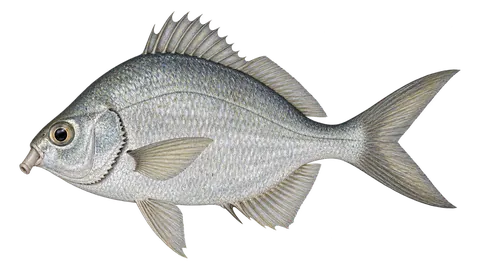
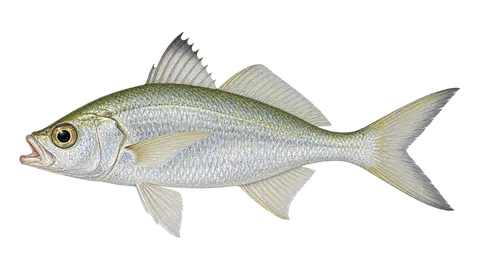


where each number comes from
The weather comes from three independent global models, cross-checked hour by hour: when they agree, confidence goes up; when they diverge, the band between them shows on the chart. Beyond 16 days, we use the GEFS ensemble of 31 simulations: if 20 of the 31 predict rain, the chance of rain is 65%. Sun and moon are calculated astronomically, with no uncertainty.
The index adds up, weighted for each species: time of day (species curve anchored to real sunrise and sunset), moon (transits, rise and set, phase), pressure (3 h trend and 24 h swing), water temperature (in rivers, estimated from air temperature; at sea, estimated by an ocean model), wind, rain, clouds, tide and the month in the species' cycle.
sources for this lookup
how accurate the forecast is
Accuracy measured in the reference project (4 regions, 93 days, forecast vs. observed): maximum temperature is off by 0.6 °C on average the next day and 1.7 °C at 7 days; rain of 5 mm or more is detected 76% of the time the next day and 57% at 7 days. Detection isn't everything: the false alarm rate isn't published here yet, and 93 days in 4 regions is still a small sample. We now also measure every day, at the app's destinations: