Skip to content
fishing forecast

grass carp

Ctenopharyngodon idella · Xenocyprididae · omnivore

Freshwaternon-native in Brazil

A large herbivorous carp from China, raised in farm ponds and pay lakes. It exceeds 30 kg and gives one of the longest fights in lake fishing.

Also called: carpa-capim, carpa-chinesa, carpa-herbívora, carpa-do-limo

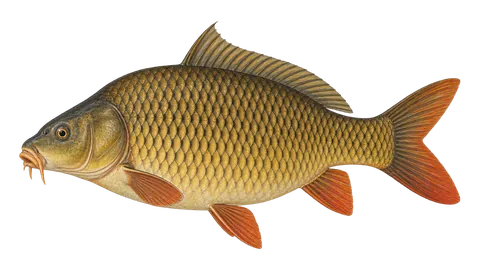
Scientific illustration of Grass carp
common size
50–80 cm
maximum
150 cm
common weight
3–10 kg
record/max.
45.0 kg
depth
0.5–6 m
ideal water
20–28 °C
location

Sample location: choose yours to see the forecast for where you fish.

period

Reading the weather across 3 global models and 31 simulations…

the species

everything about the grass carp

overview

who is the grass carp

Native to East Asia (China and the Amur River basin), the grass carp (carpa-capim) is one of the most farmed fish in the world and is also used to control aquatic plants in ponds and canals. It eats submerged plants and grass that falls into the water, and sometimes debris and invertebrates. It tolerates large temperature swings and low-oxygen water. In Brazil it is raised in farm ponds, private reservoirs and pay lakes, where it reaches large sizes. Goiás and Mato Grosso do Sul rules treat it as exotic, free capture. It demands heavy tackle and patience: it runs far and takes a long time to tire.

fun facts

  • It is used worldwide to clear farm ponds and canals overgrown with aquatic plants.
  • Introductions of the species often brought along an Asian fish tapeworm (Bothriocephalus acheilognathi).
how to recognize it

identification

Elongated, rounded body with large dark-edged scales that form a net pattern; olive-green back and golden-silver flank. Mouth at the tip of the snout, no barbels, short snout and broad head. The common carp has barbels and a deeper body; silver and bighead carps have low-set eyes and small scales.

distribution

where found

open on the large map

Exotic, native to East Asia. Raised in farm ponds, reservoirs and pay lakes; listed as exotic by the GO (Paranaíba and Araguaia-Tocantins) and MS rules, and recorded in the fish catalog of the upper Uruguay River.

Habitat: Farm ponds, reservoirs, pay lakes and eddies with aquatic vegetation.

introduced in

ParanáTocantins-AraguaiaUruguay

states

São Paulo, Paraná, Minas Gerais, Goiás, Mato Grosso do Sul, Santa Catarina, Rio Grande do Sul

calendar and clock

when to fish

best season

time of yearbest: Oct–Apr
JanFebSeaAprMayJunJulAugSepOctNovDec

Spring and summer. In the southern winter it eats little.

best time of day

0h6h12h18h sunrise ~6amsunset ~6pm

Daytime, with peaks at dawn and dusk. Feeds by day, most active early and in late afternoon; on hot days also at night.

weather, water and behavior

what affects the grass carp
sensitivity The little bars show how much each factor affects this species. Five full: it feels it a lot.

cold and cold fronts

Below about 15 °C it eats very little.

atmospheric pressure

A cold front shuts down activity.

moon

Little effect.

rain

Little effect.

water level

Little effect in farm ponds.

noise

Very wary: noise on the bank scares the fish away.

wind

Little effect.

depth

Mid-water and surface, 0.5 to 3 m.

technique, gear and bait

how to fish

rod
7' to 9', medium action, 20 to 40 lb
spinning / baitcasting reel
spinning reel 4000 to 6000 with smooth drag and good line capacity
line
monofilament 0.40 to 0.50 mm
leader
optional
hook
#1/0 to 4/0, strong

natural baits

  • massa
  • boiled corn
  • grass or tender leaves
  • bread

accessories

  • groundbait float
  • large landing net

tip from an angler

Keep quiet on the bank and use vegetable bait on the surface or mid-water. Soft drag: the first run is long.

what the law says

rules for the grass carp

Summary of the regulations we found, with the source for each. Rules change; before keeping or transporting fish, check with the state environmental agency.
Conservation: In its native range, the global IUCN assessment is Least Concern (LC, Mar 30, 2020).

Releasing into the wild without a license is an offense

releasing or introducing fish into rivers, reservoirs and lakes is prohibitedconfirm with the agency

Introducing an exotic species without a technical opinion and license is a federal environmental offense. This includes releasing a fish from a tank, pay lake or aquarium into a river or reservoir.

Source: Lei federal nº 9.605/1998, art. 31, and Decreto federal nº 6.514/2008, art. 25

catch and release
catch and release Releasing the fish alive, quickly and with a wet hand. During a closed season it isn't always allowed: what the regulation says applies.

Large fish: use a landing net, wet your hands, support the body and release quickly. Do not release it into another body of water.

in the kitchen

White flesh with Y-shaped bones; good baked, fried in chunks or as scored fillets.

calculator

how much it weighs without taking it out of the water

Length-weight relationship W = a·Lb (a = 0.00933, b = 3.09; FishBase). It's an average: a fat or lean fish can vary by 10% to 20%.

estimated weight

—

sources and references

The season weights (months), the time of day and the sensitivities (cold, pressure, moon, wind, rain, tide, strong light, murky water and noise) are the app's editorial estimates, based on the literature below and on the field experience of anglers and guides. They are not official data nor a measurement made for this species, and they may vary by region and year. Closed seasons and legal rules appear in the rules section, with the norm and a link.

  1. scientific FishBase — Ctenopharyngodon idella (ficha da espécie)Names, distribution, biology, length-weight relationship and references. Page checked on October 13, 2026.
  2. scientific IUCN Red List — Ctenopharyngodon idella (avaliação global: Pouco Preocupante, LC, 30/03/2020)Global assessment. Link given on the FishBase entry (Red List, version 2025-2).
  3. technical CABI Compendium — Ctenopharyngodon idella (grass carp). Bonham, V. (2019).Data sheet for an introduced species. DOI checked in Crossref.
  4. scientific IUCN SSC Invasive Species Specialist Group — Global Invasive Species Database: Ctenopharyngodon idellaPage checked on Oct 13, 2026.
  5. scientific Zaniboni Filho, E.; Meurer, S.; Shibatta, O. A.; Nuñer, A. P. O. (2004). Catálogo ilustrado de peixes do alto rio Uruguai. Florianópolis: Editora da UFSC; Tractebel Energia. 128 p.Printed work; the URL is the bibliographic record on FishBase, which cites this work for the species.
  6. official IN Semad-GO nº 17/2026 — normas de pesca em Goiás (Anexos I e II)Annex II lists exotic, allochthonous and hybrid species with free capture and transport. Text checked on Oct 13, 2026.
don't confuse

similar species