


the right time
to be on the water
Choose the place and the species. The index, from 0 to 100, combines weather, sun, moon and tide with each fish's habits. Up to 28 days, with each day's confidence.
Loading the forecast…
—
hour by hour
slide your finger or mouse over the chart to see each hoursee hour-by-hour table
why this index at —?
choose the day
the fishing month at a glance
what's the best window for the crew?
Choose how many fishing days. We compare each stretch by its average index, discount days with a warning or closed season, and show the 3 best.
trend for the coming weeks
Line: the middle value of 31 simulations of the American GEFS model. Band: where 8 out of 10 fall. Narrow, firm trend; wide, high uncertainty.
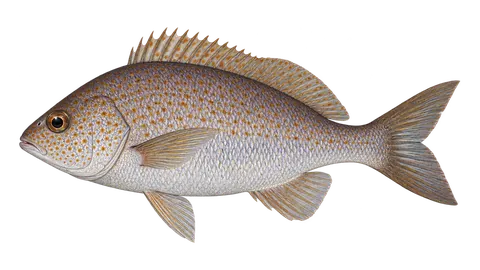
everything about the red pigfish
how to recognize it
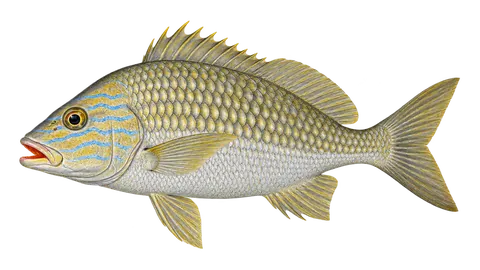
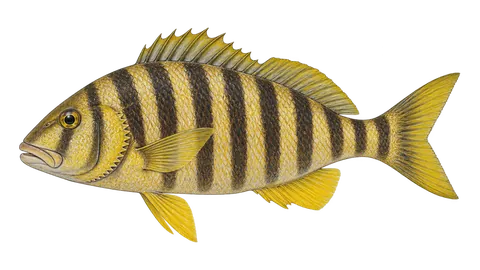
Elongated, moderately deep body, grayish-brown back with violet reflections and silvery flanks. The mark of the species is the many brownish-orange specks on the head, the upper half of the body and the dorsal fin. Small mouth, not reaching past the front of the eye; continuous dorsal fin with 12 spines and 14 soft rays. The biquara, also called corcoroca, has blue stripes on its head and a red mouth inside; the roncador has dark bands and a larger mouth.
Also called: corcoroca-verdadeira, corcoroca, cocoroca, cocoroca-verdadeira, corcoroca-jurumirim, corcoroca-legítima, coró-de-pedra
don't confuse with:
where found
open on the large mapWhere to look: Sand, mud and gravel bottoms near rocks, ledges and shallow shoals; juveniles on seagrass beds and at estuary mouths.
All along the Brazilian coast, from Amapá to Rio Grande do Sul, on sand, mud and rock bottoms. Outside Brazil, from Honduras to the Guianas and the southern Caribbean islands.
coast
states
Amapá, Pará, Maranhão, Piauí, Ceará, Rio Grande do Norte, Paraíba, Pernambuco, Alagoas, Sergipe, Bahia, Espírito Santo, Rio de Janeiro, São Paulo, Paraná, Santa Catarina, Rio Grande do Sul
when to fish
best season
Appears all year. In the Southeast and South the schools are more active and nearer the coast from spring through autumn.
best time of day
Daytime, with peaks at dawn and dusk. Nibbles during the day over sand and rock bottoms, with peaks at dawn and dusk; at piers and rocky shores it also does well early in the evening.
what affects the red pigfish
cold and cold fronts
A cold front with a drop in temperature moves schools away from the shallow spots for a day or two.
atmospheric pressure
Stable pressure helps; rough sea from a cold front makes boat fishing difficult.
moon
Small effect; new- and full-moon tides, with more current, call for heavier sinkers.
rain
Light rain doesn't matter; very muddy water at a river mouth shuts down activity.
water level
Not applicable at sea. In an estuary it prefers the saltier water of the flooding tide.
noise
Moderately sensitive: in shallow clear water, avoid knocking the hull over the school.
wind
Moderate wind doesn't bother it on the bottom; strong wind makes it hard to feel the bites.
tide
A moving tide, without too strong a current, is the best time.
depth
From 2 to 30 m for most boat catches; at piers and rocky shores, from 1 to 5 m.
how to fish
lures
- jig head 5 to 10 g with small artificial shrimp
- small sabiki
natural baits
- shrimp (small, whole or in pieces)
- corrupto
- sardine strips
- squid in thin strips
tip from an angler
Small bait and small hook: the corcoroca nibbles a lot before swallowing. If you find one, stay on the spot, because the school usually stays together.
- rod
- 6'0" to 7'0", 8 to 17 lb (boat) or 2.7 to 3.6 m (rocky shore and pier)
- spinning / baitcasting reel
- spinning reel 2500 to 4000
- line
- braided line 10 to 20 lb or monofilament 0.25 to 0.30 mm
- leader
- fluorocarbon 0.30 to 0.40 mm
- hook
- small hooks, no. 4 to 1 (small mouth)
accessories
- olive sinker or drop sinker 20 to 60 g
- two-hook leader
- pliers
catch and release
Survives release well: take the hook out with pliers, without squeezing the belly, and let it go quickly. A barbless hook makes this easier.
rules for the red pigfish
Rules change; before keeping or transporting fish, check with the state environmental agency.
We found no species-specific rule beyond the region's general rules.
Conservation: Not on the national list (Portaria GM/MMA 1.667/2026) or in the annexes of IN MMA 53/2005. We found no specific federal rule for this species.
how much it weighs without taking it out of the water
estimated weight
—
how we calculate
Length-weight relationship W = a·Lb (a = 0.01318, b = 2.97; FishBase (estimativa bayesiana, comprimento total)). It's an average: a fat or lean fish can vary by 10% to 20%.
more about the red pigfish
The corcoroca-verdadeira is a grunt of the family of the corcorocas and roncadores (grunts) from the western Atlantic, from Honduras to Rio Grande do Sul. It lives in coastal waters over sand, mud and rock bottoms, from 1 to about 70 m, and also enters brackish water. Juveniles stay near the coast, on seagrass beds. It eats crustaceans, mollusks, polychaetes and small fish. It rarely exceeds 40 cm or 1 kg, but it travels in schools and bites well, so it is a sure catch in boat fishing over sand and rock bottoms and in pier, jetty and rocky-shore fishing. It is a prized table fish, sold fresh and salted.
Family: Haemulidae · predator
fun facts
- Like other pigfish, it grunts when taken out of the water: the sound comes from the teeth in its throat rubbing together, amplified by the swim bladder.
- The scientific name appears in many sources as Orthopristis ruber; FishBase now uses the spelling Orthopristis rubra.
in the kitchen
White, tasty flesh with fine bones; very good fried whole or in steaks. Also sold salted.
similar species
sources and references (5)
The season weights (months), the time of day and the sensitivities (cold, pressure, moon, wind, rain, tide, strong light, murky water and noise) are the app's editorial estimates, based on the literature below and on the field experience of anglers and guides. They are not official data nor a measurement made for this species, and they may vary by region and year. Closed seasons and legal rules appear in the rules section, with the norm and a link.
- scientific FishBase — Orthopristis rubra (ficha da espécie)Names, distribution, biology, length-weight relationship, country list and references. Page checked on 13/10/2026. FishBase uses the spelling rubra; many Brazilian sources write ruber.
- official Portaria GM/MMA nº 1.667, de 27 de abril de 2026 — Lista Nacional Oficial de Espécies da Fauna Ameaçadas de Extinção (peixes e invertebrados aquáticos)Most recent national list. The species is not on it (search by scientific name in the text published in the DOU, checked on October 13, 2026).
- official ICMBio/SALVE — Ficha de Orthopristis ruber (avaliação nacional do risco de extinção)National extinction risk assessment by ICMBio, published in 2025. DOI checked on Crossref.
- scientific IUCN Red List — Orthopristis rubra (avaliação global: Pouco Preocupante, LC, 29/03/2011)Global assessment. Link given on the FishBase entry (Red List, version 2025-2).
- official Instrução Normativa MMA nº 53, de 22 de novembro de 2005 — tamanho mínimo de captura de espécies marinhas e estuarinas do litoral Sudeste e SulReproduction of the text published in Brazil's Official Gazette (DOU) of 24/11/2005, checked on 13/10/2026. Annexes I and II. The species does not appear in the annexes.
how we calculatewhere each number comes from
The weather comes from three independent global models, cross-checked hour by hour: when they agree, confidence goes up; when they diverge, the band between them shows on the chart. Beyond 16 days, we use the GEFS ensemble of 31 simulations: if 20 of the 31 predict rain, the chance of rain is 65%. Sun and moon are calculated astronomically, with no uncertainty.
The index adds up, weighted for each species: time of day (species curve anchored to real sunrise and sunset), moon (transits, rise and set, phase), pressure (3 h trend and 24 h swing), water temperature (in rivers, estimated from air temperature; at sea, estimated by an ocean model), wind, rain, clouds, tide and the month in the species' cycle.
sources for this lookup
how accurate the forecast is
Accuracy measured in the reference project (4 regions, 93 days, forecast vs. observed): maximum temperature is off by 0.6 °C on average the next day and 1.7 °C at 7 days; rain of 5 mm or more is detected 76% of the time the next day and 57% at 7 days. Detection isn't everything: the false alarm rate isn't published here yet, and 93 days in 4 regions is still a small sample. We now also measure every day, at the app's destinations: