

corvina drum
Cilus gilberti · Sciaenidae · predator
The trophy of surf fishing in Chile and Peru. A large croaker from the cold waters of the Humboldt Current, caught by surf casting with natural bait.
Also called: corvina-chilena, corvina-do-pacífico

- common size
- 40–70 cm
- maximum
- 92 cm
- common weight
- 1–4 kg
- record/max.
- 7.0 kg
- depth
- 0–20 m
- ideal water
- 14–20 °C

the right time
to be on the water
Choose the place and the species. The index, from 0 to 100, combines weather, sun, moon and tide with each fish's habits. Up to 28 days, with each day's confidence.
Reading the weather across 3 global models and 31 simulations…
—
hour by hour
tap or drag on the chart to read each hour · on a keyboard, arrow keyssee hour-by-hour table
why this index at —?
choose the day
Each card shows the day's index (0 to 100) and, below it, a strip with the index for each hour, from 0h to 23h. from poor to excellent.
the fishing month at a glance
what's the best window for the crew?
Choose how many fishing days. We compare each stretch by its average index, discount days with a warning or closed season, and show the 3 best.
trend for the coming weeks
Line: the middle value of 31 simulations of the American GEFS model. Band: where 8 out of 10 fall. Narrow, firm trend; wide, high uncertainty.
everything about the corvina drum
who is the corvina drum
A croaker of the drum family (Sciaenidae), living only in the southeastern Pacific, from Peru to south-central Chile. It exceeds 90 cm. It occupies sandy beaches, surf zones and coastal bottoms in the cold, rich waters of the Humboldt Current. It eats crustaceans and fish from the coastal zone; there are studies of its diet on the coast of Talcahuano, Chile. It is considered one of the best table fish in South America and is the great target of Chilean and Peruvian surf fishing, caught from the beach with long rods and natural bait, mainly in the late afternoon and at night. It is also caught from boats and rocks. In Peru there is research into farming it in captivity.
fun facts
- Like other croakers, it makes sounds with its swim bladder.
- There is research in Peru on breeding the species in captivity from broodstock caught at sea.
identification
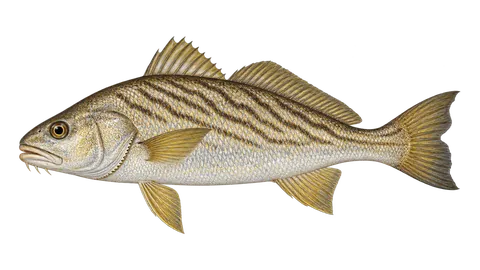
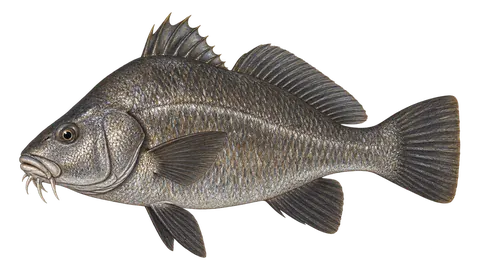
Elongated, sturdy body, silver to blue-grey on the back, with golden reflections and a pale belly. Large mouth, no barbel on the chin. Two dorsal fins joined by a deep notch, tail slightly concave to straight. The Atlantic whitemouth croaker (Micropogonias furnieri) is smaller and has short barbels on the chin and oblique bands.
where found
Does not occur in Brazil. Southeastern Pacific, from northern Peru to south-central Chile, in the cold waters of the Humboldt Current.
Habitat: Sandy beaches and surf zones, river mouths and sandy coastal bottoms next to rocks.
when to fish
best season
In Chile, beach fishing usually produces best in spring and summer (October to March). In Peru it appears all year, with variations linked to sea temperature.
best time of day
Night and twilight. Comes into the surf in the late afternoon and at night; by day it stays farther from the beach.
what affects the corvina drum
sensitivity The little bars show how much each factor affects this species. Five full: it feels it a lot.
cold and cold fronts
Adapted to cold water; sudden temperature changes, such as those of El Niño, alter its availability.
atmospheric pressure
A front with rough seas hampers beach fishing.
moon
Full and new moon tides stir the bottom more and are often good at night.
rain
Little direct effect; muddy river water can draw fish to the mouth.
water level
Does not apply at sea. The equivalent is the shape of the beach: channels and gutters between sandbars.
noise
Not very sensitive in the surf.
wind
A moderately stirred sea churns up the bottom and helps; too rough a sea prevents casting.
tide
A rising tide and high water at night are usually the best windows.
depth
Gutters and channels in the surf, 1 to 5 m.
how to fish
- rod
- surf 3.9 to 4.5 m, 100 to 200 g
- spinning / baitcasting reel
- 6000 to 8000 surf reel
- line
- monofilament 0.30 to 0.40 mm with shock leader
- leader
- 0.60 mm shock leader; rig of 1 or 2 hooks
- hook
- 2/0 to 4/0
natural baits
- beach crustaceans (tatuí, sand flea)
- shrimp
- sardine or anchovy fillet
- squid strips
accessories
- pyramid or claw sinker 100 to 150 g
- rod holder
- headlamp
tip from an angler
Cast into the channels between the sandbars, where the wave returns. In the late afternoon, shorten the cast: the croaker comes in close to the shore.
rules for the corvina drum
Summary of the regulations we found, with the source for each. Rules change; before keeping or transporting fish, check with the state environmental agency.
Conservation: Supports an important artisanal fishery in Peru and Chile.
We found no species-specific rule beyond the region's general rules.
catch and release
catch and release Releasing the fish alive, quickly and with a wet hand. During a closed season it isn't always allowed: what the regulation says applies.
Beach fish tolerate release well: unhook quickly and return it to shallow water between the waves.
in the kitchen
White, firm and highly valued meat; ceviche, grilled and fried.
how much it weighs without taking it out of the water
Length-weight relationship W = a·Lb (a = 0.00776, b = 3.04; FishBase (estimativa bayesiana); peso máximo calculado por esta relação). It's an average: a fat or lean fish can vary by 10% to 20%.
estimated weight
—
sources and references
The season weights (months), the time of day and the sensitivities (cold, pressure, moon, wind, rain, tide, strong light, murky water and noise) are the app's editorial estimates, based on the literature below and on the field experience of anglers and guides. They are not official data nor a measurement made for this species, and they may vary by region and year. Closed seasons and legal rules appear in the rules section, with the norm and a link.
- scientific FishBase — Cilus gilberti (ficha da espécie)Names, distribution, biology, length-weight relationship, country list and references. Page checked on Oct 13, 2026.
- scientific IUCN Red List — Cilus gilberti (avaliação global: Dados Insuficientes, DD, 21/02/2020)Global assessment. Link given on the FishBase entry (Red List, version 2025-2).
- scientific Chong, J. et al. (2000). Hábitos alimentarios de la corvina Cilus gilberti (Abbott, 1889) (Pisces: Sciaenidae) frente a la costa de Talcahuano. Biología Pesquera 28.DOI checked in Crossref.
- scientific Espinoza Ramos et al. (2019). Captura y acondicionamiento de reproductores de corvina Cilus gilberti en el Centro de Acuicultura Morro Sama, Tacna, Perú. Ciencia & Desarrollo 22.DOI checked in Crossref.
similar species
where each number comes from
The weather comes from three independent global models, cross-checked hour by hour: when they agree, confidence goes up; when they diverge, the band between them shows on the chart. Beyond 16 days, we use the GEFS ensemble of 31 simulations: if 20 of the 31 predict rain, the chance of rain is 65%. Sun and moon are calculated astronomically, with no uncertainty.
The index adds up, weighted for each species: time of day (species curve anchored to real sunrise and sunset), moon (transits, rise and set, phase), pressure (3 h trend and 24 h swing), water temperature (in rivers, estimated from air temperature; at sea, estimated by an ocean model), wind, rain, clouds, tide and the month in the species' cycle.
sources for this lookup
how accurate the forecast is
Accuracy measured in the reference project (4 regions, 93 days, forecast vs. observed): maximum temperature is off by 0.6 °C on average the next day and 1.7 °C at 7 days; rain of 5 mm or more is detected 76% of the time the next day and 57% at 7 days. Detection isn't everything: the false alarm rate isn't published here yet, and 93 days in 4 regions is still a small sample. We now also measure every day, at the app's destinations: